How to Recognize Dosha Imbalance (Vata, Pitta & Kapha)

Updated: Jul 6
You don’t wake up one day suddenly “out of balance.” The signs begin quietly—subtle, easy to overlook, and often dismissed as normal.
Maybe your digestion isn’t as steady, your sleep feels lighter or interrupted, or your skin reacts more easily. You may feel more irritable, more fatigued, or simply not like yourself. In Ayurveda, these are not random changes. They are early signals of imbalance in Vata, Pitta, and Kapha—your body’s way of asking for realignment before deeper disruption takes hold.
Each dosha speaks in a distinct language.Vata shows up as dryness, irregularity, and restlessness.Pitta expresses through heat, intensity, and inflammation.Kapha reveals itself as heaviness, stagnation, and low energy.
When you learn to recognize these patterns early, you gain the ability to respond with precision—restoring balance before symptoms escalate.
In this guide, you’ll learn how to identify the early signs of dosha imbalance as they appear in daily life—so you can support your body with clarity, confidence, and intention. At Saumya Ayurveda, we believe Ayurveda’s wisdom is meant to be shared. Our work is devoted to making authentic, accessible education available to all—freely and globally. Enjoy this article.

Discover more on the Saumya Ayurveda Blog—an internationally recognized Ayurveda resource, ranked #1 Ayurveda cooking blog and #3 Ayurveda blog by Feedspot.
Table of Contents

What Are the Three Doshas in Ayurveda?
You may not realize it at first—but your body is constantly expressing patterns. The way you sleep, digest food, experience energy, respond emotionally, and move through your day all reflect subtle shifts in internal balance.
Some days you feel light, scattered, and restless. Other days you feel sharp, intense, and driven. And sometimes you feel steady, calm, and grounded—but heavy or sluggish if that balance shifts too far.
In Ayurveda, these patterns are not random. They are understood through the intelligence of the three doshas: Vata, Pitta, and Kapha.
The doshas are not labels or fixed categories. They are biological forces of nature within you that govern all movement, transformation, structure, and stability in the body and mind. Everyone has all three—what makes each person unique is the proportion and expression of these energies.
When the doshas are in balance, there is ease in digestion, clarity in thinking, emotional steadiness, and resilience in the body. When they become disturbed, the body begins to speak through early, often subtle signs—before deeper imbalance develops.
Vata, Pitta, and Kapha are the three doshas in Ayurveda, each representing distinct patterns that govern how the body and mind function:
Vata governs movement and communication in the body and mind, expressing as light, dry, and changeable qualities; when imbalanced, it often shows up as irregular digestion, restlessness, and poor sleep.
Pitta governs transformation, including digestion and metabolism, and expresses as heat, intensity, and focus; when imbalanced, it may present as inflammation, irritability, and overheating.
Kapha governs structure and stability, providing grounding and nourishment; when imbalanced, it tends to show up as heaviness, sluggish digestion, congestion, and low motivation.
Each dosha expresses distinct patterns—understanding them helps you recognize imbalances, with each explored in more detail in the next section.
Your Unique Dosha Blueprint
Every individual is a unique expression of all three doshas. One or two are typically more dominant, shaping your natural tendencies, while the others provide balance and contrast.
Prakriti is your original nature and Ayurvedic constitution, established at birth.
However, what you experience day to day is your Vikriti—your current state of health and imbalance. This is constantly shifting based on food, lifestyle, stress, environment, sleep, and seasons.
Understanding the doshas is not about placing yourself into a category. It is about learning to recognize the language your body is already speaking—so you can respond earlier, more skillfully, and with greater awareness before imbalance deepens.
Why Knowing Your Dosha Imbalance Is Important
When you begin to understand Vata, Pitta, and Kapha in this way, Ayurveda becomes practical—not theoretical.
You stop guessing what is wrong and start noticing patterns early. From there, balance becomes not something you chase, but something you learn to restore with clarity and confidence.
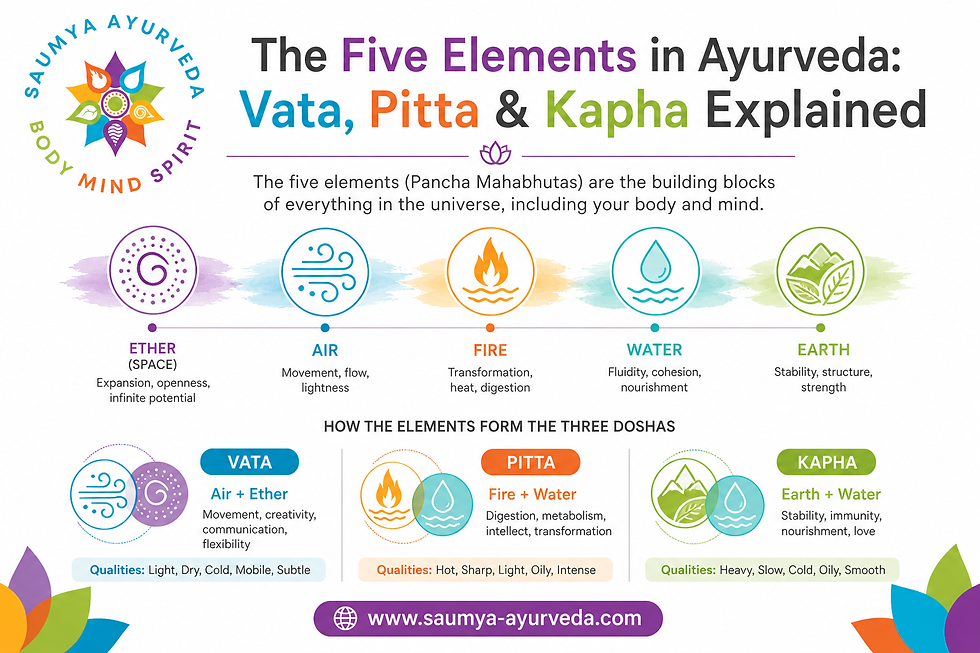
The Five Elements in Ayurveda: Vata, Pitta & Kapha Explained
In Ayurveda, the five elements—ether (space), air, fire, water, and earth—form the foundation of Vata, Pitta, and Kapha. Known as the Pancha Mahabhutas, these elements combine to create the three doshas that govern all physical and mental processes in the body.
Understanding the five elements in Ayurveda helps you identify the root cause of imbalance and restore harmony naturally.
What Are the Five Elements in Ayurveda?
The five elements (Pancha Mahabhutas) are the building blocks of all matter in the universe, including the human body:
Ether (Space) – expansion, openness
Air – movement and flow
Fire – transformation and digestion
Water – cohesion and fluidity
Earth – structure and stability
Each dosha is formed by a unique combination of these elements.
How the Five Elements Form the Three Doshas
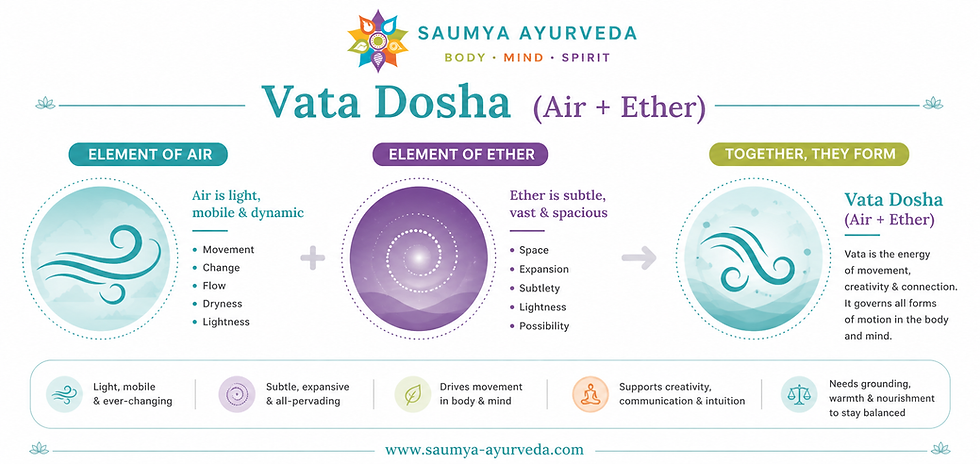
Vata Dosha (Air + Ether)
Vata is composed of air and ether, which gives it qualities of movement, lightness, and subtlety.
Core Physical & Energetic Qualities
Dry (Ruksha) – lacks moisture, leads to dryness in skin, hair, joints
Light (Laghu) – not heavy, associated with low body weight or lightness
Cold (Shita) – cool in temperature, sensitive to cold environments
Rough (Khara) – coarse, irregular texture
Subtle (Sukshma) – penetrates deeply, affects fine channels (like nerves)
Mobile (Chala) – constantly moving, changeable, active
What These Qualities Reflect
Because Vata is made of air and ether, it naturally expresses:
Movement and flow (like wind)
Lightness and expansion (like space)
Variability and change
Vata Governs
Movement (breath, circulation, nervous system activity)
Communication and creativity
When balanced: clarity, flexibility, inspirationWhen imbalanced: anxiety, bloating, dryness, insomnia.
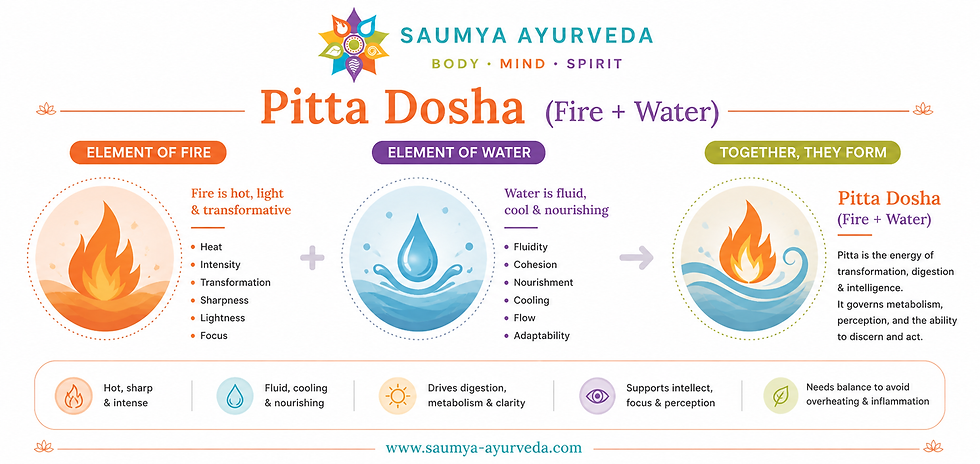
Pitta Dosha (Fire + Water)
Pitta is composed of fire and water, which gives it qualities of heat, intensity, and transformation.
Core Physical & Energetic Qualities
Hot (Ushna) – produces heat, associated with warmth and inflammation
Sharp (Tikshna) – penetrating, intense, and focused
Light (Laghu) – relatively light, though more grounded than Vata
Liquid (Drava) – fluid, spreading in nature
Slightly Oily (Snigdha) – carries some moisture and lubrication
Spreading (Sara) – diffusive, tends to spread throughout the body
What These Qualities Reflect
Because Pitta is made of fire and water, it naturally expresses:
Transformation and metabolism (like digestion and biochemical processes)
Heat and intensity (like fire)
Flow and fluidity (balanced by water)
Pitta Governs
Digestion and metabolism (enzymes, hormones, body temperature)
Vision and perception
Intellect and decision-making
When in Balance vs. Imbalance
When balanced: clarity, focus, confidence
When imbalanced: inflammation, irritability, acid reflux, overheatin
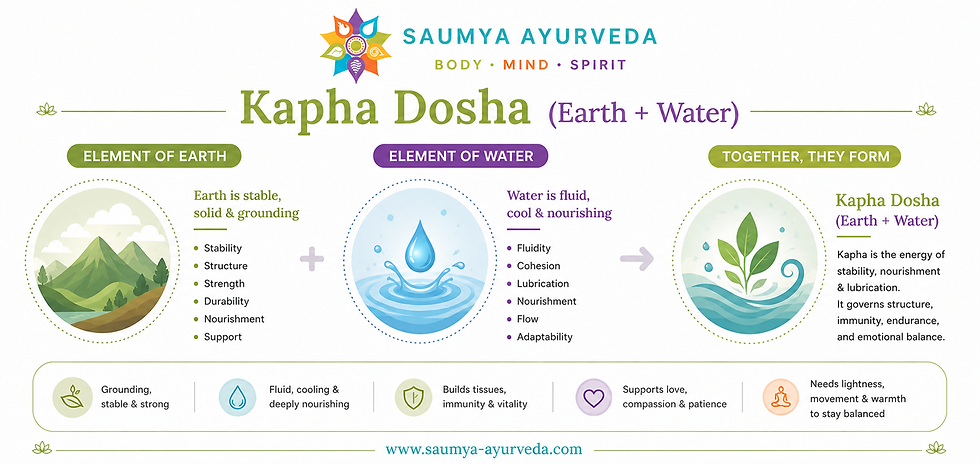
Kapha Dosha (Earth + Water)
Kapha is composed of earth and water, which gives it qualities of stability, heaviness, and structure.
Core Physical & Energetic Qualities
Heavy (Guru) – dense, grounding, and stabilizing
Slow (Manda) – steady, calm, and unhurried
Cool (Shita) – naturally cooling and stabilizing
Oily (Snigdha) – moist, lubricating, and cohesive
Smooth (Shlakshna) – soft and even in texture
Dense (Sandra) – compact and solid
Stable (Sthira) – grounded, resistant to change
What These Qualities Reflect
Because Kapha is made of earth and water, it naturally expresses:
Structure and stability (like the physical body)
Cohesion and lubrication (holding tissues together)
Nourishment and endurance
Kapha Governs
Structure and tissue building
Lubrication of joints and organs
Immune strength and resilience
Emotional stability and memory
When in Balance vs. Imbalance
When balanced: calmness, strength, endurance
When imbalanced: heaviness, congestion, weight gain, lethargy
By recognizing these patterns, Ayurveda provides a clear framework for healing through diet, herbs, and daily routine.
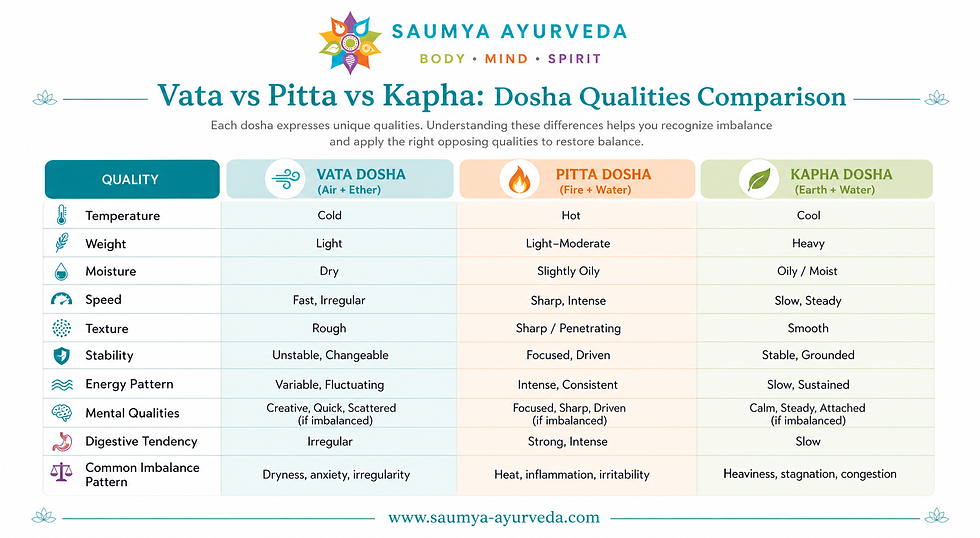
Restoring Balance Through the Elements
Ayurveda follows a simple principle: like increases like, and opposites restore balance.
Excess Vata → add warmth, grounding, nourishment
Excess Pitta → introduce cooling, calming foods and habits
Excess Kapha → bring in lightness, movement, stimulation
The Takeaway
The five elements in Ayurveda are the foundation of Vata, Pitta, and Kapha. When you understand how these elements operate in your body, you gain a deeper ability to recognize imbalance early and restore harmony naturally.

Vata Dosha: Qualities, Functions & Imbalance Signs
Vata dosha is the Ayurvedic principle of movement, made up of air and ether (space), and governs the nervous system, circulation, and all motion in the body and mind.
In Ayurveda, Vata is responsible for breath, communication, creativity, and sensory activity. When balanced, it brings clarity, energy, and adaptability. When imbalanced, it leads to dryness, anxiety, irregular digestion, and restlessness.
Vata Dosha Qualities (Gunas)
Vata is characterized by the following qualities:
Dry
Light
Cold
Rough
Subtle
Mobile
These qualities explain why excess Vata often shows up as coldness, dryness, and instability.
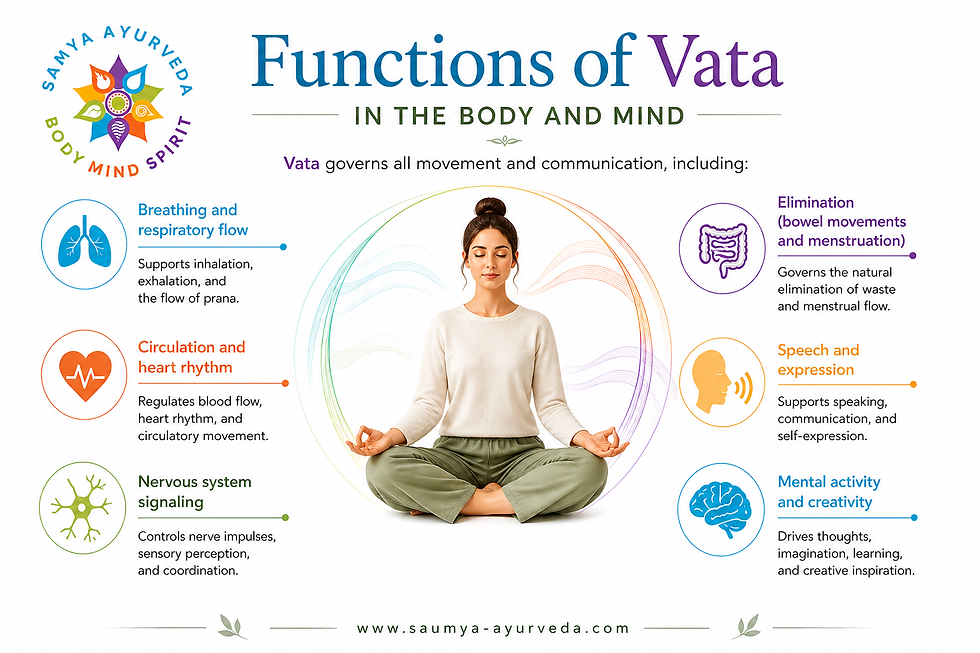
Functions of Vata in the Body and Mind
Vata governs all movement and communication, including:
Breathing and respiratory flow
Circulation and heart rhythm
Nervous system signaling
Elimination (bowel movements and menstruation)
Speech and expression
Mental activity and creativity
Because it directs movement, Vata also influences Pitta and Kapha, making it the most important dosha to regulate.
Vata Imbalance Symptoms
Vata imbalance often presents as irregular, scattered, and unpredictable symptoms affecting both body and mind.
Physical Signs of Vata Imbalance
Dryness & Depletion
Digestive Irregularity
Nervous System & Muscular Activity
Muscle tightness, spasms, or tremors
Wandering aches and pains
Tinnitus
Cardiovascular & Rhythm Disturbances
Heart palpitations
Reproductive Health
Energy & Vitality
Weight loss or difficulty gaining weight
Sleep Patterns
Circulation & Temperature
Cold hands and feet
Poor circulation
Sensitivity to cold and wind
Vata Imbalance Patterns in the Body
These patterns reflect excess dryness, irregularity, and nervous system sensitivity—the core qualities of Vata imbalance in Ayurveda.
Mental & Emotional Signs of Vata Imbalance
If you notice several of the following patterns consistently, it may indicate a Vata imbalance affecting the nervous system and mind.
Anxiety, Fear & Emotional Instability
Panic or fear
Shakiness
Restlessness & Overstimulation
Restlessness and agitation
Excessive talking
Mental Overactivity
Overthinking or excessive worry
Racing thoughts
Lack of Grounding & Stability
Feeling ungrounded or scattered
Dizziness
Cognitive Challenges
Difficulty focusing or remembering
Confusion or mental fog
Vata Imbalance Patterns in the Mind
These patterns reflect excess movement, instability, and nervous system overstimulation—the core mental qualities of Vata imbalance in Ayurveda.
Why Vata Goes Out of Balance
Vata increases with:
Irregular routines
Cold, dry, or raw foods
Dry, crunchy foods
Excess travel or movement
Overstimulation and screen time
Lack of sleep
Chronic stress

Pitta Dosha: Qualities, Functions & Imbalance Signs
Pitta dosha in Ayurveda is the principle of transformation, composed of fire and water, governing digestion, metabolism, body temperature, and mental clarity.
In Ayurveda, Pitta is responsible for breaking down food, regulating hormones, supporting vision, and sharpening intellect. When balanced, Pitta supports strong digestion, confidence, focus, and healthy skin. When imbalanced, it creates heat, inflammation, irritability, and intensity throughout the body and mind.
Understanding Pitta dosha in Ayurveda, its qualities, functions, and imbalance signs allows you to recognize excess heat early and restore balance naturally.
Pitta Dosha Qualities (Gunas)
Pitta is defined by its core qualities:
Hot
Sharp
Light
Oily
Spreading
Liquid
These qualities explain why excess Pitta often presents as heat, redness, inflammation, sharp digestion, and emotional intensity.

Functions of Pitta in the Body and Mind
Pitta governs all processes of transformation and metabolism, including:
Digestion and nutrient absorption
Body temperature regulation
Hormonal balance
Vision and perception
Skin health and complexion
Intellect, focus, and decision-making
Because Pitta transforms, it plays a central role in how the body processes food, thoughts, and experiences.
Pitta Imbalance Symptoms
Have you wondered if you might have a Pitta imbalance?
When Pitta accumulates, its hot, sharp, and intense qualities increase in the body and mind. This leads to a range of Pitta imbalance symptoms, often centered around heat, inflammation, and reactivity.
Physical Signs of Pitta Imbalance
Red, burning, or irritated skin (eczema, dermatitis)
Headaches with heat or burning sensation, migraines
Rashes or strong reactions to insect bites
Red, dry, irritated, or sensitive eyes
Inflammation (“-itis” conditions)
Acne or frequent breakouts
Heartburn, acid reflux, GERD, or ulcers
Hyperthyroid tendencies
Loose stools or diarrhea
Overactive metabolism
Nausea or discomfort when missing meals
Heat intolerance or aversion to hot environments
Persistent feeling of internal heat
Joint pain related to inflammation
Excess sweating with strong or sour body odor
Increased hunger and thirst
Excessive or unquenchable thirst
Autoimmune conditions
Fevers
Acute inflammation in joints
Sensitivity to or avoidance of sun exposure
Mental & Emotional Signs of Pitta Imbalance
Argumentative, judgmental, or overly critical tendencies
Increased competitiveness
Intensified perfectionism
Workaholic tendencies
Burnout or exhaustion from overdrive
Jealousy
Impatience and intolerance
Over-attachment to goals or outcomes
Inflamed ego or controlling, forceful personality
The Pattern Behind Pitta Imbalance
Pitta imbalance is typically intense, sharp, and heat-driven.
You may notice:
Symptoms that feel hot, inflamed, or reactive
Strong physical or emotional responses
A tendency toward overdrive, control, or perfectionism
This reflects the nature of Pitta—when out of balance, it burns too hot and too fast.
Why Pitta Goes Out of Balance
Pitta increases with anything that adds heat, intensity, or pressure, including:
Spicy, fried, or acidic foods
Excess caffeine or alcohol
Overworking and pushing beyond limits
Hot climates or prolonged sun exposure
Chronic stress or suppressed anger
High-pressure, goal-driven environments
Over time, these factors lead to excess heat and inflammation in the body.
The Takeaway
Pitta dosha in Ayurveda governs digestion, metabolism, and mental clarity, but when imbalanced, it leads to heat, inflammation, irritability, and burnout.
By recognizing the early signs of Pitta imbalance, you can take simple, effective steps to cool, calm, and restore balance naturally.

Kapha Dosha: Qualities, Functions & Imbalance Signs
Kapha dosha in Ayurveda is the principle of structure and stability, composed of earth and water, governing physical form, lubrication, immunity, and emotional grounding.
In Ayurveda, Kapha is responsible for strength, endurance, nourishment, and cohesion. When balanced, it supports calmness, resilience, steady energy, and strong immunity. When imbalanced, it leads to heaviness, congestion, slow metabolism, and emotional stagnation.
Understanding Kapha dosha in Ayurveda, its qualities, functions, and imbalance symptoms helps you recognize patterns of excess accumulation and restore balance naturally.
Kapha Dosha Qualities (Gunas)
Kapha is defined by its core qualities:
Heavy
Slow
Cool
Oily
Smooth
Dense
Stable
These qualities explain why excess Kapha often shows up as heaviness, sluggishness, congestion, and accumulation.
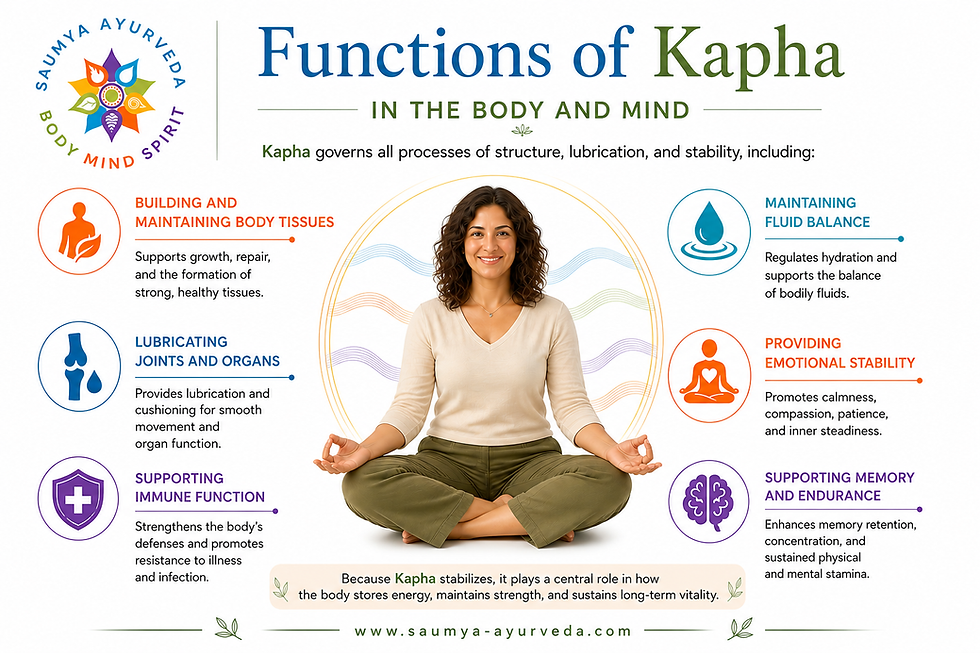
Functions of Kapha in the Body and Mind
Kapha governs all processes of structure, lubrication, and stability, including:
Building and maintaining body tissues
Lubricating joints and organs
Supporting immune function
Maintaining fluid balance
Providing emotional stability
Supporting memory and endurance
Because Kapha stabilizes, it plays a central role in how the body stores energy, maintains strength, and sustains long-term vitality.
Kapha Imbalance Symptoms
Have you wondered if you might have a Kapha imbalance?
Weight gain? Elevated cholesterol? Allergies? Rising A1C? Excess mucus? Emotional eating? Feeling dull or unmotivated?
You can have any primary dosha constitution and still experience Kapha imbalance symptoms.
When Kapha accumulates, its heavy, slow, and dense qualities increase in the body and mind, leading to patterns of stagnation, buildup, and resistance to change.
Physical Symptoms of Kapha Imbalance
Feeling foggy, dull, lethargic, or heavy
Thick, white coating on the tongue (ama)
Excess mucus and bodily fluids
Difficulty waking in the morning
Seasonal allergies or hay fever
Slow metabolism
Excess sleep or oversleeping
Excess ear wax
Oily skin and hair
Varicose veins
Glaucoma
Gallstones
Edema, swelling, or puffiness
Mental & Emotional Symptoms of Kapha Imbalance
Emotional overeating
Depression or melancholy
Sentimental attachment
Stubbornness
Greed or over-accumulation
Hoarding tendencies
Over-attachment to people or routines
Possessiveness
The Pattern Behind Kapha Imbalance
Kapha imbalance is typically slow, steady, and accumulative.
You may notice:
Symptoms that build gradually over time
A sense of heaviness, stagnation, or resistance
Difficulty initiating change or movement
This reflects Kapha’s nature—when out of balance, it holds rather than flows.
Why Kapha Goes Out of Balance
Kapha increases with anything that reinforces heaviness, stillness, and accumulation, including:
Heavy, oily, or overly sweet foods
Sedentary lifestyle
Oversleeping
Cold, damp environments
Emotional holding or attachment
Eating without true hunger
Over time, this leads to congestion, metabolic slowdown, and fluid buildup. Ayurveda teaches: when heaviness accumulates, movement restores balance.
The Takeaway
Kapha dosha in Ayurveda governs structure, stability, and nourishment, but when imbalanced, it leads to heaviness, sluggishness, congestion, and emotional attachment.
By recognizing Kapha imbalance symptoms, you can take simple, effective steps to lighten, energize, and restore balance naturally.
How Do Dosha Imbalances Develop? (Root Causes Explained)
Dosha imbalances develop when diet, lifestyle, environment, and mental patterns increase the qualities of Vata, Pitta, or Kapha beyond what the body can regulate.
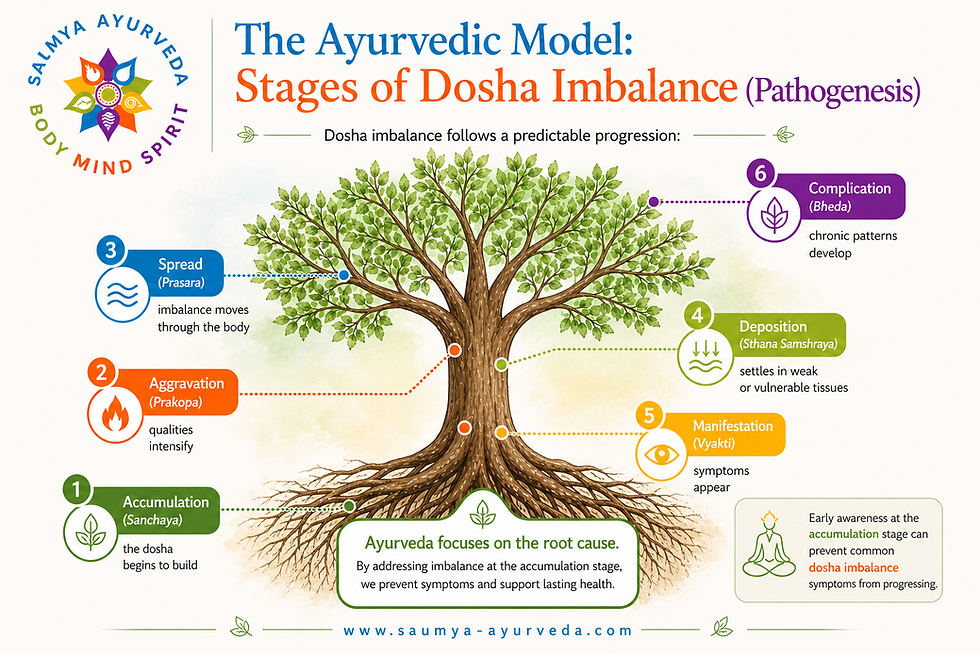
In Ayurveda, this process happens gradually—moving from accumulation to aggravation, spread, and eventually the appearance of symptoms, and ultimatley disease. Understanding how dosha imbalance develops helps you identify early changes and prevent deeper imbalance.
The Ayurvedic Model: Stages of Dosha Imbalance (Pathogenisis)
Dosha imbalance follows a predictable progression:
Accumulation (Sanchaya) – the dosha begins to build
Aggravation (Prakopa) – qualities intensify
Spread (Prasara) – imbalance moves through the body
Deposition (Sthana Samshraya) – settles in weak tissues
Manifestation (Vyakti) – symptoms appear
Complication (Bheda) – chronic patterns develop
Early awareness at the accumulation stage can prevent common dosha imbalance symptoms from progressing.
Main Causes of Dosha Imbalance
1. Diet That Increases Dosha Qualities
Dry, cold foods → increase Vata imbalance
Spicy, acidic foods → increase Pitta imbalance
Heavy, oily foods → increase Kapha imbalance
Diet is one of the most direct causes of dosha imbalance in Ayurveda.
2. Irregular Daily Routine
Inconsistent eating or sleeping
Overworking or lack of rest
Poor daily rhythm
This disrupts digestion, hormones, and nervous system balance.
3. Environmental & Seasonal Factors
Cold, dry climates → Vata imbalance
Heat and sun exposure → Pitta imbalance
Damp, heavy weather → Kapha imbalance
Seasonal shifts are a common trigger for dosha imbalance symptoms.
4. Stress & Emotional Patterns
Anxiety → Vata
Anger → Pitta
Attachment → Kapha
Mental patterns directly influence physical imbalance.
5. Sensory Overload or Deprivation
Overstimulation → Vata
Intensity and pressure → Pitta
Inactivity → Kapha
Modern life often disrupts sensory balance.
6. Suppressing Natural Urges
Ignoring hunger, sleep, or elimination creates internal imbalance and disrupts natural flow.
7. Disconnection from Natural Rhythms
Lack of alignment with daylight, seasons, and nature weakens the body’s ability to maintain balance.

How Each Dosha Becomes Imbalanced
Vata imbalance develops through excess movement, dryness, and irregularity
Pitta imbalance develops through excess heat, intensity, and overdrive
Kapha imbalance develops through heaviness, inactivity, and accumulation
The Core Ayurvedic Principle
Like increases like, and opposites restore balance.
This principle explains all dosha imbalance.
How to Prevent Dosha Imbalance
Eat according to your dosha and season
Maintain consistent daily routines
Manage stress effectively
Sleep in alignment with natural rhythms
Stay connected to nature
The Takeaway
The causes of dosha imbalance are rooted in daily habits, environment, and mental patterns that increase Vata, Pitta, or Kapha over time.
By understanding how dosha imbalance develops, you can take early, simple steps to prevent symptoms and restore balance naturally.

Early Signs of Dosha Imbalance: Recognizing Imbalance Before Symptoms Appear
In Ayurveda, imbalance begins quietly. Before distinct symptoms develop, the body communicates through patterns, not problems. Learning to recognize these early signals allows you to intervene before imbalance progresses.
What Early Imbalance Actually Looks Like
At this stage, you won’t see clear “Vata,” “Pitta,” or “Kapha” symptoms yet.
Instead, you may notice:
A general sense of feeling off or out of sync
Changes in your natural rhythm (sleep, appetite, energy)
Loss of your usual clarity, stability, or ease
Small disruptions that come and go
These are not full symptoms—they are early indicators that balance is shifting.
The Key Difference: Patterns vs Symptoms
This is where most people get confused.
Early stage → patterns (subtle, inconsistent, hard to define)
Later stage → symptoms (clear, repeated, diagnosable)
For example:
Occasional restlessness → early imbalance
Chronic anxiety or insomnia → Vata imbalance
This distinction is what separates prevention from treatment in Ayurveda.
The First Signs of Imbalance in Daily Life
Rather than focusing on symptoms, look for changes in baseline:
Rhythm
Your day feels less steady or predictable
Meals, sleep, or energy feel slightly “off”
Energy
You’re not exhausted—but not fully energized
Motivation feels inconsistent
Digestion
Not clearly problematic—but less reliable
Subtle bloating, heaviness, or irregular hunger
Mind
Slight increase in mental noise, reactivity, or dullness
Less clarity than usual
Why This Stage Matters Most
This is the accumulation stage (Sanchaya)—the root level of imbalance.
It’s the easiest stage to correct It often requires the smallest changes It prevents progression into full dosha imbalance symptoms
Ayurveda emphasizes this stage because:
How This Connects to Vata, Pitta & Kapha
At this early stage:
Vata, Pitta, or Kapha may be increasing
But the pattern is not yet dominant or clearly defined
That’s why this section comes before your dosha-specific sections.
Once patterns become stronger, they begin to express as:
Vata imbalance symptoms
Pitta imbalance symptoms
Kapha imbalance symptoms
What To Do When You Notice Early Signs
Pause and observe patterns (don’t ignore them)
Simplify your routine
Return to regular meals and sleep
Reduce excess (stimulation, heat, heaviness depending on context)
Reconnect with grounding daily habits
Small, early adjustments are the most powerful.
The Takeaway
Early signs of dosha imbalance are not obvious symptoms—they are subtle disruptions in your natural rhythm and sense of balance.
By recognizing these early changes, you can take simple steps to restore balance before Vata, Pitta, or Kapha imbalances fully develop.

How Ayurveda Restores Dosha Balance: Tips for Vata, Pitta & Kapha
Ayurveda restores dosha balance by using food, herbs, lifestyle, and daily routines to counter excess Vata, Pitta, and Kapha with opposite qualities.
When a dosha becomes imbalanced, its qualities—such as dryness, heat, or heaviness—begin to accumulate. Ayurveda brings the body back into balance by introducing opposing qualities that restore harmony naturally.
How to Balance Vata Dosha Naturally
To balance Vata, focus on warmth, grounding, and routine:
Maintain consistent daily routines
Prioritize rest and regular sleep
Do Abhyanga (Ayurvedic oil self-massage)
Reduce overstimulation and multitasking
Download Your Free Copy of Ayurveda Recipes for Balancing Vata Dosha
Keep Learning: The Ultimate Guide to Warming Foods in Ayurveda: Benefits, List & How to Use Them
How to Balance Pitta Dosha Naturally
To balance Pitta, focus on cooling and calming:
Choose cooling, hydrating foods
Avoid excessive heat, spicy foods, and overwork
Spend time in nature, especially near water
Favor moderate, non-competitive exercise

How to Balance Kapha Dosha Naturally
To balance Kapha, focus on lightness and activation:
Eat light, warm, stimulating foods
Increase daily movement and exercise
Wake early and avoid oversleeping
Reduce heavy, oily, and sweet foods
Embrace variety and change
Engage in energizing activities
Keep Reading: Guide to Kapha Season | Late Winter - Spring

Lifestyle Is the Medicine
In Ayurveda, healing comes from consistent daily habits:
Food becomes medicine
Routine becomes balancing
Awareness becomes prevention
Small, consistent changes are what restore long-term dosha balance.

The Takeaway
Learning how to balance Vata, Pitta, and Kapha naturally allows you to work with your body rather than against it. When you apply the right qualities at the right time, Ayurveda helps restore balance, support digestion, calm the mind, and build lasting vitality.

When to Seek Professional Guidance
Have you ever taken a dosha quiz and felt more confused than clear? That’s common—and there’s a reason why.
Why Dosha Quizzes Often Don’t Work
Everyone contains all three doshas
More than one dosha is often out of balance
Your environment influences your doshic state
Seasons and transitions shift the doshas
Your stage of life changes your constitution
Ayurveda is dynamic, not static—which makes accurate assessment more complex than a simple quiz.
Why Accurate Assessment Matters
“A precise doshic assessment is essential for creating the correct Ayurvedic treatment plan. Because the doshas are dynamic and influenced by lifestyle, environment, and life stage, understanding them requires depth and clarity. This is where guidance becomes invaluable.” — Veena, Saumya Ayurveda
When to Work with an experienced Certified Ayurvedic Practitioner
Consider professional guidance if you:
Have persistent or recurring symptoms
Feel unsure about your dosha or imbalance
Want a deeper, personalized understanding
Are ready for a targeted, effective plan
A Certified Ayurvedic Practitioner can provide individualized recommendations, including herbal support, food as medicine, gentle cleansing, and lifestyle practices tailored to your unique constitution.
The Takeaway
Dosha assessment is nuanced. When clarity matters, personalized guidance makes all the difference.

Ayurveda Dosha Quiz: Why the Results Often Don’t Make Sense
Have you taken an online dosha quiz—maybe even more than one—and ended up more confused than when you started?
One result says Vata. Another says Pitta. A third tells you you’re “all three.”
This experience is extremely common—and it highlights a key limitation of simplified dosha quizzes.
Ayurveda is not based on one-dimensional labeling. Your constitution is influenced by digestion, lifestyle, stress, environment, age, and current imbalances. What feels like your “type” today may shift when your body is under strain or depletion.
There are three primary doshas—Vata, Pitta, and Kapha—but most individuals carry a unique combination of all three, expressed in constantly changing ways. That complexity is exactly what makes quick assessments feel inconsistent.
As you read through the early signs of dosha imbalance, focus less on labels and more on patterns. Your body is already giving you information—it just needs the right language to be understood.
And when you’re ready for deeper clarity beyond generalized quizzes, an individualized Ayurvedic assessment can help translate those patterns into a clear, practical path forward—so you’re no longer guessing, but responding with confidence.

Our Commitment to Accessible Ayurveda Education
At Saumya Ayurveda, we believe Ayurveda's transformative ancient wisdom belongs to everyone—not just those who can afford it. That's why we're committed to making high-quality, authentic Ayurveda education available globally, free of charge.
Through our free eBooks, guides, and educational resources, we offer practical, grounded wisdom to help those seeking greater balance, vitality, and wellbeing integrate Ayurveda into their daily lives.
Accessible. Authentic. Free. Just as it was meant to be.
Free Ayurveda eBooks – Download practical guides, recipes, and wellness resources to support your health journey.
Ayurveda Blog – Enjoy easy-to-read articles, seasonal wellness tips, healthy recipes, and everyday inspiration—always educational, never a sales pitch.
Free Guided Traditional Progressive Meditations – Practice authentic, step-by-step guided meditations to cultivate calm, focus, and inner stillness.
Monthly Educational Newsletter – Receive seasonal Ayurveda insights, new articles, healthy recipes, and free resources delivered to your inbox each month.

FAQ: How to Recognize Dosha Imbalance
How do I recognize dosha imbalance in Ayurveda? You can recognize dosha imbalance by noticing consistent changes in your energy, digestion, sleep, mood, and mental clarity. When patterns such as restlessness, heat, or heaviness repeat, it often indicates an imbalance in Vata, Pitta, or Kapha.
What are common signs of Vata, Pitta, and Kapha imbalance?
Vata imbalance: irregular digestion, anxiety, dry skin, poor sleep
Pitta imbalance: acid reflux, inflammation, irritability, overheating
Kapha imbalance: weight gain, sluggishness, congestion, low motivation
Can more than one dosha be imbalanced at the same time? Yes, it is very common for multiple doshas to be out of balance at once, especially when lifestyle, stress, and environment affect the body over time.
Why is it hard to identify dosha imbalance on my own? Doshas are dynamic and influenced by season, climate, routine, and stage of life. This makes self-assessment more complex than a simple checklist.
What is the difference between prakriti and vikriti? Prakriti is your natural constitution, while vikriti is your current state of imbalance. Understanding this difference is key to accurate assessment.
How quickly can dosha imbalance develop? Dosha imbalance develops gradually through repeated habits, diet, stress, and environmental influences. Early changes often appear before clear symptoms.
Can dosha imbalance be corrected naturally? Yes. Ayurveda restores balance using food, lifestyle, herbs, and daily routines that counter the qualities of the imbalanced dosha.
What is a dosha in Ayurveda? A dosha is a biological energy—Vata, Pitta, or Kapha—that governs physical and mental processes in the body. Balance among the doshas supports health, while imbalance leads to symptoms.

Final Thoughts
Recognizing dosha imbalance is not about labeling yourself as Vata, Pitta, or Kapha—it’s about learning to observe the patterns your body and mind express each day.
In Ayurveda, imbalance rarely happens suddenly. It develops gradually through daily habits, environment, and internal responses. The more attuned you become to these patterns, the earlier you can respond—and the easier it is to restore balance.
Vata may express itself through irregularity and restlessness.Pitta through heat, intensity, and reactivity.Kapha through heaviness, stagnation, and accumulation.
These are not fixed identities, but dynamic expressions that shift over time.
The goal is not perfection—it is awareness.
When you begin to recognize changes in your energy, digestion, mood, and rhythm, you gain the ability to respond with clarity and intention. This is where Ayurveda becomes truly powerful: small, consistent adjustments can prevent deeper Vata, Pitta, and Kapha imbalances from developing.
And when clarity feels out of reach, personalized guidance can help you understand your unique doshic picture and move forward with confidence.

What Our Clients Say | Saumya Ayurveda Testimonials
Real Transformations Through Ayurveda Consultation
Physician Testimonial (Medical Endorsement)
“As a physician, I have always believed that prevention is better than cure. In today’s healthcare environment, Ayurveda offers a logical and natural approach to long-term health and prevention.
I began working with Veena during a very demanding phase of my life, and she made the process accessible even within my busy schedule. I was encouraged to follow a steady, sustainable approach focused on real lifestyle change.
Over time, I experienced meaningful improvements in balance, energy, and well-being. In my medical practice, I now see many patients with similar stress- and diet-related imbalances, which has further reinforced my trust in Ayurvedic principles.
I have since referred several patients to Saumya Ayurveda and consider Veena a valuable resource in supporting holistic well-being.”
Dr. Gauri Nagargoje
M.D., Oncology & Hematology
Physician Testimonial (Medical Endorsement)
“As a physician, I initially struggled with Ayurveda’s simplicity and depth, but Veena’s guidance made it practical, scientific, and deeply effective.
Veena has transformed my health and perspective on healing. I experienced significant improvements in focus, digestion, stress response, and overall vitality.
Her personalized approach made lifestyle changes easy and sustainable.
This journey not only improved my health but also inspired a lifelong commitment to integrating Ayurveda into holistic healthcare.”
Dr. Jessica Bedi
D.O., & Ayurvedic Doctor
Angela B., Minnesota USA

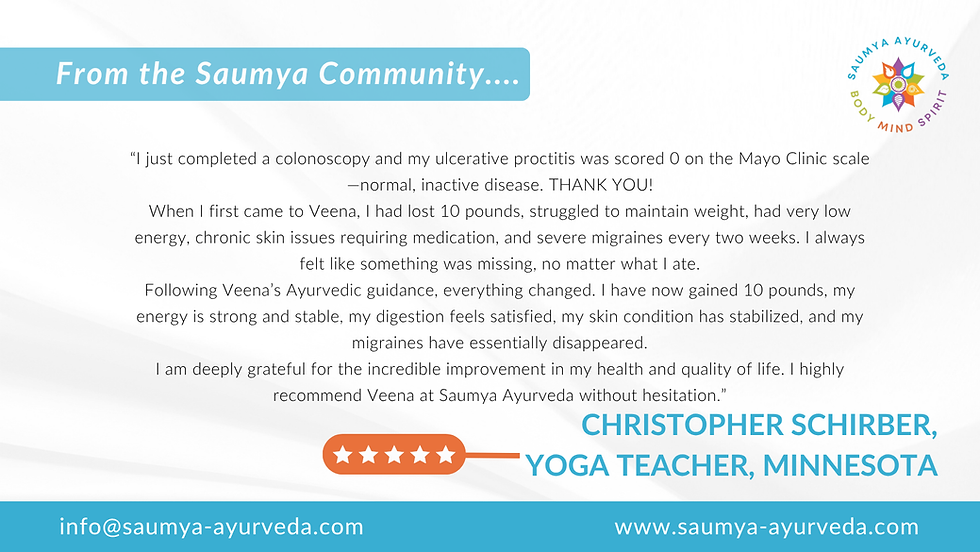


Explore more client success stories from Saumya Ayurveda and see how Ayurveda supports healing, balance, and transformation.

Discover the Saumya Ayurveda Way
At Saumya Ayurveda, we see you as a whole being—not just a collection of symptoms. True health is more than the absence of disease; it is a state of balance between body, mind, and awareness.
Many people today feel unheard or only partially supported in conventional health systems, especially when symptoms persist without clear answers.
This is where Ayurveda offers a different path.
If you are seeking a holistic approach to health and balanced living, you are in the right place. Saumya Ayurveda provides personalized Ayurvedic guidance designed to support physical, mental, and emotional harmony—helping you move toward a more vibrant and aligned life.
Our approach is rooted in classical Ayurveda and adapted for modern life, with a focus on understanding your unique dosha and prakriti (your natural constitution ) so recommendations are truly individualized—not generic.
Saumya Ayurveda offers concierge-style, client-centered care, meaning your experience is personal, supportive, and free from retail or product pressure. The focus is entirely on education, clarity, and sustainable lifestyle transformation.
Through structured Ayurveda consultation packages, you receive ongoing guidance, thoughtful coaching, and practical tools to help you create lasting change—not temporary fixes.
Begin your Ayurveda journey and book a free 15-minute discovery call.

Meet Veena: Your Trusted Ayurvedic Guide for Clients Worldwide
Veena Blilie is a Certified Ayurvedic Practitioner, Ayurveda teacher, meditation guide, and monk with over three decades of experience helping clients worldwide achieve greater balance and well-being through Ayurveda.
As founder of Saumya Ayurveda and President Emeritus of the Meditation Center, Veena serves clients worldwide through personalized Ayurvedic wellness guidance, meditation, and yoga practices.
Saumya Ayurveda has been recognized as the #1 Ayurveda cooking blog and the #3 Ayurveda website and blog and has received multiple consecutive awards for best wellness practice.
Through her work, Veena shares practical Ayurvedic guidance, nourishing recipes, and wellness education for modern living.
Inspired from an early age by learning herbal remedies, food as medicine, and traditional healing practices at her grandmother’s knee, Veena combines traditional Ayurvedic wisdom with compassionate, accessible guidance that supports mental, physical, and spiritual well-being.
Known for her warmth, humor, intuitive approach, and accessible style, Veena empowers people to create sustainable health through personalized Ayurvedic wellness plans designed to fit naturally into everyday life.
Veena is also the author of several free Ayurveda eBooks and writes the educational articles published on the Saumya Ayurveda blog.
As seen in:
Voice America
Albuquerque The Magazine
Learn more about Veena and her work through Saumya Ayurveda.
Disclaimer: This information is for educational purposes only and is not a substitute for professional medical advice. Ayurveda works best when tailored to your unique doshic profile, so it’s essential to understand your constitution and imbalances before using herbs, foods, or lifestyle practices. Consult a Certified Ayurvedic Practitioner for personalized guidance.