


Ayurveda for Seasonal Allergies: An Ayurvedic Approach to Allergy Relief

Updated: Sep 20
Seasonal allergies can arrive with the changing seasons, bringing sneezing, congestion, a runny or itchy nose, watery eyes, postnasal drip, and sometimes fatigue or coughing. For some people, these symptoms return predictably each year as pollen and other environmental allergens increase.
Ayurveda looks at seasonal allergies through an individualized lens. Rather than assuming that every person experiences allergies in the same way, Ayurveda considers the relationship between the changing seasons, dosha imbalances, digestion, daily routine, environment, stage of life, and individual constitution.
Understanding your own dosha imbalances can be a useful first step. By observing when symptoms appear, what seems to aggravate them, and how your digestion, sleep, stress, and daily habits change with the seasons, you can begin to recognize which dosha imbalances and qualities may be influencing your experience.

Explore more on the Saumya Blog, selected top Ayurveda blogs and websites.
Learn how to recognize your unique dosha imbalances with seasonal allergies and support balance through Ayurvedic food, herbs, lifestyle, and daily practices.
Key Takeaways
Seasonal allergy symptoms can vary depending on which doshas are out of balance. Sneezing, congestion, runny or itchy nose, watery eyes, postnasal drip, coughing, and fatigue may reflect different Vata, Pitta, and Kapha qualities, and more than one dosha may be out of balance at the same time.
Kapha often becomes especially relevant during spring. Increased moisture, heaviness, congestion, and mucus may coincide with the qualities of the season, although Vata or Pitta may also be involved depending on the individual's symptoms and current state of balance.
Vata and Pitta may become more prominent as the seasons change. In fall, Vata qualities such as dryness, lightness, and variability may become more noticeable, while summer's heat, redness, and irritation may reflect Pitta qualities. Seasonal allergy symptoms can therefore shift as the environment and the qualities of the season change.
Supporting balance involves more than a single remedy. Ayurvedic food, attention to digestion, seasonal routines, nasal practices, breathwork, sleep, stress management, herbs, and reducing exposure to known triggers can all play a role in an individualized approach.
Self-observation helps you understand your unique doshic imbalance. Noticing the qualities of your symptoms, when they appear, and what may aggravate them can provide valuable insight into which doshas may be involved and how your imbalance changes with food, digestion, sleep, stress, environment, and the seasons.
Table of Contents
“Ayurveda teaches us to see through observation—to notice the qualities present within us, the qualities present in our environment, the qualities that arise at different stages of life, and the qualities that shape each season and each place. As we learn to observe these qualities, we begin to see how they influence one another, constantly shifting and responding. This is the dance of the doshas.” — Veena
What Are Seasonal Allergies?
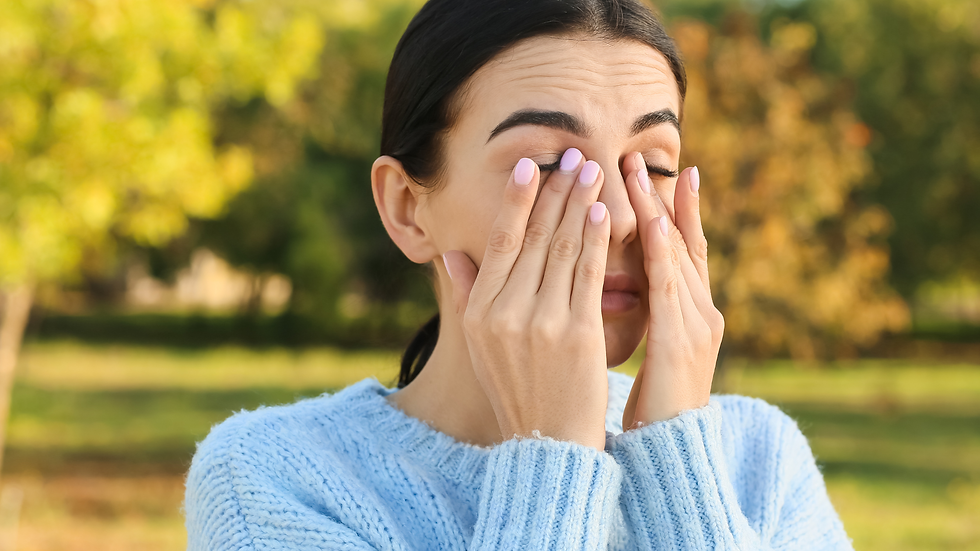
Seasonal allergies, also called seasonal allergic rhinitis or hay fever, occur when the immune system reacts to pollen from trees, grasses, weeds, and other plants. Common symptoms include sneezing, a runny or
stuffy nose, coughing, and itchy eyes, nose, mouth, or throat. (NIH)
When someone with seasonal allergies encounters an allergen, the immune system identifies the substance as a threat and produces an allergic response. This can involve the release of histamine and other chemicals, leading to inflammation and symptoms affecting the nose, eyes, throat, and respiratory tract.
Common Symptoms of Seasonal Allergies
Sneezing
Runny or stuffy nose
Itchy nose, throat, or roof of the mouth
Watery, red, or itchy eyes
Postnasal drip
Coughing
Fatigue or disrupted sleep
Symptoms can vary from person to person and may follow different seasonal patterns depending on the allergens involved. Tree pollen is commonly associated with spring, grass pollen with late spring and summer, and ragweed pollen with late summer and fall. Other allergens, including dust mites, pet dander, and certain molds, can contribute to symptoms throughout the year.
Seasonal allergies can affect more than the nose and eyes. Persistent symptoms may interfere with sleep, concentration, and daily activities, and allergies can worsen asthma symptoms in people who have both conditions. (Mayo Clinic)
Seasonal allergies are different from a common cold. A cold is caused by a virus, while seasonal allergies result from an immune response to an allergen. Recognizing the difference can help you better understand your symptoms and determine when additional care may be appropriate.
With this modern medical understanding as a foundation, we can now explore how Ayurveda understands seasonal allergies through the lens of the seasons, doshic imbalance, digestion, environment, and individual constitution.

How Does Ayurveda Understand Seasonal Allergies?
Ayurveda approaches seasonal allergies from a whole-person and individualized perspective. Rather than viewing allergy symptoms in isolation, Ayurveda considers the relationship between the seasons, doshic imbalance (Vikriti), digestion, daily routine, environment, and individual constitution (Prakriti).
In Ayurveda, the changing seasons naturally influence the qualities of the body and mind. As the environment changes, so can our doshic balance and physiological needs.
Spring, for example, is traditionally associated with increasing Kapha qualities such as heaviness, moisture, coolness, and congestion. For some individuals, these qualities may coincide with the time of year when seasonal allergy symptoms become more noticeable.
Ayurveda places particular importance on Agni, or digestive capacity, because healthy Agni is considered fundamental to maintaining balance and health. Agni governs the digestion and transformation of nourishment and is central to the Ayurvedic understanding of health.
Learn more in Improve Agni: Your Digestive Fire Is Key to Good Health.
When Agni is impaired, Ayurveda describes the formation of Ama, traditionally understood in Ayurveda as a product of impaired digestion and metabolism. Within the Ayurvedic framework, Ama is regarded as a fundamental contributor to dosha imbalance and disease, particularly when it accumulates and interferes with the normal functioning of the body's channels.
For a deeper exploration, see Understanding Ama in Ayurveda: The Key to Good Health.
In Ayurveda, Agni—the principle of digestion and transformation—is considered fundamental to health. Classical Ayurvedic texts describe different states of Agni and emphasize the importance of maintaining appropriate digestive function. The Charaka Saṃhitā discusses Agni extensively in Cikitsā Sthāna 15, particularly in relation to digestion and disorders of Grahaṇī.
From an Ayurvedic perspective, understanding seasonal allergies therefore involves looking beyond the immediate symptoms to Agni, Ama, doshic imbalances, seasonal influences, and the individual's unique constitution and lifestyle.
These concepts are part of a broader Ayurvedic understanding of health that places emphasis on digestion, daily habits, prevention, and maintaining balance. Learn more in What Is Ayurveda? A Beginner's Guide.
Ayurveda is inherently individualized; it does not offer a one-size-fits-all approach. Two people may experience the same allergens very differently. This is where Ayurveda shines: looking beyond the symptoms to understand the root causes of the doshic imbalances specific to each person.

Seasonal Allergies and the Three Doshas
Seasonal allergies do not present in exactly the same way for everyone. From an Ayurvedic perspective, the qualities and characteristics of your symptoms can offer insight into which doshas may be involved in your current experience.
For a broader understanding of how Vata, Pitta, and Kapha express themselves and how their qualities can become imbalanced, see How to Recognize Dosha Imbalance (Vata, Pitta & Kapha).
Kapha: Congestion, Heaviness, and Mucus
Kapha is often especially relevant during spring, when qualities such as moisture, coolness, heaviness, and congestion tend to increase. These Kapha qualities can also be present during winter, particularly when conditions are cold and damp, and may contribute to congestion and mucus.
A Kapha-influenced doshic presentation may include:
Nasal congestion or stuffiness
Excess mucus or postnasal drip
Heaviness in the head or body
Sluggishness or fatigue
A feeling of fullness or congestion in the sinuses
Symptoms that are more noticeable in the morning or in damp conditions
When these qualities are prominent, Ayurveda considers whether increased Kapha and obstruction in the body's channels may be part of the individual's current imbalance.
Mucus itself can also provide useful information for Ayurvedic self-observation. Learn more in Ayurveda Mucus Analysis: What Your Snot Says About Your Health.
Vata: Dryness, Irritation, and Variability
A Vata-influenced pattern may have a different quality. Instead of primarily experiencing heaviness and mucus, there may be more dryness, sensitivity, irritation, and variability.
Possible features include:
Dry or irritated nasal passages
A dry cough
Sneezing that comes in bouts
Variable or shifting symptoms
Sensitivity to wind, cold, or dry environments
Restlessness or disrupted sleep
Because Vata is associated with qualities such as dryness, lightness, mobility, and irregularity, these qualities can provide useful information when observing an individual's allergy pattern.
Pitta: Heat, Redness, and Irritation
A Pitta-influenced presentation may be characterized by more heat, redness, and irritation.
Possible features include:
Red, itchy, or irritated eyes
Burning or irritation in the nose or throat
Increased sensitivity to heat
Facial warmth, flushing, or redness
Skin redness, itching, or irritation
Rashes or other inflammatory skin reactions
Symptoms that feel more intense in hot conditions
In Ayurvedic assessment, these qualities may suggest that Pitta is involved in the individual's current imbalance, even when environmental allergens are the immediate trigger.
Your Allergy Pattern May Involve More Than One Dosha
These categories are not rigid diagnostic labels. An individual may experience congestion and mucus alongside dryness or irritation, or notice that the pattern changes as the season progresses.
For example, someone may experience Kapha-type congestion in the morning but develop more Vata-type dryness later in the day. Another person may experience primarily Pitta-type eye irritation during a particular season.
This is one reason Ayurveda does not rely on a single approach for everyone with seasonal allergies. What and how you are experiencing allegies symptoms matters.
Instead of asking, "Which dosha causes allergies?", a more useful Ayurvedic question is:
"Which qualities are most prominent in my symptoms right now, and what might they be telling me about my current dosha imbalances?"
This kind of self-observation is central to Ayurveda. Rather than simply labeling a symptom as Vata, Pitta, or Kapha, Ayurveda encourages you to notice the qualities over time—including changes in mucus, dryness, irritation, digestion, energy, sleep, and your response to different environments and seaons.
🌿Saumya Self-Observation™ ExerciseRather than simply labeling symptoms as Vata, Pitta, or Kapha, observe what is happening in your body (and mind) and how your symptoms change over time. Ask yourself:
The goal is not to diagnose yourself or assign a fixed dosha. Self-observation helps you recognize patterns and qualities unique to your experience. |
If you would like to develop your self-observation practice further, download the free Observable Ayurveda: A Beginner’s Guide to Ayurvedic Self-Observation and learn how to recognize patterns and qualities that may help you better understand your individual doshic balance.

The Role of Agni and Digestion
In Ayurveda, Agni—the digestive and metabolic fire—is considered fundamental to health. Agni governs the digestion and transformation of food and is traditionally understood to play an important role in nourishment, energy, resilienece, elimination, and recovery.
For a deeper exploration of Agni, see Saumya Ayurveda's Improve Agni: Your Digestive Fire Is Key to Good Health.
Agni, Ama, and the Ayurvedic View of Imbalance
Within the Ayurvedic framework, impaired Agni is associated with the formation of Ama, traditionally described as incompletely digested or unmetabolized material. Ayurveda considers Ama an important contributor to imbalance when it accumulates and interferes with normal functioning.
In the Ayurvedic understanding of disease, Ama is considered a fundamental contributor to many disease processes. When Agni is impaired and digestion is incomplete, Ama may form and contribute to doshic disturbance and disease. (Charaka Samhita)
Veena’s Perspective
|
Digestion Is Individual
Ayurveda does not assume that everyone digests food in the same way. Agni is influenced by your individual constitution and current dosha imbalances, so digestive needs are not the same for everyone.
This is one reason two people may experience the same allergy season differently. One person may notice congestion and heaviness alongside sluggish digestion, while another may experience constipation, irregular appetite, or increased gas and bloating during the same season.
The Gut Health & Digestion collection explores this broader Ayurvedic relationship between digestion and whole-body health, including articles on gut health, the gut-brain connection, leaky gut, MCAS, histamine, and digestion.
From Digestion to Seasonal Support
Understanding Agni provides an important foundation for the sections that follow. Once you begin to recognize your own digestive responses, seasonal changes, and doshic imbalances, Ayurveda can take a more individualized approach to food, daily routine, nasal practices, breathwork, and other forms of seasonal support.
The focus is not on finding one remedy for everyone. It is on understanding what your body is showing you and what may support greater balance for your constitution and current dosha imbalances.

Ayurvedic Lifestyle Support During Allergy Season
Ayurveda places considerable emphasis on daily routine and seasonal awareness (Ritucharya). During allergy season, simple adjustments to your daily habits can help you apply Ayurvedic principles through greater self-observation of changes in weather, environment, digestion, energy, and sleep.
Ayurveda invites you to observe the qualities of your experience and adjust your routine accordingly. What feels balancing at one time may not be appropriate at another, and what supports one person may not support another.
Veena’s Perspective
|
Align Your Daily Routine With the Season
In Ayurveda, Dinacharya, or daily routine, provides a foundation for maintaining balance. Keeping relatively consistent times for waking, meals, movement, work, rest, and sleep can create greater rhythm and stability.
Seasonal changes may also call for adjustments. During spring, when Kapha qualities such as heaviness, moisture, coolness, and sluggishness tend to increase, Ayurveda may emphasize lighter food, regular movement, and practices that encourage warmth, invigoration, and circulation.
Spring is also an important time in Ayurveda for seasonal renewal and adjusting daily habits to the changing qualities of the season.
If you would like to explore this approach more deeply, download the free Complete Guide to Ayurvedic Spring Cleansing, which explores traditional Ayurvedic approaches to spring cleansing, digestion, food, and seasonal routines.
Keep Moving
Regular movement is an important part of Ayurvedic lifestyle practices. During seasons when you feel particularly heavy, sluggish, or congested, gentle to moderate movement may help you feel more energized and support a sense of lightness.
Your movement practice does not need to be intense. Walking, yoga, stretching, and other movement appropriate for your constitution and current energy can become part of your daily rhythm.
Ayurveda also considers how movement and yoga practices may be adapted to an individual's doshic picture. Explore The Best Asana and Pranayama for Your Dosha: A Guide for Vata, Pitta, and Kapha for guidance on choosing practices according to Vata, Pitta, and Kapha.
The goal is consistency and finding an intensity and frequency of movement that are balancing for your individual doshic picture.
Support Healthy Sleep
Seasonal allergy symptoms can interfere with sleep, particularly when congestion, coughing, or postnasal drainage becomes bothersome at night.
Ayurveda considers sleep an important foundation of health and emphasizes creating a calm, consistent transition from daytime activity into nighttime rest. A supportive evening routine might include reducing stimulation, shutting off screens at sundown, gentle movement, breath awareness, meditation, and quiet time before bed.
For practical ideas, explore 10 Ayurvedic Evening Rituals for a Calming Night.
Practice Gentle Breath Awareness
Breath awareness can also become part of a supportive daily routine. Diaphragmatic breathing is a foundational practice, with formal morning and evening routines that help you relearn diaphragmatic breathing as your natural way of breathing throughout the day.
Absolutely. I’d make it more natural and keep the focus on the eBook rather than the brand.
The free Diaphragmatic Breathing: The Essential Guide provides a practical introduction to diaphragmatic breathing and explores how this practice can support relaxation, sleep, digestion, and energy.
Download the free eBook and begin exploring a simple, accessible way to reconnect with your natural breath.
Free Guided Practices for Greater Calm and Focus
A guided practice can make it easier to establish a consistent routine, particularly when you are beginning or returning to meditation or relaxation practices.
Free Guided Practices include a Two-Minute Meditation, 11-minute daily guided practices, systematic relaxation, and longer meditation practices. These practices can be incorporated into natural transition points throughout the day or used as part of a morning or evening routine.
Explore the free guided practices and find a simple practice that fits naturally into your morning and evening routines.
Pay Attention to Your Environment
Lifestyle support during allergy season also includes paying attention to known environmental triggers. If certain pollens, outdoor conditions, or other exposures consistently aggravate your symptoms, reducing exposure when practical can be an important part of managing seasonal allergies.

Food and Seasonal Allergies
In Ayurveda, food is not one-size-fits-all. When food is appropriate for your doshic picture, it can become medicine—supporting digestion, balance, and overall well-being.
This is especially relevant when considering seasonal allergies. Instead of focusing only on individual foods, Ayurveda looks at how food, digestion, and the doshas interact within the whole person.
During allergy season, the Ayurvedic approach is therefore not simply to create a list of “allergy foods” to eat or avoid. It is about supporting Agni so food can be properly digested, helping prevent the accumulation of Ama, and supporting healthy elimination.
Instead, Ayurveda asks a more useful question: How can food choices support your individual needs as the season changes?
Eat With the Season
Ayurveda's principle of Ritucharya, or seasonal living, recognizes that food choices can change with the seasons.
Spring, for example, is traditionally associated with increasing Kapha qualities such as coolness, moisture, heaviness, and sluggishness. During this transition, Ayurveda may favor foods that are lighter, freshly prepared, and appropriate for the individual's constitution and current state.
Choose Food According to Your Individual Needs
Ayurveda does not recommend that everyone follow the same seasonal diet. The same food can be nourishing for one person and less appropriate for another.
Food choices may be influenced by:
Your Prakruti, or individual constitution
Your current Vikruti, or state of imbalance
The season and climate
Your appetite and digestive capacity
Your energy levels
The qualities of your current symptoms
Understanding the difference between your Prakruti and Vikruti can provide a useful foundation for making more individualized food choices. Learn more in Prakruti vs. Vikruti: Understanding Your Ayurvedic Constitution and Current Imbalance.
This is the foundation of the Ayurvedic principle of food as medicine: food becomes supportive when it helps balance the doshas, support Agni, and reduce Ama—not simply because it is labeled “healthy.”
For a deeper exploration of this individualized approach, read Food as Medicine 101: Ayurvedic Nutrition for Body, Mind, & Spirit.
Favor Fresh, Seasonal, Easily Digestible Meals
For example, during Pitta season, Ayurveda favors foods that counter qualities of heat, intensity, and sharpness. This may mean emphasizing fresh, seasonal foods, naturally cooling ingredients, and meals that are gentle and easy to digest.
The goal is not to follow a rigid “Pitta diet,” particularly because seasonal allergies may involve more than one dosha. Instead, choose foods that are appropriate for your individual doshic picture.
Food as Medicine Is Personal
Ayurveda invites you to move away from rigid lists of “good” and “bad” foods and toward greater self-awareness of how food actually affects you.
Notice what happens when you eat different foods during different seasons. Consider your appetite, digestion, energy, and overall sense of balance rather than focusing on a single symptom.
Free Ayurvedic Recipe eBooks
Putting Ayurvedic food principles into practice is easier with practical recipes designed for seasonal and individual needs.
Explore the Free Ayurvedic Recipe eBook Collection for recipe and nutrition guides that make it easier to bring food-as-medicine principles into your kitchen.

Nasal Practices: Neti and Nasya
Ayurveda includes several nasal practices as part of daily and seasonal self-care. Two commonly discussed practices are Jala Neti, or saline nasal irrigation, and Nasya, the application of Ayurvedic oil to the nasal passages.
Jala Neti: Saline Nasal Irrigation
Jala Neti involves gently rinsing the nasal passages with a saline solution using a neti pot or another appropriate irrigation device. From a modern medical perspective, saline nasal irrigation may provide some relief from nasal symptoms associated with seasonal allergies, including congestion and irritation.
Water safety is essential. Never use ordinary tap water for nasal irrigation. Use distilled or sterile water, or water that has been appropriately boiled and cooled, and clean the irrigation device according to the manufacturer's instructions.
If nasal irrigation causes pain, significant irritation, or worsening symptoms, discontinue the practice and seek appropriate medical guidance.
Nasya: Ayurvedic Nasal Oil
Nasya is a traditional Ayurvedic practice involving the application of herbalized oil to the nasal passages. Within Ayurveda, Nasya is traditionally used to lubricate and nourish the nasal passages and is often considered especially relevant when dryness and Vata qualities are prominent.
The appropriate oil and method can vary according to constitution, current state of balance, season, environment, and individual needs.
For a detailed explanation of the traditional practice, see Nasya Oil: Benefits, How-To and Guide to Nasya Treatment.
Neti and Nasya Are Not the Same Practice
Although both involve the nose, their methods and purposes differ:
Jala Neti uses saline water to rinse the nasal passages.
Nasya uses Ayurvedic oil applied to the nasal passages.
Neti is primarily a cleansing practice, while Nasya is traditionally used to lubricate and nourish the nasal passages.
The appropriate practice depends on the individual and the circumstances.
For seasonal allergies, saline nasal irrigation has some evidence for symptom relief, while evidence specifically evaluating Nasya for seasonal allergic rhinitis is much more limited. (NIH)
Nasal Practices for Seasonal Allergy Support
Neither Neti nor Nasya should automatically be considered appropriate for everyone. The nature of your symptoms, the season, your constitution, and your current state all matter.
If you choose to practice Jala Neti, water safety is non-negotiable. If you are considering Nasya, especially if you have an acute illness or respiratory condition, seek appropriate professional guidance before beginning.
The goal is not simply to add another practice to your routine. It is to understand which practice is appropriate for you, how to use it correctly, and when it may be better to pause or seek guidance.

Pranayama (Breathwork) and Seasonal Allergy Support
Ayurveda and Yoga are sister sciences, and both recognize the profound relationship between the body, mind, and breath. In Ayurveda, the breath is an important bridge between body and mind. Pranayama, the traditional yogic practice of working with the breath, can be incorporated into daily life to cultivate greater awareness, steadiness, and relaxation.
For seasonal allergy support, the emphasis should be on gentle, appropriate breathing practices rather than forceful techniques. In the yogic tradition, pranayama is also used to purify, balance, and regulate the nadis, the subtle channels through which prana is understood to flow.
Breathwork is not a treatment for seasonal allergies, but it can be a supportive part of an overall routine, particularly when stress, tension, or disrupted sleep accompany seasonal symptoms.
Begin With Diaphragmatic Breathing
Diaphragmatic breathing is a foundational breath practice and an accessible place to begin. Avoid trying to force the breath to become deeper, the practice develops awareness of the natural movement of the diaphragm and encourages a more relaxed breathing pattern.
The free Diaphragmatic Breathing: The Essential Guide provides a practical introduction to the practice, with guidance for developing a simple daily breath practice and exploring its relationship to relaxation, sleep, digestion, clarity, and resilience.
Download the free guide and begin with a few minutes of gentle diaphragmatic breathing each day.
Explore Pranayama More Deeply
Once diaphragmatic breathing feels familiar, you may want to explore a broader range of traditional pranayama practices.
Cultivating Inner Stillness: A Guide to Pranayama Breathwork introduces diaphragmatic breathing as a foundation for breathwork and explores additional traditional techniques and practices for developing greater awareness of the breath, prana, and inner stillness.
Download the free eBook and explore pranayama as a practice of greater awareness, steadiness, and inner stillness.
Keep Breathwork Appropriate to Your Individual Needs
Not every pranayama practice is appropriate for every person or every situation. Your breathing pattern, current state, constitution, and overall health should be considered when choosing a practice.
The goal is not to perform increasingly complicated breathing techniques. It is to develop a steady, sustainable relationship with the breath that fits naturally into your daily routine and supports balance for your individual doshic picture.
A gentle but important note about pranayama: Pranayama is a subtle practice, and the technique, intensity, duration, and way a practice is performed matter. A breathing practice that is appropriate for one person may be inappropriate for another, and practicing a technique incorrectly or beyond your capacity may contribute to discomfort or imbalance rather than greater wellbeing.
This is one reason traditional pranayama is best learned progressively and, particularly when exploring more advanced techniques, under the guidance of an experienced meditation and pranayama teacher who can help you understand which practices are appropriate for you and how to practice them correctly.
In a group yoga class, a breathing technique may necessarily be taught in a one-size-fits-all way. But an important question is: Is that particular practice right for you? The technique, intensity, duration, and progression of pranayama may need to be adapted to your individual constitution, current doshic state, and capacity.
Learning pranayama is therefore not simply about learning a breathing technique. It is about learning which practices are appropriate for you and how to practice them correctly, with guidance that takes your individual needs into account.

Stress, Sleep, and the Nervous System
Seasonal allergies can affect more than the nose and eyes. Persistent symptoms and disrupted sleep can contribute to stress, fatigue, and difficulty feeling rested.
Ayurveda takes a whole-person view of these patterns. Instead of looking only at allergy symptoms, it also considers sleep, stress, daily rhythms, mental activity, and the relationship between the body and mind.
Stress and Seasonal Symptoms
When symptoms persist or sleep is disrupted, allergy season can become increasingly stressful. Ayurveda emphasizes practices that cultivate steadiness, relaxation, and regularity, particularly when the mind and nervous system feel overstimulated.
Stress and allergy symptoms can exist alongside one another, and supporting overall wellbeing may make it easier to navigate periods when symptoms are more noticeable.
Explore the Nervous System articles for Ayurvedic perspectives and practical guidance related to stress, relaxation, the nervous system, and mind-body balance.
Protect Your Sleep
Sleep can become especially important during allergy season. Congestion, coughing, nasal irritation, or postnasal drainage may make it harder to sleep well, leaving you feeling tired during the day.
Ayurveda places considerable emphasis on consistent daily rhythms and creating the conditions for restful sleep. A regular bedtime, a calming evening routine, reduced stimulation before bed, and gentle relaxation practices can all support this rhythm.
For practical ideas, explore 10 Ayurvedic Evening Rituals for a Calming Night.
Free eBook: The Complete Guide to Ayurveda for Better Sleep
If seasonal symptoms are affecting your sleep, the free Complete Guide to Ayurveda for Better Sleep offers a deeper exploration of stress, diaphragmatic breathing, guided relaxation, daily rhythms, and self-observation.
Download the free eBook and explore simple Ayurvedic practices for creating better conditions for restful sleep.

Ayurvedic Herbs Traditionally Used for Respiratory Support
Ayurveda has a long tradition of using herbs to support respiratory health, digestion, and balance during seasonal changes. In the Ayurvedic tradition, herbs are not generally selected according to a symptom alone. Their qualities, actions, preparation, constitution, and suitability for the individual are all considered.
Ayurveda has more than 5,000 years of traditional experience with medicinal herbs and their uses. The herbs discussed here have traditional Ayurvedic applications for supporting respiratory health and balance, while modern research on their specific uses for seasonal allergies is still developing.
Tulsi: Traditionally Used for Respiratory Support
Tulsi (Ocimum tenuiflorum), or holy basil, is traditionally valued in Ayurveda for supporting respiratory health and is commonly used in Ayurvedic preparations and teas.
From an Ayurvedic perspective, tulsi may be considered when congestion, heaviness, or excess mucus are part of an individual's seasonal pattern.
Pippali: Traditionally Used for Respiratory Support
Pippali (Piper longum), or long pepper, is an important herb in traditional Ayurveda and is widely used in classical formulations, particularly in contexts involving Kapha, digestion, and respiratory health.
Its warming and penetrating qualities make it traditionally relevant when congestion, sluggish digestion, or excess mucus are prominent.
Because Pippali is a medicinal herb, it should not simply be treated as an everyday remedy for everyone. The preparation, dose, constitution, and current state of balance matter.
Ginger: Warming and Traditionally Supportive
Ginger (Zingiber officinale) is widely used in Ayurveda and is traditionally valued for its warming qualities and relationship to Agni and digestion.
Rather than repeating detailed remedies already covered elsewhere, ginger is included here as an example of how an herb may fit into a broader individualized seasonal approach.
For practical Ayurvedic approaches to cough and congestion, see 7 Ayurvedic Remedies You Can Try to Relieve Cough and Congestion.
Licorice: Traditionally Used for the Respiratory System
Licorice root (Yashtimadhu) has a long history of use in Ayurveda and traditional herbal medicine. Within Ayurveda, it is traditionally used to soothe and support the respiratory passages.
Licorice is not appropriate for everyone, particularly in concentrated or prolonged use. It can interact with medications and may affect blood pressure, potassium levels, and fluid balance, so professional guidance is appropriate before using medicinal doses.
Guduchi: Traditional Ayurvedic Use
Guduchi (Tinospora cordifolia) is an important herb in Ayurvedic tradition and is used in a variety of classical formulations.
Guduchi has also been studied in relation to allergic conditions. NCCIH notes that Tinospora, also called guduchi, has been investigated for allergic rhinitis, along with a number of other nutritional and herbal approaches. However, evidence for these approaches remains limited or inconsistent.
Herbs Are Individualized in Ayurveda
Ayurveda does not recommend choosing an herb simply because it is associated with a particular symptom. Constitution, current doshic picture, state of Agni and Ama, season, stage of life, and the specific qualities of the symptoms all matter.
For example, an approach traditionally used when Kapha-type congestion and excess mucus are prominent may not be appropriate when dryness or irritation is the dominant doshic picture.
For a deeper exploration of Ayurvedic approaches to mucus, congestion, and respiratory patterns, see Ayurveda Mucus Analysis: What Your Snot Says About Your Health.
You can also explore the Herbal Remedies collection for broader Ayurvedic herbal education.
Herbal Knowledge
Ayurveda has a long tradition of using herbs according to the individual, the herb, and the circumstances. An herb that is appropriate for one person may not be appropriate for another. Ayurvedic herbal selection considers factors such as constitution, current doshic imbalances, Agni, digestion, medications, health conditions, and other individual circumstances.
Just as pharmaceutical medications can have side effects and interactions, herbs are active substances and need to be selected appropriately. The goal is not simply to choose an herb for a symptom, but to understand which herb is appropriate for the individual and how it should be used.
If you take prescription medications, are pregnant or breastfeeding, or have a health condition, appropriate professional guidance is important before adding herbs to your routine.

What Does the Research Say About Ayurveda and Seasonal Allergies?
Modern research on Ayurvedic approaches to seasonal allergies is still developing. Some Ayurvedic practices and herbs have been studied for allergic rhinitis, but the amount and quality of research varies considerably depending on the specific practice or herb.
For example, NCCIH notes that saline nasal irrigation may modestly improve some seasonal allergy symptoms, while research on Guduchi (Tinospora cordifolia) remains too limited and inconsistent to draw firm conclusions.
Jala Neti, the traditional Ayurvedic practice of saline nasal rinsing, has some supportive clinical evidence for relieving symptoms of allergic rhinitis. Research suggests that regular saline nasal irrigation may provide modest improvement in some nasal allergy symptoms. Safe water practices are essential when using a neti pot or other nasal-rinsing device. (NIH)
This distinction is important. Traditional Ayurvedic knowledge and modern clinical research answer different questions. Ayurveda provides a traditional framework for understanding constitution, doshic balance, digestion, seasonal influences, lifestyle, and individualized care. Modern research evaluates whether a particular intervention produces measurable effects under defined study conditions.
Research on medicinal plants and Ayurvedic practices for allergic rhinitis is continuing to grow. Clinical studies have investigated individual herbs and preparations for allergic rhinitis, including herbs used in Ayurveda such as Guduchi (Tinospora cordifolia). Reviews of medicinal plants have reported potential benefits for some nasal symptoms, although the quality and consistency of the evidence varies among individual herbs and preparations.
This is an area of active research. Some studies have reported positive findings, while others have found limited or inconsistent benefits. A 2024 systematic review of 29 randomized controlled trials found that medicinal plants may improve some measures of allergic rhinitis, but concluded that clearer evidence is still needed for individual medicinal plants and specific preparations. (PubMed)
Ayurveda brings a long tradition of using herbs and practices according to the individual, while modern research is continuing to investigate how particular herbs and preparations may work and for whom they may be most appropriate. The research should therefore be considered herb by herb and practice by practice, alongside the extensive traditional knowledge from which these approaches come.
When to Seek Medical Care
Seasonal allergies are often manageable, but persistent, severe, or unusual symptoms warrant medical evaluation.
Consider speaking with a healthcare professional if:
Symptoms are persistent or affecting sleep, daily activities, or quality of life.
Over-the-counter treatments aren't providing adequate relief or cause troublesome side effects.
You experience wheezing, chest tightness, shortness of breath, or a persistent cough.
Symptoms are unusually severe or don't improve as expected.
You are unsure whether your symptoms are caused by allergies or another condition.
Know When It Is an Emergency
Difficulty breathing, throat swelling or tightness, dizziness, fainting, or signs of a severe allergic reaction require emergency medical attention. Call 911 or your local emergency number.
Ayurvedic practices may provide complementary support, but should not delay appropriate medical care or replace prescribed treatment for significant allergy or respiratory symptoms.

Frequently Asked Questions
What does Ayurveda say about seasonal allergies?
Ayurveda approaches seasonal allergies through an individualized framework that considers the seasons, doshic balance, constitution, digestion, lifestyle, environment, and the qualities of a person's symptoms. Ayurveda does not assume that everyone with seasonal allergies will experience them in the same way.
Which dosha is associated with seasonal allergies?
Kapha is often especially relevant during spring, when qualities such as heaviness, moisture, coolness, and congestion traditionally increase. However, seasonal allergy symptoms may also involve Vata or Pitta qualities, depending on the individual's symptoms and current state of balance.
What are common Ayurvedic herbs used for seasonal allergies?
Ayurvedic herbs traditionally used for respiratory support include Tulsi, Pippali, ginger, licorice, and Guduchi. Their suitability depends on the individual's constitution, current doshic state, digestion, medications, and other circumstances.
Can Ayurveda cure seasonal allergies?
There is currently not enough clinical evidence to say that Ayurveda cures seasonal allergies. Ayurvedic practices may be explored as complementary support, while appropriate medical care remains important for persistent or significant symptoms.
Can Ayurvedic herbs help with allergy congestion?
Some herbs are traditionally used in Ayurveda to support Kapha, mucus, and congestion. Evidence for individual herbs varies, and an herb that is appropriate for one person may not be appropriate for another.
Is Jala Neti helpful for seasonal allergies?
Saline nasal irrigation may provide modest relief from some nasal symptoms of allergic rhinitis, according to available research. If using a neti pot or other nasal-irrigation device, use distilled, sterile, or appropriately boiled and cooled water and keep the device clean.
What is the difference between Jala Neti and Nasya?
Jala Neti involves rinsing the nasal passages with saline water. Nasya is a traditional Ayurvedic practice involving the application of oil to the nasal passages. They are different practices and are not interchangeable.
Can food affect seasonal allergies?
Ayurveda does not recommend one universal “allergy diet.” Food choices may be considered in relation to constitution, doshic balance, digestion, season, climate, and individual response. The focus is on supporting Agni, reducing Ama, and choosing foods that are appropriate for the individual.
Can pranayama help with seasonal allergies?
Gentle breathing practices may support breath awareness, relaxation, and steadiness, particularly when stress or disrupted sleep accompany seasonal symptoms. Pranayama is not a treatment for allergic rhinitis and should not replace appropriate medical care, particularly when wheezing or difficulty breathing is present.
When should I see a doctor for seasonal allergies?
Seek medical evaluation when symptoms are persistent, severe, significantly affecting daily life, or not responding adequately to treatment. Wheezing, chest tightness, or shortness of breath warrant medical attention. Difficulty breathing, throat swelling or tightness, dizziness, or fainting require emergency care.
Can I use Ayurvedic herbs with allergy medication?
Herbs can have pharmacological effects and may interact with medications. If you take prescription or over-the-counter medications, have a medical condition, are pregnant or breastfeeding, or are considering concentrated herbal preparations, discuss their use with an appropriate healthcare professional.
How can I understand my own seasonal allergy experience?
Begin with self-observation. Notice when symptoms appear, which symptoms are most prominent, how they change throughout the day and season, and whether they coincide with changes in digestion, sleep, energy, stress, weather, humidity, and environmental exposure. Ayurveda uses this observation to understand individual doshic imbalances and qualities rather than relying on a single symptom or fixed dosha label.

Sanskrit & Ayurvedic Terms Glossary
Agni
The digestive and metabolic fire in Ayurveda. Agni governs the digestion and transformation of food and is traditionally considered fundamental to nourishment, energy, and overall health.
Ama
Traditionally described as incompletely digested or metabolized material that can form when Agni is impaired. Within the Ayurvedic framework, Ama is considered a contributor to doshic imbalance and disease processes.
Ayurveda
A traditional system of medicine from India that takes an individualized approach to health and wellbeing, considering constitution, doshic balance, digestion, lifestyle, environment, and seasonal influences.
Dinacharya
The Ayurvedic concept of a daily routine. Dinacharya emphasizes consistent rhythms for activities such as waking, eating, movement, rest, and sleep.
Dosha
One of three fundamental Ayurvedic principles—Vata, Pitta, and Kapha—associated with particular qualities and functions in the body and mind. Ayurveda considers both an individual's constitution and their current state of doshic balance.
Guduchi
Tinospora cordifolia, an herb traditionally used in Ayurveda in a variety of formulations. Guduchi has also been studied in relation to allergic conditions.
Jala Neti
A traditional nasal-cleansing practice involving saline water used to gently rinse the nasal passages. Modern saline nasal irrigation has been studied for symptoms of allergic rhinitis.
Kapha
One of the three doshas, associated with qualities such as heaviness, coolness, moisture, stability, and structure. In Ayurveda, Kapha is often especially relevant during spring and may also become prominent under cold, damp conditions.
Nasya
A traditional Ayurvedic practice involving the application of oil to the nasal passages. Nasya is traditionally used to lubricate and nourish the nasal passages and is individualized according to the person's needs.
Pippali
Piper longum, also known as long pepper. Pippali is an important herb in traditional Ayurveda and is commonly used in classical formulations, particularly in contexts involving Kapha, digestion, and respiratory health.
Pitta
One of the three doshas, associated with qualities such as heat, intensity, transformation, and sharpness. Pitta may be considered when symptoms involve heat, redness, or irritation.
Prakruti
An individual's natural constitution or baseline Ayurvedic nature, traditionally understood in relation to the proportions of Vata, Pitta, and Kapha.
Pranayama
Traditional yogic practices involving the regulation and cultivation of the breath. Pranayama is used to develop greater awareness, steadiness, and control of breathing.
Ritucharya
The Ayurvedic principle of seasonal living. Ritucharya recognizes that changes in the environment and seasons can influence the body's needs and recommends adapting diet and lifestyle accordingly.
Tulsi
Ocimum tenuiflorum, also known as holy basil. Tulsi is traditionally valued in Ayurveda and commonly used in preparations associated with respiratory and general seasonal support.
Vata
One of the three doshas, associated with qualities such as dryness, lightness, mobility, and irregularity. Vata may be considered when symptoms involve dryness, irritation, variability, or sensitivity to cold and wind.
Vikruti
An individual's current state of imbalance or deviation from their natural constitution (Prakruti). Ayurveda considers Vikruti when assessing what may be contributing to a person's present symptoms or state.
Yashtimadhu
The Sanskrit name commonly used in Ayurveda for licorice root (Glycyrrhiza glabra), traditionally used in Ayurvedic herbal preparations, including those intended to support the respiratory passages.

Final Thoughts
Seasonal allergies can be frustrating, particularly when symptoms return year after year as the environment changes. Ayurveda offers an individualized way of understanding your experience, looking beyond the symptom itself to consider the season, constitution, doshic balance, digestion, daily routine, and other influences.
The goal is not to find one herb, one food, or one Ayurvedic practice that works for everyone. Ayurveda encourages you to observe how your body responds to seasonal changes and which qualities become more prominent in your experience.
You may notice that your symptoms are characterized primarily by congestion and mucus, while someone else experiences more dryness, irritation, or heat. Your needs may also change as the season progresses.
This is where self-observation and individualized care become important. By noticing your symptoms and how you respond to different foods, practices, environments, and daily habits, you can develop a clearer understanding of your individual doshic imbalances.
Ayurvedic practices can be explored as complementary support, while modern medical care remains important when symptoms are persistent, severe, or affecting breathing.
The most useful question may not be, “What is the best remedy for seasonal allergies?” but rather:
“What is my body and mind showing me, and what can I learn from it?”
That shift—from simply focusing on a symptom to understanding your individual experience—is at the heart of an Ayurvedic approach.

What Our Clients Say | Saumya Ayurveda Testimonials
Real Transformations Through Ayurveda Consultation
Physician Testimonial (Medical Endorsement)
“As a physician, I have always believed that prevention is better than cure. In today’s healthcare environment, Ayurveda offers a logical and natural approach to long-term health and prevention.
I began working with Veena during a very demanding phase of my life, and she made the process accessible even within my busy schedule. I was encouraged to follow a steady, sustainable approach focused on real lifestyle change.
Over time, I experienced meaningful improvements in balance, energy, and well-being. In my medical practice, I now see many patients with similar stress- and diet-related imbalances, which has further reinforced my trust in Ayurvedic principles.
I have since referred several patients to Saumya Ayurveda and consider Veena a valuable resource in supporting holistic well-being.”
Dr. Gauri Nagargoje
M.D., Oncology & Hematology
Physician Testimonial (Medical Endorsement)
“As a physician, I initially struggled with Ayurveda’s simplicity and depth, but Veena’s guidance made it practical, scientific, and deeply effective.
Veena has transformed my health and perspective on healing. I experienced significant improvements in focus, digestion, stress response, and overall vitality.
Her personalized approach made lifestyle changes easy and sustainable.
This journey not only improved my health but also inspired a lifelong commitment to integrating Ayurveda into holistic healthcare.”
Dr. Jessica Bedi
D.O., & Ayurvedic Doctor


Alison, F., Minnesota, USA
Explore more client success stories from Saumya Ayurveda and see how Ayurveda supports healing, balance, and transformation.

Discover the Saumya Ayurveda Way
Ayurveda Begins With Seeing the Whole Person
At Saumya Ayurveda, symptoms are not viewed in isolation. Ayurveda looks at the relationship between digestion, elimination, sleep, stress, energy, daily rhythms, mind, stage of life, season, climate, constitution, and current doshic imbalances to understand the patterns that influence how you feel.
When health concerns persist, it can be frustrating to feel that individual symptoms are being addressed without understanding the bigger picture. Ayurveda offers another way—one that asks not only “What is the symptom?” but also “What are the body and mind communicating?”
Personalized Ayurveda, Rooted in Tradition
Saumya Ayurveda combines classical Ayurvedic principles with practical guidance for modern life. Your Ayurvedic plan is based on your individual prakriti (natural constitution), vikriti (current state of doshic imbalance), lifestyle, and circumstances—not a generic dosha checklist or one-size-fits-all protocol.
The goal is not to overwhelm you with rules. It is to help you understand your own body and mind and make sustainable changes that fit naturally into your life, informed by the wisdom of Ayurveda.
For those who want ongoing support, concierge-style Ayurveda consultation packages provide personalized guidance, thoughtful follow-up, and practical tools to help turn Ayurvedic principles into everyday habits.
Education First. Personalized Guidance When You Need It.
Veena takes an education-first, client-centered approach. At Saumya Ayurveda, our favorite product is knowledge.
You won't find education built around selling a supplement, herb, or wellness product. Instead, you'll find traditional Ayurvedic perspectives, practical guidance, and timeless principles that help you better understand your body, mind, and unique constitution.
When understanding deepens, better choices naturally follow.
Learn. Observe. Understand. Transform.
Begin your Ayurveda journey with a free 15-minute Discovery Call with Veena and explore whether personalized Ayurvedic guidance is right for you.

Meet Veena: Your Trusted Ayurvedic Guide for Clients Worldwide
Veena Blilie is a Certified Ayurvedic Practitioner, Ayurveda teacher, meditation guide, and monk with over three decades of experience helping clients worldwide achieve greater balance and well-being through Ayurveda.
As founder of Saumya Ayurveda and President Emeritus of the Meditation Center, Veena serves clients worldwide through personalized Ayurvedic wellness guidance, meditation, and yoga practices.
Saumya Ayurveda has been recognized as the #1 Ayurveda cooking blog and the #3 Ayurveda website and blog and has received multiple consecutive awards for best wellness practice.
Through her work, Veena shares practical Ayurvedic guidance, nourishing recipes, and wellness education for modern living.
Inspired from an early age by learning herbal remedies, food as medicine, and traditional healing practices at her grandmother’s knee, Veena combines traditional Ayurvedic wisdom with compassionate, accessible guidance that supports mental, physical, and spiritual well-being.
Known for her warmth, humor, intuitive approach, and accessible style, Veena empowers people to create sustainable health through personalized Ayurvedic wellness plans designed to fit naturally into everyday life.
Veena is also the author of several free Ayurveda eBooks and writes the educational articles published on the Saumya Ayurveda blog.
As seen in:
Voice America
Albuquerque The Magazine
Learn more about Veena and her work through Saumya Ayurveda.
Disclaimer: This information is for educational purposes only and is not a substitute for professional medical advice. Ayurveda works best when tailored to your unique doshic profile, so it’s essential to understand your constitution and imbalances before using herbs, foods, or lifestyle practices. Consult a Certified Ayurvedic Practitioner for personalized guidance.


