Why Seasonal Transitions Matter for Ojas: An Ayurveda Guide to Immunity and Resilience

Have you ever noticed that you seem more vulnerable when the seasons change?
Perhaps your energy suddenly drops in the fall. Your allergies flare in the spring. Sleep becomes less restful. Stress feels harder to manage. Or you find yourself catching every cold that seems to be going around. If so, you're not alone.
While many people think about supporting their immune system during cold and flu season, Ayurveda recognizes that the transition between seasons is often when the body is most vulnerable.
As the weather, daylight, humidity, and even your daily routines begin to shift, your body must continually adapt. These periods of change place unique demands on your physiology and often reveal how resilient—or depleted—you truly are.
The seasonal guidance in this article applies to both the Northern and Southern Hemispheres, with recommendations aligned to the seasons where you live.
This is where Ojas, Ayurveda's essence of vitality, resilience, and immunity, becomes especially important.
Instead of waiting until symptoms appear, Ayurveda encourages us to prepare for seasonal transitions before they fully arrive. By supporting Ojas during these times of change, we can help our bodies adapt more smoothly, maintain stronger immunity, and cultivate lasting resilience throughout the year.

Seasonal transitions place greater demands on the body, making them a time when immunity and resilience are naturally tested. Ayurveda teaches that protecting Ojas—your body's vital essence of vitality, resilience, and immunity—helps support your body's ability to adapt, maintain energy, and stay well throughout the year.
Key Takeaways
Seasonal transitions place additional demands on the body and often reveal underlying imbalances.
In Ayurveda, Ojas is the essence of vitality, resilience, immunity, and longevity.
Ojas serves as the body's reserve capacity, helping us adapt to stress, recover from challenges, and maintain balance during times of change.
Strong Ojas supports steady energy, healthy digestion, restful sleep, emotional well-being, and overall resilience.
Seasonal changes require the body to adapt to shifts in temperature, daylight, routines, activity levels, and environmental conditions.
Autumn naturally increases Vata dosha, while spring naturally increases Kapha dosha.
Supporting Ojas with nourishing foods, healthy digestion, restorative sleep, stress management, and consistent daily routines can help make seasonal transitions feel easier.
From an Ayurvedic perspective, true immunity is not simply avoiding illness—it is the ability to adapt, recover, and thrive through change.
Table of Contents

Why Seasonal Awareness Matters More Than Ever
Many people have noticed that the seasons no longer seem as predictable as they once were. Summer heat may linger well into autumn. Spring may arrive earlier than expected. Winter may feel shorter, milder, more extreme, or interrupted by sudden shifts in temperature. In many parts of the world, seasonal transitions have become less distinct and more variable than they were for previous generations.
Yet despite these changes, the body and mind continue to respond to their environment. Our physiology constantly adapts to changes in daylight, temperature, humidity, and activity levels. Even subtle shifts can influence sleep, digestion, energy, mood, immunity, and overall well-being.
This is one reason the wisdom of Ayurveda remains so relevant today. Rather than relying solely on the calendar, Ayurveda encourages us to observe the qualities of our environment and respond accordingly. Is the weather becoming hotter or cooler? Drier or more humid? Windier or calmer? These changing qualities influence the whole person, whether we consciously notice them or not.
This is where Ojas becomes especially important. As the body's reserve of vitality, resilience, and adaptability, Ojas helps us remain steady through change. When Ojas is well nourished, we recover more easily, maintain steadier energy, and are better equipped to adapt to both expected and unexpected challenges.
The seasons may not always follow the patterns they once did, but our need for resilience remains the same. By cultivating seasonal awareness and supporting Ojas throughout the year, we create a stronger foundation for lasting health, balance, and well-being.

What Is Ojas in Ayurveda?
In Ayurveda, Ojas is often described as the essence of vitality, resilience, immunity, and longevity. Classical Ayurvedic texts describe Ojas as the essence of all the body's tissues and the foundation of vitality, strength, and resilience. (Charaka Samhita, Sutrasthana, Chapter 17, Kiyantashirasiya Adhyaya.)
According to Ayurveda, Ojas is the most refined product of healthy digestion and nourishment. As food is properly digested and transformed, each of the body's tissues is nourished in sequence. Ojas is considered the subtle essence that emerges from this process—the body's deepest reserve of strength, vitality, and resilience.
For this reason, Ojas is often described as the body's reserve capacity. It supports our ability to adapt to stress, recover from illness and challenges, maintain balance, and remain resilient during times of increased demand. Unlike the temporary boost that comes from stimulants or adrenaline, Ojas provides a more sustainable source of energy—the steady vitality that supports long-term health and well-being.
Ojas influences far more than immunity alone. When it is abundant, we often experience:
✓ Steady, sustainable energy
✓ Strong immunity and healthy recovery
✓ Emotional balance and resilience
✓ Healthy digestion
✓ Restful sleep
✓ Mental clarity and focus
✓ A deep sense of vitality and well-being
✓ Greater adaptability during stressful times
When Ojas becomes depleted, the opposite may occur. You may notice:
✓ Fatigue
✓ Lowered immunity
✓ Slower recovery from stress or illness
✓ Sleep disturbances
✓ Digestive imbalance
✓ Increased sensitivity to stress
✓ Emotional overwhelm
✓ A general sense of depletion or reduced resilience
Many people describe low Ojas not as one specific symptom, but as a feeling that something is simply off. They may feel less energized, less grounded, less adaptable, or find themselves thinking, "I don't feel like myself anymore." The vitality and resilience they once enjoyed no longer feel as accessible.
Over time, chronic stress, inadequate sleep, overwork, poor digestion, excessive stimulation, and irregular daily routines can gradually deplete Ojas. Because Ojas is the body's deepest reserve of vitality and resilience, it becomes especially important during times of change.
Seasonal transitions require the body to continually adapt to shifts in temperature, daylight, activity levels, and environmental conditions. These periods of adaptation often reveal whether Ojas is abundant—or in need of replenishment. This is why Ayurveda places such importance on protecting and nourishing Ojas throughout the year.

How Seasonal Changes Affect Immunity, Energy, and Resilience
One of Ayurveda's most profound teachings is that health is never static. Just as nature is constantly changing, our bodies and minds are continually adapting to the world around us.
Modern research supports this understanding. NIH studies suggest that seasonal changes influence many aspects of human physiology, including immune function, inflammation, metabolism, mood, and susceptibility to certain illnesses.
Researchers have also found that immune markers, gene expression, and other biological processes naturally fluctuate throughout the year, reinforcing Ayurveda's long-held observation that the body continuously adapts to seasonal change.
Seasonal transitions bring changes in:
✓ Temperature
✓ Daylight hours
✓ Humidity
✓ Activity levels
✓ Daily routines
✓ Environmental exposures
✓ Sleep patterns
Although these shifts may seem subtle, the body is constantly working behind the scenes to maintain balance. Adjusting to cooler temperatures, changing schedules, different sleep patterns, and shifts in activity levels requires energy and internal resources. From an Ayurvedic perspective, every period of adaptation draws upon our reserve of resilience—our Ojas.
This is true not only during seasonal transitions, but also during periods of stress, travel, illness, major life changes, overwork, and emotional challenges. When Ojas is abundant, we tend to adapt more easily, recover more quickly, maintain steadier energy, and remain grounded through change. When Ojas is depleted, even ordinary transitions can feel more demanding, leaving us fatigued, overwhelmed, or more vulnerable to the effects of stress and seasonal change.
This is one reason Ayurveda places such importance on protecting and nourishing Ojas throughout the year—especially during the transition between seasons, when the body's need to adapt is often at its greatest.
"Seasonal transitions are like unexpected expenses for your Vitality Bank Account. The more Ojas you've saved through daily habits, the more resilient you'll be when life—and the seasons—change." — Veena Blilie

Signs Your Ojas May Need Extra Support
Seasonal transitions often reveal underlying imbalances that may have been quietly developing beneath the surface. During these times, the body naturally requires additional nourishment and resilience to adapt to changing conditions.
Common signs that your Ojas may benefit from extra support include:
✓ Slow recovery from illness or periods of prolonged stress
Classical Ayurvedic texts describe Oja Kshaya (depletion of Ojas) as a state of weakness, diminished strength, reduced vitality, loss of luster, and impaired resilience. (Charaka Samhita, Sutrasthana 17, Kiyantashirasiya Adhyaya.)
In modern life, depleted Ojas may be experienced as persistent fatigue, increased susceptibility to illness, poor sleep, emotional overwhelm, diminished mental clarity, or a general sense of feeling run down. These signs do not necessarily indicate a serious medical condition. More often, they reflect the body's increased need for nourishment, restorative rest, and the consistent daily habits that gradually rebuild vitality and resilience.

Why Ojas Is Vulnerable During Seasonal Change
Every season carries its own unique qualities. Summer is hot, bright, active, and expansive. Autumn introduces cooler temperatures, dryness, movement, and change. Winter encourages conservation, stillness, and restoration, while spring brings renewal, growth, and increasing activity. As these qualities shift, the body must continually adapt.
These seasonal changes influence far more than the weather. They can affect:
✓ Digestion
✓ Sleep patterns
✓ Energy levels
✓ Immune function
✓ Mood and emotional well-being
From an Ayurvedic perspective, every period of adaptation requires energy and draws upon our reserve of vitality and resilience. This is where Ojas becomes especially important. As the body's reserve capacity, Ojas helps us maintain balance, recover from the demands of change, and adapt with greater ease.
When Ojas is abundant, seasonal transitions often feel smoother and less disruptive. When Ojas is depleted, even ordinary changes may leave us feeling fatigued, overwhelmed, or more vulnerable to digestive imbalance, sleep disturbances, and the effects of stress.
For this reason, Ayurveda has long emphasized protecting and replenishing Ojas during seasonal transitions. By nourishing Ojas throughout the year, we create a stronger foundation for resilience, balanced immunity, and lasting well-being.

August and September: Nature's Seasonal Turning Point
August and September occupy a unique place in the year. Although often viewed as simply another summer month, Ayurveda recognizes it as an important seasonal bridge—a time when both nature and the body begin preparing for the next phase of the year.
Environmental factors such as changing daylight influence the body's circadian rhythm, which helps regulate sleep, energy, appetite, and many other biological processes. As daylight gradually shifts throughout the year, the body must continually adapt to these natural changes. (Mayo Clinic)
Across much of the Northern Hemisphere, the intensity of summer begins to soften. Days grow shorter, routines shift, vacations come to an end, and the pace of life often changes. Even when temperatures remain warm, the body and mind sense these subtle changes long before we consciously recognize them.
Meanwhile, those in the Southern Hemisphere are moving through late winter and preparing for spring. Although the seasons differ, both hemispheres share the same experience: transition.
From an Ayurvedic perspective, seasonal transitions place additional demands on the body because they require continual adaptation. Supporting Ojas during these turning points helps build the vitality and resilience needed to navigate change with greater ease.

Supporting Ojas During Late Summer and Autumn
For those living in the Northern Hemisphere, late summer marks the beginning of a gradual transition into autumn.
As the seasons shift, Vata dosha naturally begins to increase. Vata is associated with movement, dryness, lightness, and change—the same qualities that become more prominent in the environment during this time of year.
As a result, many people notice changes such as:
✓ Difficulty sleeping
✓ Increased stress or anxiety
✓ Racing thoughts
✓ Feeling scattered or overwhelmed
✓ Dry skin and dehydration
✓ Irregular digestion and constipation
✓ Fluctuating energy levels
✓ Greater sensitivity to busy schedules
These experiences are often a normal response to seasonal change rather than a sign that something is wrong. The body is working to adapt to a new set of environmental conditions, and that process requires energy.
This is why late summer and early autumn are important times to support Ojas. By strengthening the body's reserves before the demands of autumn fully arrive, we can often navigate the transition with greater ease and resilience.
Ayurveda recommends emphasizing qualities that balance Vata and help protect Ojas, including warmth, nourishment, stability, and grounding.
Simple ways to support Ojas during this season include:
✓ Eating regular, nourishing meals
✓ Choosing warm, cooked foods over cold or highly processed foods
✓ Maintaining consistent sleep and daily routines
✓ Allowing time for rest and recovery
✓ Practicing stress-management techniques such as meditation, gentle yoga, or pranayama (breathing exercises)
✓ Enjoying grounding self-care practices such as warm baths or self-massage with oil (abhyanga) and oil pulling.
✓ Avoiding excessive busyness and overscheduling whenever possible
These simple practices help create the conditions for Ojas to be protected and replenished, supporting greater vitality, resilience, and well-being throughout the autumn season.
Nourishing Ojas is an ongoing practice. Explore our free Ayurveda eBooks for additional guidance on food, lifestyle, seasonal self-care, and building long-term vitality.


Supporting Ojas During Late Winter and Spring
In the Southern Hemisphere, as winter gradually gives way to spring, the body begins adapting to a new set of seasonal influences.
In Ayurveda, Kapha dosha naturally becomes more prominent during late winter and early spring.
Kapha is associated with heaviness, stability, moisture, and accumulation—qualities that tend to increase during this time of year.
As temperatures begin to warm, the accumulated heaviness of winter starts to soften and move.
As a result, many people notice changes such as:
✓ Lingering fatigue
✓ Changes in digestion
✓ A desire for renewed energy and movement
These experiences are often a normal response to seasonal change rather than a sign that something is wrong. The body is transitioning from a season of conservation and rest into a season of growth, activity, and renewal.
This is why late winter and early spring are important times to support vitality and resilience. While the body naturally begins clearing accumulated Kapha, it is equally important to protect the deeper reserves of vitality that support long-term health and resilience.
Ayurveda recommends emphasizing qualities that help balance Kapha while continuing to nourish Ojas, including lightness, movement, warmth, and healthy digestion.
Simple ways to support Ojas during this season include:
✓ Choosing lighter, seasonal meals that are easy to digest
✓ Supporting healthy digestion and elimination
✓ Spending time outdoors and enjoying fresh air
✓ Maintaining consistent sleep and daily routines
✓ Practicing stress-management techniques such as meditation, yoga, or breathing exercises
✓ Avoiding excessive heaviness, stagnation, and oversleeping
✓ Creating space for renewal, growth, and positive change
These simple practices help support the body's natural transition into spring while protecting Ojas, promoting greater vitality, resilience, and well-being throughout the season.

A Note About Spring Cleansing
Spring has traditionally been viewed in Ayurveda as an ideal time for gentle cleansing and renewal.
As the accumulated Kapha of winter begins to liquefy and move, supporting digestion, elimination, and healthy daily routines can help the body transition more smoothly into the warmer months.
The goal is not aggressive detoxification, but rather creating the conditions that allow the body's natural cleansing processes to function efficiently while preserving and protecting Ojas.
By adjusting food, movement, breathing practices, and herbal support according to your constitution, you can help maintain strong Ojas while supporting the body's natural process of renewal, promoting greater vitality, resilience, and well-being throughout the spring season.

Flowing With the Seasons Instead of Against Them
Modern life often encourages us to maintain the same pace every day of the year.
We eat similar foods, follow similar schedules, and expect consistent performance regardless of season.
Ayurveda offers a different perspective.
The concept of Ritucharya, or seasonal living, is described in classical Ayurvedic texts such as the Charaka Samhita (Sutrasthana, Chapter 6) and Ashtanga Hridayam (Sutrasthana, Chapters 3–4).
These texts emphasize adjusting diet, lifestyle, and daily habits in harmony with the seasons to help maintain balance and support long-term health.
Rather than resisting seasonal changes, Ayurveda encourages us to adapt alongside them.
This may mean:
Prioritizing rest during periods of increased demand
Eating more nourishing foods when feeling depleted
Establishing consistent daily routines
Supporting healthy digestion
Creating space for recovery before exhaustion develops
Adjusting lifestyle habits to align with seasonal rhythms
These simple yet powerful practices help protect Ojas and strengthen the body's ability to remain resilient throughout the year.

Practical Ways to Support Ojas During Seasonal Transitions
While every individual is unique, several foundational Ayurvedic practices can help support Ojas throughout the changing seasons.
Prioritize Restful Sleep
Sleep is one of the body's most important opportunities for restoration and renewal. Consistent, high-quality sleep helps replenish energy reserves, support immunity, and strengthen resilience during periods of seasonal change.
Choose Nourishing Foods
Freshly prepared, wholesome meals provide the foundation for healthy digestion and the formation of Ojas. Warm, seasonal foods are often easier to digest and more supportive than highly processed or overly cold foods.
Support Healthy Digestion
Ayurveda considers digestion the cornerstone of health. When digestion is balanced, the body is better able to absorb nutrients and create the strong foundation needed for vitality and resilience.
Manage Stress Proactively
Chronic stress can quickly deplete Ojas. Meditation, pranayama, gentle movement, time in nature, and meaningful social connection can help support emotional balance and adaptability.
Maintain Consistent Daily Rhythms
Regular sleep, meal, and activity schedules provide stability during times of environmental change. Consistency helps the body adapt more efficiently and conserve energy.

True Immunity Is the Ability to Adapt
In Ayurveda, immunity is about far more than avoiding illness. True health is the ability to respond to life's challenges with resilience, recover when needed, and return to balance. As the seasons change and life brings stress, travel, busy schedules, and unexpected setbacks, our ability to adapt becomes just as important as avoiding disease.
This adaptive resilience is one of the most important roles of Ojas.
When Ojas is well nourished, we often experience:
More stable energy
Greater emotional resilience
Better sleep and recovery
Stronger digestion
An improved ability to adapt to stress
Greater ease during seasonal transitions
By supporting Ojas through nourishing food, healthy digestion, restorative sleep, stress management, and seasonal self-care, we build the inner reserves that help us navigate life's inevitable ups and downs with greater strength and ease. Ultimately, Ayurveda teaches that true immunity is not simply protection—it is the capacity to adapt, recover, and flourish in every season of life.

There is a saying: "The mind is more in the body than the body is in the mind."
The Saumya 3-Step Meditation Process helps shift the nervous system from fight-flight-freeze mode into a state of rest, restore, and relax.
Give it a try for 40 days and observe the changes for yourself. The more grounded, centered, and relaxed we become, the more smoothly life tends to flow.
"The breath is the bridge between the mind and body. By training the breath, we become calmer, more focused, and more grounded. As stress decreases, well-being improves. These simple practices can help us feel—and even look—younger." — Veena, Saumya Ayurveda
1. Learn Diaphragmatic Breathing
Diaphragmatic breathing can be life-changing. When we relearn how to breathe deeply and naturally, we help shift the body from fight-flight-freeze mode into a state of rest, restoration, and relaxation—the state from which healing, resilience, and balance can flourish.
2. Daily Guided Practices
Commit to 11 minutes each morning and evening using the guided practices provided. These sessions serve as powerful anchors for your daily Ayurvedic routine and help cultivate greater calm, focus, and presence.
3. Ayurveda Daily Routines
Support your meditation practice by incorporating simple Ayurvedic rituals into your day:
Begin by choosing one or two practices from these routines that provide you with the greatest support. As you perform them, apply the two-minute meditation technique and bring your full awareness to the task at hand. In doing so, ordinary daily activities become opportunities for mindfulness, presence, and inner calm. This is meditation woven into everyday life.

Frequently Asked Questions
Why do seasonal transitions affect the body?
Seasonal transitions bring changes in temperature, daylight hours, humidity, activity levels, sleep patterns, and daily routines. The body must continually adapt to these shifts, which requires energy and places additional demands on physical and emotional resources.
Why do I feel more tired when the seasons change?
From an Ayurvedic perspective, adaptation requires energy. During periods of seasonal change, the body is working to maintain balance while adjusting to new environmental conditions. If Ojas is depleted, fatigue and reduced resilience may become more noticeable.
What is Ojas in Ayurveda?
Ojas is considered the essence of vitality, resilience, immunity, and longevity. It serves as the body's reserve of strength and helps support healthy energy, recovery, emotional balance, and overall well-being.
What are common signs of low Ojas?
Signs of depleted Ojas may include fatigue, lowered immunity, poor recovery, sleep disturbances, digestive imbalance, increased stress, emotional overwhelm, and difficulty adapting to change.
Why is Ojas important during seasonal transitions?
Seasonal transitions require the body to continually adapt. Because Ojas helps support resilience and recovery, these periods often reveal whether Ojas is abundant—or in need of replenishment.
Which dosha is most affected during autumn?
Autumn is primarily associated with an increase in Vata dosha, which is characterized by movement, dryness, and change. As Vata increases, some people may experience anxiety, sleep disturbances, dry skin, irregular digestion, or fluctuating energy levels.
Which dosha is most affected during spring?
Spring is primarily associated with an increase in Kapha dosha, which is characterized by heaviness, moisture, and accumulation. This may contribute to congestion, allergies, sluggishness, brain fog, or low motivation.
How can I support Ojas during seasonal change?
Ayurveda recommends supporting Ojas through nourishing foods, healthy digestion, restorative sleep, stress management, appropriate exercise, consistent daily routines, and seasonal self-care practices.
Can Ojas be rebuilt?
According to Ayurveda, Ojas can be nourished over time through consistent lifestyle habits that support digestion, nourishment, sleep, emotional well-being, and overall balance. Building Ojas is generally viewed as a gradual process rather than a quick fix.
What does Ayurveda mean by “true immunity”?
Ayurveda views immunity as more than simply avoiding illness. True immunity is the ability to adapt, recover, maintain balance, and remain resilient through the inevitable changes and challenges of life.

Glossary of Ayurvedic Terms
Agni (Digestive Fire)
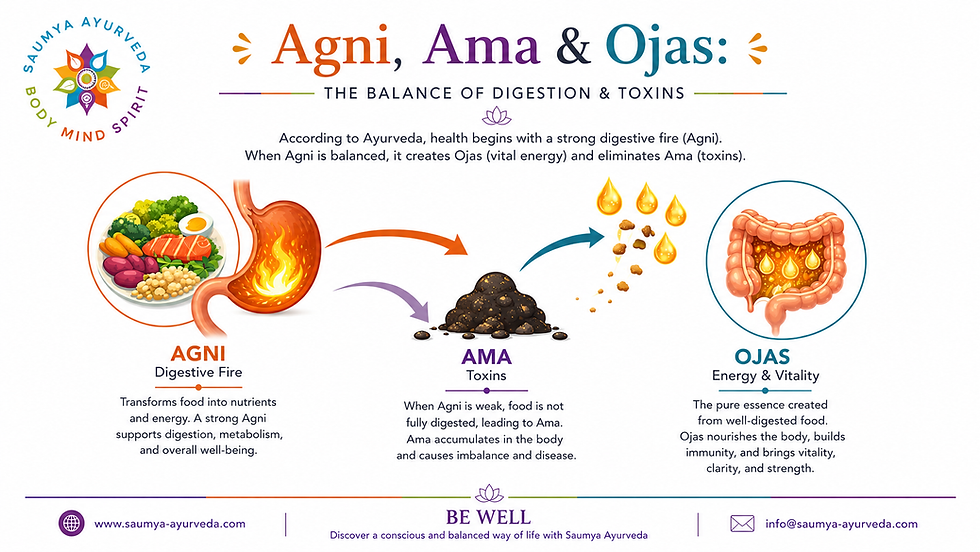
Agni is the body's digestive and metabolic fire. Strong Agni transforms food into nourishment, supports healthy tissue formation, and helps build Ojas. Weak Agni contributes to the formation of Ama.
Ama
Ama is the toxic byproduct of incomplete digestion and metabolism. According to Ayurveda, Ama can interfere with healthy tissue nourishment and gradually deplete vitality.
Ayurveda
Ayurveda is a traditional system of natural health that originated in India more than 5,000 years ago. It emphasizes personalized nutrition, lifestyle, herbs, and daily routines to restore balance and promote long-term well-being.
Dhatus
The Dhatus are the body's seven tissues that are nourished sequentially through healthy digestion. Ojas is considered the most refined essence produced after these tissues have been properly nourished.
Dinacharya
Dinacharya is Ayurveda's daily routine. Consistent habits such as regular mealtimes, restorative sleep, meditation, and self-care help support digestion, resilience, and overall health.
Dosha
The three Doshas—Vata, Pitta, and Kapha—are the biological energies that govern physical and mental function. Every person has a unique combination of these energies that influences their constitution and health.
Kapha
Kapha is the Dosha composed primarily of earth and water elements. It provides stability, nourishment, lubrication, endurance, and resilience. Healthy Ojas shares many of Kapha's nourishing qualities.
Ojas
Ojas is the body's deepest reserve of vitality, resilience, immunity, and well-being. It develops through healthy digestion, nourishing food, restorative sleep, balanced living, and healthy relationships.
Prakriti
Prakriti is your unique Ayurvedic constitution established at birth. It reflects your natural balance of the three Doshas and serves as the foundation for personalized Ayurvedic recommendations.
Prana
Prana is the vital life force that animates the body and mind. Healthy breathing, balanced living, and meditation help support the flow of Prana and contribute to overall vitality.
Pranayama
Pranayama refers to yogic breathing techniques that regulate Prana, calm the nervous system, reduce stress, and support overall health and resilience.
Rasayana
Rasayana is Ayurveda's branch of rejuvenation. It includes nourishing foods, herbs, and lifestyle practices that promote vitality, healthy aging, and the cultivation of Ojas.
Tejas
Tejas is the subtle essence of healthy metabolism, perception, and transformation. Together, Tejas, Prana, and Ojas work to support balanced physical, mental, and emotional health.
Vata
Vata is the Dosha composed of air and ether elements. It governs movement, the nervous system, breathing, circulation, and communication throughout the body. When out of balance, excess Vata can contribute to Ojas depletion.
Vikriti
Vikriti refers to your current state of imbalance. Unlike Prakriti, Vikriti changes over time and is influenced by diet, stress, sleep, lifestyle, environment, age, and other factors.

Continue Your Ayurveda Knowledge Journey
Ojas is just one part of Ayurveda's timeless approach to vibrant health. Continue exploring the interconnected principles of digestion, daily rhythms, nourishment, and lifestyle that build resilience, strengthen vitality, and support lasting balance—one small step at a time.
1. Learn the Foundations of Ayurveda
Understanding Ojas: Ayurveda's Guide to Lasting Vitality, Energy & Resilience
The Seven Dhatus Explained: How Ayurveda Builds Strength, Immunity & Vitality
What Is Prakriti vs. Vikriti? Understanding Your Ayurvedic Constitution and Current Imbalance
The Five Elements in Ayurveda: Understanding Yourself Through Nature
The Three Malas: Ayurveda’s Guide to Healthy Elimination, Digestion & Balance
2. Build a Strong Foundation
3. Better Understand Your Unique Constitution
4. Support Your Vitality Naturally
5. Explore Common Health Challenges Through an Ayurvedic Lens
7 Ayurvedic Remedies for Maintaining Healthy Blood Pressure Naturally
Gut-Brain Connection in Ayurveda: Reduce Anxiety Through Digestion
Leaky Gut Syndrome in Ayurveda: Causes, Symptoms, Diet, and Natural Healing
Histamine Intolerance: Symptoms, Causes, Diet, and Ayurvedic Treatment for Natural Relief
MCAS Natural Treatment: Ayurvedic Diet, Herbs, and Root Causes

Our Commitment to Accessible Ayurveda Education
At Saumya Ayurveda, we believe Ayurveda's transformative ancient wisdom belongs to everyone—not just those who can afford it. That's why we're committed to making high-quality, authentic Ayurveda education available globally, free of charge.
Through our free eBooks, guides, and educational resources, we offer practical, grounded wisdom to help those seeking greater balance, vitality, and wellbeing integrate Ayurveda into their daily lives.
Accessible. Authentic. Free. Just as it was meant to be.
Free Ayurveda eBooks – Download practical guides, recipes, and wellness resources to support your health journey.
Ayurveda Blog – Enjoy easy-to-read articles, seasonal wellness tips, healthy recipes, and everyday inspiration—always educational, never a sales pitch.
Free Guided Traditional Progressive Meditations – Practice authentic, step-by-step guided meditations to cultivate calm, focus, and inner stillness.
Monthly Educational Newsletter – Receive seasonal Ayurveda insights, new articles, healthy recipes, and free resources delivered to your inbox each month.

Final Thoughts
Nature is constantly changing, and so are we.
The seasons remind us that health is not a fixed destination but an ongoing relationship with the world around us. As our environment changes, our bodies and minds are continually called to adapt.
Ayurveda teaches us to honor these natural rhythms rather than resist them. By paying attention to the body's changing needs and responding with nourishment, rest, and thoughtful self-care, we create the conditions for greater balance, resilience, and well-being.
This is one of the most important ways to protect and nourish Ojas—the body's vital essence of vitality, resilience, immunity, and longevity. When Ojas is well supported, we are better able to recover from challenges, adapt to change, and move through life's seasons with greater steadiness and ease.
No season lasts forever. Periods of growth, rest, challenge, and renewal are all part of life's natural rhythm. Rather than resisting these cycles, Ayurveda encourages us to work with them. In doing so, we cultivate not only lasting vitality, but also a deeper trust in the body's innate wisdom.
By nourishing Ojas throughout the year, we build a strong foundation for resilience, balanced immunity, and vibrant health in every season of life.
If you're experiencing persistent fatigue, recurring digestive concerns, poor recovery, or difficulty adapting to seasonal change, a personalized Ayurvedic consultation can help identify underlying imbalances and create a plan tailored to your unique constitution.

What Our Clients Say | Saumya Ayurveda Testimonials
Real Transformations Through Ayurveda Consultation
Physician Testimonial (Medical Endorsement)
“As a physician, I have always believed that prevention is better than cure. In today’s healthcare environment, Ayurveda offers a logical and natural approach to long-term health and prevention.
I began working with Veena during a very demanding phase of my life, and she made the process accessible even within my busy schedule. I was encouraged to follow a steady, sustainable approach focused on real lifestyle change.
Over time, I experienced meaningful improvements in balance, energy, and well-being. In my medical practice, I now see many patients with similar stress- and diet-related imbalances, which has further reinforced my trust in Ayurvedic principles.
I have since referred several patients to Saumya Ayurveda and consider Veena a valuable resource in supporting holistic well-being.”
Dr. Gauri Nagargoje
M.D., Oncology & Hematology
Physician Testimonial (Medical Endorsement)
“As a physician, I initially struggled with Ayurveda’s simplicity and depth, but Veena’s guidance made it practical, scientific, and deeply effective.
Veena has transformed my health and perspective on healing. I experienced significant improvements in focus, digestion, stress response, and overall vitality.
Her personalized approach made lifestyle changes easy and sustainable.
This journey not only improved my health but also inspired a lifelong commitment to integrating Ayurveda into holistic healthcare.”
Dr. Jessica Bedi
D.O., & Ayurvedic Doctor


Anne R., Minneapolis, Minnesota, USA
Explore more client success stories from Saumya Ayurveda and see how Ayurveda supports healing, balance, and transformation.

Discover the Saumya Ayurveda Way
Ayurveda begins with seeing the whole person.
At Saumya Ayurveda, symptoms are not viewed in isolation. Ayurveda looks at the relationship between digestion, elimination, sleep, stress, energy, daily rhythms, mind, stage of life, season, climate, constitution, and current dosha imbalances to understand the patterns that influence how you feel.
When health concerns persist, it can be frustrating to feel that individual symptoms are being addressed without understanding the bigger picture. Ayurveda offers another way—one that asks not only “What is the symptom?” but also “What are the body and mind communicating?”
Personalized Ayurveda, Rooted in Tradition
Saumya Ayurveda combines classical Ayurvedic principles with practical guidance for modern life. Your Ayurveda plan is based on your individual prakriti (natural constitution), virkriti (current imbalances of the doshas), lifestyle, and circumstances—not a generic dosha checklist or one-size-fits-all protocol.
The goal is not to overwhelm you with rules. It is to help you understand your own body and mind, and make sustainable changes that fit naturally into your life, informed by the wisdom of Ayurveda.
For those who want ongoing support, concierge-style Ayurveda consultation packages provide personalized guidance, thoughtful follow-up, and practical tools to help turn Ayurvedic principles into everyday habits.
Education First. Personalized Guidance When You Need It.
Veena takes an education-first, client-centered approach. At Saumya Ayurveda, our favorite product is knowledge. You won’t find education built around selling a supplement, herb, or wellness product. Instead, you’ll find traditional Ayurvedic perspectives, practical guidance, and timeless principles that help you better understand your body, mind, and unique constitution.
When understanding deepens, better choices naturally follow.
For those who want ongoing support, Saumya Ayurveda consultation packages provide personalized guidance, thoughtful follow-up, and practical tools to help turn Ayurvedic principles into everyday habits.
Learn. Observe. Understand. Transform.
Begin your Ayurveda journey with a free 15-minute Discovery Call with Veena and explore whether personalized Ayurvedic guidance is right for you.

Meet Veena: Your Trusted Ayurvedic Guide for Clients Worldwide
Veena Blilie is a Certified Ayurvedic Practitioner, Ayurveda teacher, meditation guide, and monk with over three decades of experience helping clients worldwide achieve greater balance and well-being through Ayurveda.
As founder of Saumya Ayurveda and President Emeritus of the Meditation Center, Veena serves clients worldwide through personalized Ayurvedic wellness guidance, meditation, and yoga practices.
Saumya Ayurveda has been recognized as the #1 Ayurveda cooking blog and the #3 Ayurveda website and blog and has received multiple consecutive awards for best wellness practice.
Through her work, Veena shares practical Ayurvedic guidance, nourishing recipes, and wellness education for modern living.
Inspired from an early age by learning herbal remedies, food as medicine, and traditional healing practices at her grandmother’s knee, Veena combines traditional Ayurvedic wisdom with compassionate, accessible guidance that supports mental, physical, and spiritual well-being.
Known for her warmth, humor, intuitive approach, and accessible style, Veena empowers people to create sustainable health through personalized Ayurvedic wellness plans designed to fit naturally into everyday life.
Veena is also the author of several free Ayurveda eBooks and writes the educational articles published on the Saumya Ayurveda blog.
As seen in:
Voice America
Albuquerque The Magazine
Learn more about Veena and her work through Saumya Ayurveda.
Disclaimer: This information is for educational purposes only and is not a substitute for professional medical advice. Ayurveda works best when tailored to your unique doshic profile, so it’s essential to understand your constitution and imbalances before using herbs, foods, or lifestyle practices. Consult a Certified Ayurvedic Practitioner for personalized guidance.