The Five Elements in Ayurveda: Understanding Yourself Through Nature

Updated: Sep 3
One of Ayurveda's most profound teachings is that we are not apart from nature—we are a part of nature.
Everything in the natural world is composed of Earth, Water, Fire, Air, and Space. Known in Sanskrit as the Panchamahabhutas, these same five elements form the foundation of your body, mind, and spirit.
This understanding changes the way we see ourselves. Instead of viewing health as something to fix or control, Ayurveda invites us to observe. The changing seasons, the food we eat, our energy, emotions, digestion, and daily rhythms all reflect the continual interplay of the Five Elements.
As we learn to recognize them within ourselves, we begin to understand our unique nature and the profound yet simple daily choices that help restore balance.
In this guide, you'll discover how the Five Elements shape you, influence your everyday life, and remain one of Ayurveda's most enduring teachings for living in harmony with yourself and the natural world.

The Five Elements in Ayurveda—Earth, Water, Fire, Air, and Space (Panchamahabhutas)—are the fundamental building blocks of nature and the human body. Ayurveda teaches that these elements shape your constitution, influence your physical and mental health, and guide the daily choices that help restore balance and well-being.
Key Takeaways
The five elements—Earth, Water, Fire, Air, and Space (Panchamahabhutas)—are the foundation of Ayurveda and exist throughout nature and within every person.
The unique balance of these five elements shapes your constitution (Prakriti), influences your body and mind, and affects how you experience everyday life.
The five elements combine to form the three doshas, nourish the seven dhatus, support healthy digestion (Agni), and ultimately contribute to the development of Ojas.
Learning to recognize the qualities of the five elements within yourself is one of Ayurveda's most powerful practices for cultivating self-awareness and making choices that support balance.
Through mindful observation, nourishing food, healthy routines, and living in harmony with nature, you can support your body's natural ability to maintain health and well-being.
Table of Contents
"We are not taking a walk in nature—we are nature. Ayurveda teaches us to see ourselves not as separate from nature, but as a part of it." -Veena Blilie

What Are the Five Elements (Panchamahabhutas)?
The Five Elements, known in Sanskrit as the Panchamahabhutas (pan-cha ma-ha-bhoo-tas), are one of the foundational principles of Ayurveda. They are the building blocks of everything in nature—including your body, mind, and spirit.
The Five Elements are:
Earth (Prithvi) — stability, structure, and grounding
Water (Jala) — nourishment, cohesion, and fluidity
Fire (Agni) — transformation, metabolism, and intelligence
Air (Vayu) — movement, communication, and change
Space (Akasha) — openness, possibility, and connection
Ayurveda teaches that we are not separate from nature—we arise from nature. The same elements that give mountains their strength, rivers their flow, the sun its warmth, the wind its movement, and the sky its vastness also exist within you. They influence how you digest your food, build healthy tissues, think, move, rest, and respond to the world around you.
Every person embodies all five elements. What makes each of us unique is the proportion in which they are expressed. This unique combination shapes your constitution (Prakriti) and influences your physical, mental, and emotional tendencies.
The five elements are not abstract philosophical ideas—they can be observed in everyday life. They combine to form the three doshas, nourish the seven dhatus, influence the strength of Agni (digestive fire), and ultimately contribute to the development of Ojas, Ayurveda's deepest expression of vitality and resilience.
As you begin to observe these elemental qualities within yourself, you'll discover a deeper understanding of your unique nature and the simple choices that help create balance.

Seeing Nature Within Yourself
The Five Elements are not abstract philosophical ideas—they are living qualities you can observe within yourself every day. Ayurveda invites you to recognize how Earth, Water, Fire, Air, and Space express themselves through your body, mind, and everyday experiences.
Rather than searching for the Five Elements somewhere outside yourself, begin by noticing where they already exist. They influence your strength, nourishment, digestion, movement, creativity, emotions, and the countless rhythms that shape daily life.
You can begin observing the Five Elements in simple ways:
Earth gives strength and stability to your bones and muscles.
Water nourishes your tissues and supports flow throughout the body.
Fire transforms food into nourishment and ideas into action.
Air moves your breath, thoughts, words, and every movement you make.
Space (Akasha) creates room for stillness, deep listening, creativity, and possibility.
Perhaps one of Ayurveda's greatest gifts is learning to observe these qualities with curiosity rather than judgment. As you begin to recognize the Five Elements within yourself, your body becomes a teacher. Everyday experiences become opportunities to better understand your unique nature and make choices that cultivate greater balance and well-being.

Earth: The Element of Stability
Earth (Prithvi) is the element of stability, structure, and endurance. It provides the solid foundation that supports all of life. Just as mountains, forests, and fertile soil offer strength and steadiness to the natural world, the Earth element gives your body and mind resilience, stability, and the ability to grow.
Within the body, Earth provides structure. It supports healthy bones, muscles, teeth, and connective tissues, along with the physical strength needed to move through life. Emotionally, Earth helps us feel grounded, patient, dependable, and secure.
One of Ayurveda's greatest teachings is that the qualities we see in nature also exist within us. When the Earth element is balanced, we often feel steady, resilient, and able to meet life's challenges with patience and confidence.
When Earth becomes excessive, we may feel heavy, sluggish, resistant to change, or overly attached to familiar routines. When Earth is depleted, we may feel ungrounded, physically weak, scattered, or as though life lacks a solid foundation.
Rather than judging these experiences as good or bad, Ayurveda invites us to observe them with curiosity. Every feeling of stability—or instability—is an opportunity to better understand what your body and mind may be asking for.
🌿 Observable AyurvedaPause for a moment and notice:
|
Sometimes, the simple act of noticing is the first step toward restoring balance.

Water: The Element of Nourishment
Water (Jala) is the element of nourishment, flow, and connection. Just as rivers nourish the land and rain sustains all living things, Water nourishes every cell of your body and supports the flow of life within you.
Within the body, Water provides hydration, lubrication, and nourishment.
It carries nutrients to your tissues, supports healthy circulation, cushions your joints, and helps maintain the softness and vitality that allow your body to function with ease. Emotionally, Water is reflected in compassion, adaptability, and connection with ourselves and others.
When the Water element is in balance, we often feel nourished, calm, flexible, and emotionally supported. Like a gently flowing stream, Water teaches us to adapt without losing our direction.
When Water becomes excessive, we may feel heavy, stagnant, or emotionally attached. When it is depleted, we may notice dryness, depletion, or a sense that something within us needs nourishment.
Ayurveda reminds us that these experiences are not flaws to fix but invitations to observe.
By paying attention to the ways Water is expressed within us, we begin to better understand what our body and mind need to return to balance.
🌿 Observable AyurvedaPause for a moment and notice:
|
As you begin to observe the qualities of Water within yourself, you may discover that even small, nourishing choices can create gentle but meaningful change over time.

Fire: The Element of Transformation
Fire (Agni) is the element of transformation. Just as the sun transforms darkness into light and a seed into a flourishing plant, Fire gives us the ability to transform food into nourishment, experiences into wisdom, and ideas into action.
Within the body, Fire is best known for supporting digestion and metabolism, helping us break down food and absorb the nutrients needed to sustain life. Beyond digestion, Fire also fuels energy, perception, understanding, courage, and the capacity for meaningful change.
When the Fire element is balanced, we often feel energized, focused, motivated, and able to meet life's challenges with clarity and purpose.
When Fire becomes excessive, we may feel overheated, impatient, irritable, or driven beyond our limits. When it is depleted, we may experience sluggish digestion, low energy, lack of motivation, or difficulty embracing change.
Ayurveda reminds us that transformation happens every day. Every meal we digest, every lesson we learn, and every challenge we overcome reflects the quiet work of Fire within us. By observing how this element is expressed, we gain insight into what supports our health and where greater balance may be needed.
🌿 Observable AyurvedaTake a moment to reflect:
|
As you begin to observe the qualities of Fire within yourself, you may discover that lasting transformation doesn't come from pushing harder, but from tending the steady flame that already exists within you.

Air: The Element of Movement
Air (Vayu) is the element of movement. Just as the wind carries seeds across a field and clouds across the sky, Air creates movement throughout your body and mind. Every breath, every heartbeat, every thought, and every step reflects the presence of this dynamic element.
Within the body, Air governs movement. It supports breathing, circulation, communication within the nervous system, the movement of food through the digestive tract, and the ability to think, speak, and respond to the world around us. Air also inspires creativity, curiosity, enthusiasm, and our capacity to embrace change.
When the Air element is balanced, we often feel energized, creative, adaptable, and mentally clear. Like a gentle breeze, it allows life to flow with ease while keeping us open to new experiences.
When Air becomes excessive, we may feel restless, scattered, anxious, or overwhelmed. When it is depleted, we may feel uninspired, mentally sluggish, or resistant to movement and change.
Ayurveda reminds us that movement is essential to life, but so is balance. By observing how Air is expressed within us, we begin to recognize when we need more movement—and when we need more stillness.
🌿 Observable AyurvedaTake a moment to reflect:
|
As you begin to observe the qualities of Air within yourself, you may discover that every mindful breath is an opportunity to return to balance.

Space: The Element of Possibility
Space (Akasha) is the element of openness. Just as the sky provides room for the sun, moon, clouds, and stars, Space provides the room needed for life to exist. Without Space, nothing can move, communicate, grow, or transform.
Within the body, Space is found wherever there is openness. It exists within the mouth, lungs, digestive tract, blood vessels, joints, and the countless channels that allow nourishment, movement, and communication throughout the body.
Space also exists within the mind. It is present in moments of quiet reflection, deep listening, meditation, creativity, and stillness. It reminds us that not every moment needs to be filled.
When the Space element is balanced, we often feel calm, present, and open. We have room to listen, learn, reflect, and simply be.
When Space becomes excessive, we may feel scattered, disconnected, or ungrounded. When there is too little Space, life can feel crowded, rushed, or overwhelming.
Ayurveda teaches that health is not only created by what we add to our lives, but also by the space we create within them. A few quiet moments, a mindful breath, restful sleep, or time spent in silence can restore a sense of balance that constant activity cannot.
🌿Observable AyurvedaTake a moment to reflect:
|
Sometimes the greatest healing doesn't come from doing more. It begins by creating enough space to listen to the wisdom that has been within you all along.
The Five Elements are not simply concepts to understand—they are living forces expressed through your body, mind, emotions, and daily experiences. As they shift in response to the seasons, food, stress, sleep, and stage of life, they continually influence how you feel. Understanding how these elements work together is the foundation for understanding your unique Ayurvedic constitution.

How the Five Elements Shape Your Constitution
One of Ayurveda's most important teachings is that every person contains all Five Elements. No one is made of only Earth, Water, Fire, Air, or Space. Instead, each of us expresses these elements in a unique proportion, creating our individual constitution, known in Ayurveda as Prakriti.
Your constitution influences many aspects of who you are, including your physical characteristics, digestion, energy, emotions, sleep, and natural tendencies. It also helps explain why one person thrives on a particular routine, food, or climate while another feels better with something entirely different.
The Five Elements combine to form the three doshas—Vata, Pitta, and Kapha. These doshas are not separate from the elements; they are expressions of them.
Vata is primarily composed of Air and Space, supporting movement, communication, and creativity.
Pitta is primarily composed of Fire and Water, supporting digestion, transformation, and metabolism.
Kapha is primarily composed of Earth and Water, providing structure, nourishment, and stability.
Although one or two doshas usually predominate, all three doshas—and all Five Elements—are always present. Together, they create the remarkable uniqueness of every individual.
Perhaps one of Ayurveda's greatest gifts is the reminder that there is no "perfect" constitution. Every combination of the Five Elements has its own strengths, challenges, and gifts. The goal is not to become someone else, but to better understand your own nature.
From that understanding comes the ability to make choices that help maintain balance throughout the changing seasons of life. That awareness is the foundation of living in balance according to Ayurveda.

The Five Elements in Everyday Life
Understanding the Five Elements becomes most meaningful when you begin to observe them in everyday life. They are reflected in your body, your thoughts, the food you eat, the changing seasons, and the world around you.
Earth is present in the routines that help you feel steady and grounded.
Water is reflected in nourishment, hydration, and the relationships that foster connection.
Fire is at work whenever transformation takes place—from digesting a meal to learning something new.
Air is present in every breath, movement, conversation, and new idea.
Space is found in moments of quiet, deep listening, creativity, and rest.
The Five Elements are continually changing. A warm summer day expresses different qualities than a cold winter morning. A busy week feels different from a restful weekend. Your body, mind, and needs also change throughout the seasons of the year and the seasons of your life.
Ayurveda invites us to notice these changes with curiosity rather than judgment. Instead of asking, "How do I get back to normal?" we begin asking, "What qualities are present today, and what is my body showing me?" These simple observations deepen our understanding of ourselves and help guide the choices that restore balance.
The more you practice self-observation, the more naturally you'll recognize the patterns that support your health and well-being. Over time, these everyday observations become a trusted guide, helping you make choices that cultivate greater balance, resilience, and vitality.

Observing the Five Elements Around You
One of Ayurveda's greatest teachings is that observation comes before change.
Before recommending herbs, changing your diet, or establishing a new routine, Ayurveda invites you to simply notice. The more carefully you observe the world around you, the more clearly you begin to understand yourself.
Spend a few moments watching nature. Notice the steadiness of a mountain, the flow of a river, the warmth of the sun, the breeze across your skin, or the openness of the sky. Each reflects one of the Five Elements. Then gently turn that same awareness inward.
Some days you may notice more Fire. Other days may feel the lightness of Air or the stability of Earth. Nothing remains exactly the same because nature is always changing—and so are we.
The practice of self-observation isn't about judging yourself or trying to become someone different. It is about recognizing the qualities that are present in this moment. From that awareness, wiser choices naturally follow.
Over time, these simple observations become a trusted guide, helping you make choices that cultivate greater balance, resilience, and well-being.

Supporting Balance Through Daily Choices
Ayurveda reminds us that balance is created through the small choices we make every day. As we begin to recognize the qualities of the Five Elements within ourselves, we naturally become more aware of what helps restore balance and what may be contributing to imbalance.
Sometimes balance comes from choosing a warm, nourishing meal instead of rushing through lunch. Other times it means stepping outside for fresh air, getting to bed a little earlier, spending time in nature, or taking a few slow, mindful breaths before responding to a stressful situation. These simple choices become powerful when they are made with awareness.
Just as nature is always changing, so are we. The choices that bring balance in one season, stage of life, or even one day may be different from those needed in another. Ayurveda encourages us to observe these changes with curiosity rather than judgment, trusting that our needs naturally evolve over time.
There is no perfect routine and no one-size-fits-all approach to health. Instead, Ayurveda invites us to return, again and again, to the wisdom of self-observation. By noticing the qualities present within us and responding with intention, we become better able to make choices that support lasting balance.
Perhaps one of Ayurveda's greatest gifts is the reminder that lasting balance isn't found by striving to become someone else. It begins by understanding your own nature. From that understanding comes the wisdom to make choices that nourish your body, calm your mind, and help you live with greater balance, resilience, and well-being.

Frequently Asked Questions
What are the Five Elements in Ayurveda?
The Five Elements—Earth, Water, Fire, Air, and Space—are the building blocks of everything in nature, including the human body and mind. Ayurveda teaches that every person contains all five elements in unique proportions. Together, they influence your constitution, health, and the way you experience the world.
What is Panchamahabhutas?
Panchamahabhutas is the Sanskrit term for the Five Great Elements: Earth (Prithvi), Water (Jala), Fire (Agni), Air (Vayu), and Space (Akasha). Ayurveda teaches that these five elements form the foundation of all living things and combine in different ways to create each person's unique constitution.
How do the Five Elements relate to the doshas?
The Five Elements combine to form the three doshas. Vata is primarily made of Air and Space, Pitta is primarily Fire and Water, and Kapha is primarily Earth and Water. Although one or two doshas may predominate, all three doshas—and all five elements—are present in everyone.
Can the Five Elements become out of balance?
The Five Elements themselves do not become imbalanced. Instead, the way they are expressed within the body and mind can shift in response to factors such as diet, daily routine, stress, the seasons, age, and lifestyle. Ayurveda focuses on recognizing these changing qualities and making choices that help restore balance.
How can I recognize the Five Elements in everyday life?
The Five Elements are expressed in both nature and your daily experience. You might notice the steadiness of Earth, the flow of Water, the warmth of Fire, the movement of Air, or the openness of Space. Ayurveda encourages you to observe these qualities both around you and within yourself as a way of better understanding your own nature.
Why is self-observation important in Ayurveda?
Ayurveda teaches that observation comes before change. By noticing the qualities present in your body, mind, and environment, you develop a deeper understanding of your unique constitution and your changing needs. This awareness helps guide daily choices that support balance.
Can I have all Five Elements in my body?
Yes. Everyone contains all Five Elements. What makes each person unique is the proportion in which those elements are expressed. These unique combinations create your constitution and contribute to your physical characteristics, natural tendencies, and overall health.
How do I begin living in balance with the Five Elements?
Begin by observing. Notice how the qualities of the Five Elements appear in your body, mind, daily routine, and the natural world. As your awareness grows, you'll naturally begin making choices that help maintain balance. Ayurveda reminds us that lasting well-being is built through small, consistent choices rather than perfection.

Glossary of Ayurvedic Terms
Akasha – The Sanskrit word for Space, one of the Five Elements. It represents openness and the space that allows movement, communication, and growth.
Ayurveda – A traditional system of health and healing that originated in India more than 5,000 years ago. Ayurveda means "the science of life" and emphasizes living in balance with nature.
Doshas – The three mind-body energies—Vata, Pitta, and Kapha—formed from combinations of the Five Elements. Together, they influence your physical, mental, and emotional characteristics.
Jala – The Sanskrit word for Water, one of the Five Elements. It represents nourishment, hydration, and connection.
Kapha – The dosha composed primarily of Earth and Water. Kapha provides structure, stability, and nourishment.
Panchamahabhutas – The Sanskrit term for the Five Great Elements: Earth (Prithvi), Water (Jala), Fire (Agni), Air (Vayu), and Space (Akasha).
Pitta – The dosha composed primarily of Fire and Water. Pitta governs transformation, digestion, metabolism, and discernment.
Prakriti – Your unique Ayurvedic constitution—the natural combination of the doshas and Five Elements present at birth.
Prithvi – The Sanskrit word for Earth, one of the Five Elements. It represents stability, structure, and grounding.
Vata – The dosha composed primarily of Air and Space. Vata governs movement, communication, breathing, and the nervous system.
Vayu – The Sanskrit word for Air, one of the Five Elements. It represents movement, creativity, and change.

Continue Your Ayurveda Knowledge Journey
Now that you've explored the Five Elements, continue your Ayurveda journey with these resources to deepen your understanding of your constitution, strengthen your digestion, and support lasting health through every season and stage of life.
1. Learn the Foundations of Ayurveda
2. Build a Strong Foundation
3. Better Understand Your Unique Constitution
4. Support Your Vitality Naturally
How to Do Abhyanga Massage at Home: Benefits, Oils, and Step-by-Step Guide
Why Seasonal Transitions Matter for Ojas: An Ayurveda Guide to Immunity and Resilience (Coming Septemner 2026)
5. Explore Common Health Challenges Through an Ayurvedic Lens
7 Ayurvedic Remedies for Maintaining Healthy Blood Pressure Naturally
Gut-Brain Connection in Ayurveda: Reduce Anxiety Through Digestion
Leaky Gut Syndrome in Ayurveda: Causes, Symptoms, Diet, and Natural Healing
Histamine Intolerance: Symptoms, Causes, Diet, and Ayurvedic Treatment for Natural Relief
MCAS Natural Treatment: Ayurvedic Diet, Herbs, and Root Causes
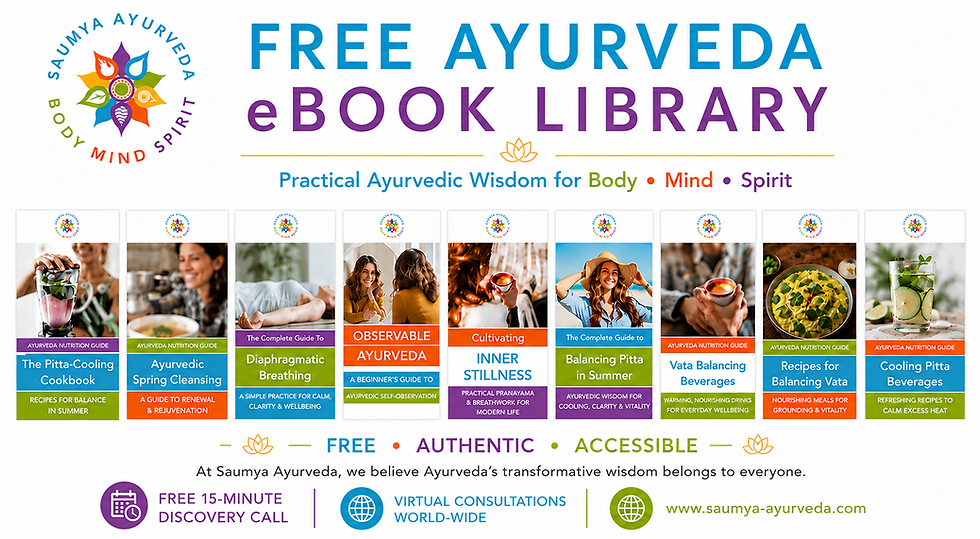
Our Commitment to Accessible Ayurveda Education
At Saumya Ayurveda, we believe Ayurveda's transformative ancient wisdom belongs to everyone—not just those who can afford it. That's why we're committed to making high-quality, authentic Ayurveda education available globally, free of charge.
Through our free eBooks, guides, and educational resources, we offer practical, grounded wisdom to help those seeking greater balance, vitality, and wellbeing integrate Ayurveda into their daily lives.
Accessible. Authentic. Free. Just as it was meant to be.
Free Ayurveda eBooks – Download practical guides, recipes, and wellness resources to support your health journey.
Ayurveda Blog – Enjoy easy-to-read articles, seasonal wellness tips, healthy recipes, and everyday inspiration—always educational, never a sales pitch.
Free Guided Traditional Progressive Meditations – Practice authentic, step-by-step guided meditations to cultivate calm, focus, and inner stillness.
Monthly Educational Newsletter – Receive seasonal Ayurveda insights, new articles, healthy recipes, and free resources delivered to your inbox each month.

Final Thoughts
The Five Elements offer more than a way to understand Ayurveda—they offer a way to understand yourself.
As you begin to recognize Earth, Water, Fire, Air, and Space within your body, mind, and daily experiences, you'll discover that every moment becomes an opportunity for self-observation. The more you notice these qualities, the more clearly you understand your unique nature and the choices that help cultivate balance.
Ayurveda reminds us that self-understanding is a lifelong journey, not a destination. There is no perfect constitution, perfect routine, or perfect way to live. Instead, Ayurveda invites us to approach ourselves with curiosity, compassion, and awareness, trusting that our needs naturally change throughout the seasons of life.
This is the heart of Ayurveda. The word Ayurveda means "the knowledge of life." To understand life more deeply, we begin by understanding ourselves.
Perhaps that is Ayurveda's greatest gift. Through the simple practice of observing yourself through the lens of nature, you gain the wisdom to make choices that support greater balance, resilience, and well-being.

What Our Clients Say | Saumya Ayurveda Testimonials
Real Transformations Through Ayurveda Consultation
Physician Testimonial (Medical Endorsement)
“As a physician, I have always believed that prevention is better than cure. In today’s healthcare environment, Ayurveda offers a logical and natural approach to long-term health and prevention.
I began working with Veena during a very demanding phase of my life, and she made the process accessible even within my busy schedule. I was encouraged to follow a steady, sustainable approach focused on real lifestyle change.
Over time, I experienced meaningful improvements in balance, energy, and well-being. In my medical practice, I now see many patients with similar stress- and diet-related imbalances, which has further reinforced my trust in Ayurvedic principles.
I have since referred several patients to Saumya Ayurveda and consider Veena a valuable resource in supporting holistic well-being.”
Dr. Gauri Nagargoje
M.D., Oncology & Hematology
Physician Testimonial (Medical Endorsement)
“As a physician, I initially struggled with Ayurveda’s simplicity and depth, but Veena’s guidance made it practical, scientific, and deeply effective.
Veena has transformed my health and perspective on healing. I experienced significant improvements in focus, digestion, stress response, and overall vitality.
Her personalized approach made lifestyle changes easy and sustainable.
This journey not only improved my health but also inspired a lifelong commitment to integrating Ayurveda into holistic healthcare.”
Dr. Jessica Bedi
D.O., & Ayurvedic Doctor


Anne R., Minneapolis, Minnesota, USA
Explore more client success stories from Saumya Ayurveda and see how Ayurveda supports healing, balance, and transformation.

Discover the Saumya Ayurveda Way
Ayurveda begins with seeing the whole person.
At Saumya Ayurveda, symptoms are not viewed in isolation. Ayurveda looks at the relationship between digestion, elimination, sleep, stress, energy, daily rhythms, mind, stage of life, season, climate, constitution, and current dosha imbalances to understand the patterns that influence how you feel.
When health concerns persist, it can be frustrating to feel that individual symptoms are being addressed without understanding the bigger picture. Ayurveda offers another way—one that asks not only “What is the symptom?” but also “What are the body and mind communicating?”
Personalized Ayurveda, Rooted in Tradition
Saumya Ayurveda combines classical Ayurvedic principles with practical guidance for modern life. Your Ayurveda plan is based on your individual prakriti (natural constitution), virkriti (current imbalances of the doshas), lifestyle, and circumstances—not a generic dosha checklist or one-size-fits-all protocol.
The goal is not to overwhelm you with rules. It is to help you understand your own body and mind, and make sustainable changes that fit naturally into your life, informed by the wisdom of Ayurveda.
For those who want ongoing support, concierge-style Ayurveda consultation packages provide personalized guidance, thoughtful follow-up, and practical tools to help turn Ayurvedic principles into everyday habits.
Education First. Personalized Guidance When You Need It.
Veena takes an education-first, client-centered approach. At Saumya Ayurveda, our favorite product is knowledge. You won’t find education built around selling a supplement, herb, or wellness product. Instead, you’ll find traditional Ayurvedic perspectives, practical guidance, and timeless principles that help you better understand your body, mind, and unique constitution.
When understanding deepens, better choices naturally follow.
For those who want ongoing support, Saumya Ayurveda consultation packages provide personalized guidance, thoughtful follow-up, and practical tools to help turn Ayurvedic principles into everyday habits.
Learn. Observe. Understand. Transform.
Begin your Ayurveda journey with a free 15-minute Discovery Call with Veena and explore whether personalized Ayurvedic guidance is right for you.

MEET VEENA: YOUR TRUSTED AYURVEDIC GUIDE FOR CLIENTS WORLDWIDE
Veena Blilie is a Certified Ayurvedic Practitioner, Ayurveda teacher, meditation guide, and monk with more than three decades of experience helping people cultivate greater balance, vitality, and well-being through Ayurveda.
As the founder of Saumya Ayurveda and President Emeritus of the Meditation Center, Veena provides personalized Ayurvedic consultations, meditation instruction, and yoga guidance for clients around the world.
Saumya Ayurveda has been recognized as the #1 Ayurveda cooking blog and the #3 Ayurveda website and blog, and has received multiple consecutive
awards for Best Wellness Practice. Through her work, Veena shares practical Ayurvedic guidance, nourishing recipes, and educational resources that make this ancient wisdom accessible for modern living.
Inspired from an early age by her grandmother, who taught her about herbal remedies, food as medicine, and traditional healing practices, Veena combines classical Ayurvedic wisdom with compassionate, accessible guidance that supports physical, mental, and spiritual well-being.
Known for her warmth, humor, and approachable teaching style, Veena empowers people to better understand their unique nature and build sustainable habits that support lasting health and vitality.
Veena is also the author of several free Ayurveda eBooks and writes the educational articles published on the Saumya Ayurveda blog.
As seen in:
Voice America
Albuquerque The Magazine
Learn more about Veena and her work through Saumya Ayurveda.
Disclaimer: This information is for educational purposes only and is not a substitute for professional medical advice. Ayurveda works best when tailored to your unique doshic profile, so it’s essential to understand your constitution and imbalances before using herbs, foods, or lifestyle practices. Consult a Certified Ayurvedic Practitioner for personalized guidance.