What Is Prakriti vs. Vikriti? Understanding Your Ayurvedic Constitution and Current Imbalance

Updated: Sep 3
Someone may naturally have a Pitta constitution but develop symptoms of Vata imbalance after years of chronic stress. Another person may have a Kapha constitution yet experience excess digestive heat and acid reflux from aggravated Pitta. These situations often confuse people who are new to Ayurveda, especially if they have taken an online dosha quiz.
The key is understanding two foundational Ayurvedic concepts: Prakriti and Vikriti. Prakriti describes your unique constitution—the qualities you were born with. Vikriti describes your current state of balance or imbalance, which changes throughout life.
Learning the difference between these two concepts helps explain why two people with the same constitution can feel completely different and why successful Ayurvedic care is always individualized.

Prakriti is your unique Ayurvedic constitution, established at conception and relatively unchanged throughout life. Vikriti is your current state of balance or imbalance, influenced by factors such as diet, stress, sleep, seasons, and lifestyle. Understanding both helps Ayurveda provide personalized recommendations that support lasting health.
Table of Contents
Key Takeaways
Prakriti is your unique constitution established at conception.
Vikriti is your current state of balance or imbalance.
Your symptoms often reflect Vikriti—not Prakriti.
Stress, diet, sleep, seasons, aging, illness, and daily habits all influence Vikriti.
Understanding both allows Ayurveda to provide truly individualized care.
Online quizzes may offer a helpful introductio,n but everyone has all three doshas, which continually respond to your daily life.

What Is Prakriti?
In Ayurveda, Prakriti refers to your inherent constitution. It represents the unique balance of Vata, Pitta, and Kapha established at conception and remains your natural blueprint throughout life.
The classical Ayurvedic texts, including the Charaka Samhita and Sushruta Samhita, explain that each person is born with a unique constitution that shapes their physical, mental, and emotional tendencies and serves as the foundation for individualized care.
Your Prakriti influences many of your enduring characteristics, including your body frame, metabolism, emotional tendencies, sleep patterns, and natural strengths. It is not something that needs to be changed or corrected.
Instead, it provides the foundation for understanding how your body and mind function best.
Ayurveda recognizes that every constitution has its own unique strengths and challenges. There is no "best" dosha or ideal body type.
Health is not about becoming more like someone else—it is about understanding your unique nature and learning how to support it through food, lifestyle, and daily habits.
When your Prakriti is honored and your doshas remain in balance, your body is naturally able to function with greater ease, resilience, and vitality.
Every person has all three doshas—Vata, Pitta, and Kapha—but in a unique combination that is entirely their own. This unique balance influences your physical characteristics, digestion, energy, emotions, and natural tendencies throughout life.

What Is Vikriti?
While Prakriti remains relatively constant throughout life, Vikriti reflects your current state of balance or imbalance. It describes how your doshas have shifted away from their natural constitution in response to the experiences and demands of daily life.
The classical Ayurvedic texts, including the Charaka Samhita, emphasize understanding a person's present state of balance before recommending diet, lifestyle, herbs, or other therapies. This personalized approach is one of the qualities that makes Ayurveda unique.
Your Vikriti changes continually in response to factors such as:
Chronic stress
Diet
Sleep habits
Work schedule
Seasonal changes
Environmental shifts
Travel
Aging
Illness
Relationships
Emotional experiences
Because Vikriti is always changing, your symptoms may change as well. You may feel balanced and energized during one season of life, then notice digestive discomfort, restless sleep, low energy, or increased irritability during another.
These shifts are a natural part of life. Insteaad of treating everyone the same, Ayurveda considers your current state of balance and offers personalized recommendations to help restore harmony.
Classical References
Charaka Samhita, Vimana Sthana 8
Charaka Samhita, Sutra Sthana 20
Sushruta Samhita, Sutra Sthana 15
Learn how to recognize the everyday signs your body is communicating with this free beginner's guide to Ayurvedic self-observation. Download your copy here.

Prakriti vs. Vikriti: What's the Difference?
One of the most important concepts in Ayurveda is understanding the difference between Prakriti and Vikriti. Although the words sound similar, they describe two very different aspects of your health.
Think of Prakriti as your body's original blueprint. It is the unique balance of Vata, Pitta, and Kapha you were born with and remains relatively constant throughout your life.
Vikriti, on the other hand, reflects your current state of balance or imbalance. It changes over time in response to your diet, sleep, stress, relationships, work, the seasons, aging, illness, and many other aspects of daily life.
A simple way to remember the difference is:
Prakriti is who you are.
Vikriti is what is happening right now.
Imagine two people who both have a naturally Vata-dominant constitution. One may be well rested, eating nourishing meals, and following a consistent daily routine. The other may be experiencing chronic stress, irregular meals, frequent travel, and poor sleep. Although their Prakriti is the same, their Vikriti may be very different.
This is why Ayurveda does not make recommendations based on your constitution alone. It also considers what is happening in your life today. Understanding both your Prakriti and your Vikriti allows Ayurveda to offer personalized guidance that supports your body's return to balance rather than relying on a one-size-fits-all approach.
Learn how to recognize the observable signs of Vata, Pitta, and Kapha imbalance so you can better understand what your body is communicating today.
Continue learning with Understanding the Three Doshas: A Comprehensive Guide to Imbalances, where you'll discover the observable signs of Vata, Pitta, and Kapha imbalance and learn what your body may be communicating.

Why Your Symptoms May Not Match Your Constitution
This is one of the most common points of confusion for people learning Ayurveda—and one of the reasons an individualized approach is so important.
Many people assume that if they have a Vata, Pitta, or Kapha constitution, they should only experience the characteristics associated with that dosha. In reality, your current symptoms often reflect your Vikriti, not your Prakriti.
For example:
A naturally calm Kapha constitution may experience anxiety, insomnia, dry skin, and constipation—classic signs of a Vata imbalance.
A person with a primarily Vata constitution may develop heartburn, irritability, excessive hunger, and loose stools when Pitta becomes aggravated.
A Pitta constitution may experience sluggish digestion, weight gain, congestion, and fatigue if Kapha accumulates over time.
These shifts are a natural part of life. Stress, diet, sleep, work, seasonal changes, aging, illness, and many other factors can temporarily disturb your natural balance. Your constitution does not change, but your current state does.
This is why Ayurveda looks beyond symptoms alone. Instead of asking, "What is your dosha?" Ayurveda also asks, "What is happening in your body and your life right now?" Understanding both your Prakriti and your Vikriti allows for recommendations that are personalized, practical, and responsive to your current needs instead of relying on generalized advice.

How Life Changes Your Vikriti
Life is constantly influencing the doshas. Your current state of balance is shaped not only by what you eat, but also by how you live, work, rest, and move through the different seasons of life.
There are many reasons your Vikriti may change. Long work hours may increase Vata. Hot weather can aggravate Pitta. A sedentary lifestyle may contribute to excess Kapha. Poor digestion can weaken Agni and contribute to the formation of Ama.
Life itself also plays an important role. Many of life's ordinary experiences can influence your body's natural balance, including:
Emotional stress
Processed foods
Frequent travel
Caring for young children or aging parents
Pregnancy, postpartum, perimenopause, and menopause
Illness or injury
Grief and loss
Major life transitions, such as beginning a new career, retirement, divorce, or moving to a new home
Even joyful experiences require the body and mind to adapt. Welcoming a new baby, getting married, starting a new job, or moving into a new home are all positive life events, yet they still influence the doshas as the body adjusts to change.
These changes rarely happen overnight. More often, they develop gradually through the accumulation of daily habits, responsibilities, and life experiences until symptoms begin to appear.
Sometimes this process begins much earlier than we realize. A pattern of imbalance may start in childhood, continue through adolescence, and gradually evolve over years or even decades. If left unaddressed, an imbalance doesn't simply disappear because we enter a new stage of life. Instead, it may continue to influence our health as the body's needs change with age.
Ayurveda describes three broad stages of life, each naturally influenced by a different dosha:
Childhood (Kapha stage): A time of growth, development, and building the body's tissues.
Adulthood (Pitta stage): A period of transformation, productivity, responsibility, and ambition.
Later life (Vata stage): A stage when movement, change, wisdom, and the natural aging process become more prominent.
An imbalance that begins during one stage of life can influence the next. For example, years of digestive weakness, chronic stress, irregular meals, poor sleep, unresolved grief, or a demanding lifestyle may gradually accumulate before symptoms become noticeable.
By the time someone reaches perimenopause, retirement, or later adulthood, it may feel as though their symptoms appeared suddenly. In reality, the body has often been adapting to years of accumulated imbalance.
Fortunately, the body also has an incredible capacity to heal. The same daily choices that contribute to imbalance can also help restore balance. Nourishing meals, restorative sleep, regular routines, mindful movement, stress management, and appropriate Ayurvedic care help guide the body back toward its natural state of balance.
Ayurveda reminds us that lasting health is not built through perfection. It is cultivated through the simple choices we make each day, repeated consistently over time. Those small daily choices become daily deposits that build Ojas, strengthening your body's capacity for balance, resilience, and lifelong well-being.

Why an Online Dosha Quiz Can Only Tell Part of the Story
For many people, an online dosha quiz is their first introduction to Ayurveda. It can be a fun and helpful way to begin learning about the doshas and discover some of your natural tendencies.
At the same time, it's important to recognize that a quiz can only tell part of the story.
Most online quizzes ask questions about how you feel today. Are you sleeping well? Is your digestion strong? Do you feel anxious, irritable, or sluggish? Those questions provide valuable information, but they often reflect your current state of balance (Vikriti) more than your lifelong constitution (Prakriti).
Imagine taking the same quiz during a peaceful vacation, after several months of chronic stress, while recovering from an illness, or during perimenopause. Your answers—and your results—could be very different each time. That doesn't necessarily mean your constitution has changed. More often, it means your Vikriti has changed .
No questionnaire—whether online or in a book—can fully determine your constitution. Understanding Prakriti takes time, thoughtful conversation, careful observation, and an appreciation of the patterns that have shaped your health throughout your life.
This is one of the qualities that makes Ayurveda so unique. Ayurveda recognizes that every person is dynamic and continually responding to the changing seasons.
You have all three doshas—Vata, Pitta, and Kapha—and each one is continually responding to your diet, digestion, sleep, stress, relationships, climate, the seasons, your stage of life, and countless other influences.
It is also very common to have more than one dosha out of balance at the same time. For example, someone may experience a Vata imbalance affecting sleep and anxiety while also having a Pitta imbalance contributing to heartburn and irritability.
Another person may have weakened Agni, accumulated Ama, increased Kapha, and elevated Vata simultaneously. Ayurveda looks at the whole picture rather than trying to fit every person into a single dosha label.
Understanding your health isn't about asking, "Which dosha am I?" It is about understanding which doshas need support right now, why, and how. That is where Ayurveda becomes truly individualized.
🌿 Saumya Self-ObservationInstead of asking, "What is my dosha?" try asking: "What is my body communicating today?" Take a moment to notice your current patterns.
Remember: These observations reflect your Vikriti (current state), not necessarily your Prakriti (natural constitution). |
How Saumya Ayurveda Evaluates Imbalance
Rather than relying on a single quiz, Saumya Ayurveda takes a comprehensive and individualized approach to understanding your health. Every recommendation begins by looking at the whole person—not just a score on a questionnaire.
Your current state of balance is viewed through many different lenses, including your:
Lifelong health history
Digestive patterns and Agni
Appetite and food preferences
Energy throughout the day
Sleep quality
Stress and resilience (Ojas)
Emotional well-being
Sweat
Seasonal patterns (Ritucharya)
Daily routines (Dinacharya)
The observable signs of Vata, Pitta, and Kapha imbalance
Each piece offers another clue. Together, they create a much more complete understanding of your health than any questionnaire could provide.

Supporting Balance While Honoring Your Constitution
One of the greatest gifts of Ayurveda is that it teaches us to work with our bodies rather than against them.
The goal is not to become "more Vata," "less Pitta," or "more Kapha." Nor is it to change who you are. Your Prakriti is your unique constitution, and it is something to understand, appreciate, and support—not something to fix.
Instead, Ayurveda gently addresses the imbalances that have developed over time. As your Vikriti becomes more balanced, your body's natural intelligence is better able to do what it was designed to do.
This is why Ayurveda focuses on simple, sustainable practices that nourish your whole being. Food, digestion, sleep, daily routines, movement, stress management, meaningful relationships, time in nature, and appropriate herbs all work together to support lasting health.
As balance is restored, many people notice improvements in digestion, sleep, energy, mood, mental clarity, resilience, and overall well-being. These changes often develop gradually, reflecting the body's remarkable ability to heal when given the right conditions and consistent support.
Healing is not about becoming someone different. It is about removing the obstacles that prevent your body from functioning as it was designed to function. Ayurveda reminds us that your body is always seeking balance. Our role is to create the conditions that allow that balance to emerge.
Instead of striving for perfection, Ayurveda invites us to become curious observers of our own lives. The more we understand our unique constitution and recognize the changing patterns of imbalance, the more confidently we can make daily choices that support long-term health, vitality, and well-being.

Frequently Asked Questions
Can my Prakriti change?
No. Ayurveda teaches that your Prakriti is established at conception and remains your natural constitution throughout life.
Can my Vikriti change?
Yes. Your Vikriti changes continually in response to diet, lifestyle, stress, seasons, aging, illness, and other life experiences.
Why doesn't my dosha quiz match my symptoms?
Many online quizzes capture your current state of balance rather than your lifelong constitution. Significant stress, illness, or seasonal influences can affect your answers.
Can someone have more than one dosha imbalance?
Yes. It is common for two or even all three doshas to be involved in an individual's current Vikriti. This is one reason personalized assessment is so valuable.
Why does Saumya Ayurveda look beyond dosha quizzes?
Because Ayurveda recognizes that understanding a person's health requires more than a questionnaire. A comprehensive assessment considers lifelong patterns, current symptoms, digestion, lifestyle, and many observable signs to develop individualized recommendations.

Ayurveda Glossary
Agni
In Ayurveda, Agni refers to the body's digestive and metabolic "fire." Strong Agni helps you digest food efficiently, absorb nutrients, eliminate waste, and maintain energy, vitality, and overall health.
Ama
Ama is the Ayurvedic term for undigested food, toxins, or metabolic waste that accumulates when digestion is weak. Over time, Ama can interfere with the body's natural functions and contribute to imbalance and disease.
Doshas
The doshas are the three primary energies that govern all physical, mental, and physiological processes in the body. Every person has a unique combination of Vata, Pitta, and Kapha, which together shape their constitution and influence their current state of balance.
Kapha
Kapha is the dosha composed of the earth and water elements. It provides stability, strength, lubrication, endurance, and emotional steadiness. When out of balance, Kapha may contribute to sluggish digestion, congestion, weight gain, fatigue, and attachment.
Pitta
Pitta is the dosha composed primarily of the fire element with a small amount of water. It governs digestion, metabolism, body temperature, focus, and transformation. When aggravated, Pitta may contribute to heartburn, inflammation, irritability, loose stools, or excessive heat.
Prakriti
Prakriti is your unique Ayurvedic constitution, established at conception. It represents your natural balance of Vata, Pitta, and Kapha and remains relatively constant throughout life. Understanding your Prakriti provides the foundation for personalized Ayurvedic care.
Vata
Vata is the dosha composed of the air and space elements. It governs movement throughout the body, including breathing, circulation, communication, and the nervous system. When out of balance, Vata may contribute to anxiety, dry skin, constipation, insomnia, and feeling scattered or overwhelmed.
Vikriti
Vikriti refers to your current state of balance or imbalance. Unlike Prakriti, Vikriti changes throughout life in response to factors such as diet, stress, sleep, climate, aging, illness, and daily habits. Ayurveda evaluates both Prakriti and Vikriti to create personalized recommendations.

Continue Your Ayurveda Knowledge Journey
Now that you've explored Prakriti and Vikriti, continue your Ayurveda journey with these resources to deepen your understanding of your unique constitution, strengthen your digestion, build vitality, and support lasting balance through every season and stage of life.
1. Learn the Foundations of Ayurveda
2. Build a Strong Foundation
3. Better Understand Your Unique Constitution
4. Support Your Vitality Naturally
How to Do Abhyanga Massage at Home: Benefits, Oils, and Step-by-Step Guide
Why Seasonal Transitions Matter for Ojas: An Ayurveda Guide to Immunity and Resilience (Coming Septemner 2026)
5. Explore Common Health Challenges Through an Ayurvedic Lens
7 Ayurvedic Remedies for Maintaining Healthy Blood Pressure Naturally
Gut-Brain Connection in Ayurveda: Reduce Anxiety Through Digestion
Leaky Gut Syndrome in Ayurveda: Causes, Symptoms, Diet, and Natural Healing
Histamine Intolerance: Symptoms, Causes, Diet, and Ayurvedic Treatment for Natural Relief
MCAS Natural Treatment: Ayurvedic Diet, Herbs, and Root Causes
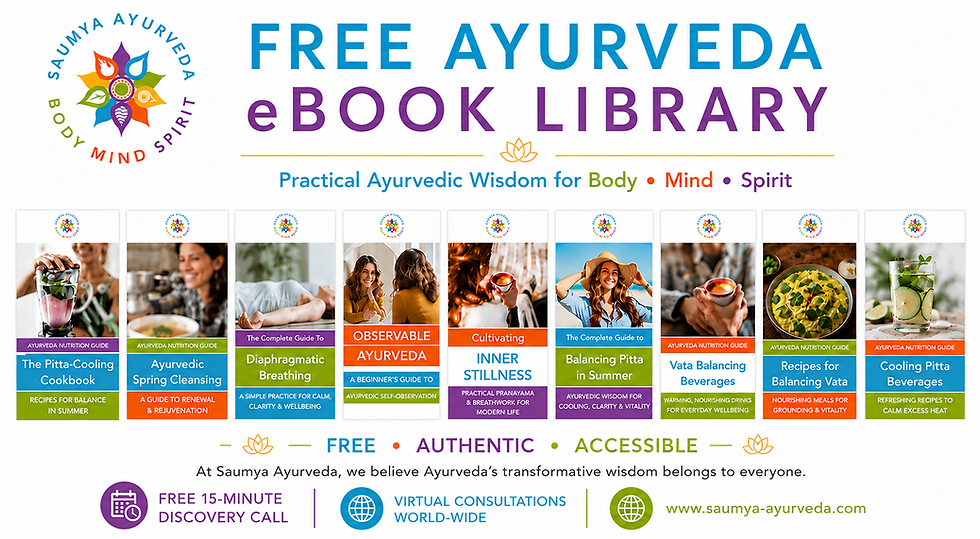
Our Commitment to Accessible Ayurveda Education
At Saumya Ayurveda, we believe Ayurveda's transformative ancient wisdom belongs to everyone—not just those who can afford it. That's why we're committed to making high-quality, authentic Ayurveda education available globally, free of charge.
Through our free eBooks, guides, and educational resources, we offer practical, grounded wisdom to help those seeking greater balance, vitality, and wellbeing integrate Ayurveda into their daily lives.
Accessible. Authentic. Free. Just as it was meant to be.
Free Ayurveda eBooks – Download practical guides, recipes, and wellness resources to support your health journey.
Ayurveda Blog – Enjoy easy-to-read articles, seasonal wellness tips, healthy recipes, and everyday inspiration—always educational, never a sales pitch.
Free Guided Traditional Progressive Meditations – Practice authentic, step-by-step guided meditations to cultivate calm, focus, and inner stillness.
Monthly Educational Newsletter – Receive seasonal Ayurveda insights, new articles, healthy recipes, and free resources delivered to your inbox each month.

Final Thoughts
One of the greatest gifts of Ayurveda is its recognition that no two people are exactly alike. Your Prakriti provides the foundation for your health, while your Vikriti reveals what your body needs today. Understanding both allows you to make choices that are aligned with your unique constitution rather than following advice designed for someone else.
As you become more aware of your body's patterns, you begin to see that health is not a fixed destination but an ongoing relationship with yourself. Every meal, every night's sleep, every season, and every stage of life offers another opportunity to observe, learn, and respond with greater wisdom and compassion.
Ayurveda is not about striving for perfection or becoming someone different. It is about honoring who you are, recognizing when balance has shifted, and gently supporting your body's natural ability to restore harmony. Over time, these small, consistent choices can have a profound impact on your digestion, energy, resilience, and overall well-being.
Your constitution is uniquely yours. By understanding your Prakriti, recognizing your Vikriti, and making thoughtful daily choices, you can cultivate lasting balance and build a strong foundation for lifelong health.

What Our Clients Say | Saumya Ayurveda Testimonials
Real Transformations Through Ayurveda Consultation
Physician Testimonial (Medical Endorsement)
“As a physician, I have always believed that prevention is better than cure. In today’s healthcare environment, Ayurveda offers a logical and natural approach to long-term health and prevention.
I began working with Veena during a very demanding phase of my life, and she made the process accessible even within my busy schedule. I was encouraged to follow a steady, sustainable approach focused on real lifestyle change.
Over time, I experienced meaningful improvements in balance, energy, and well-being. In my medical practice, I now see many patients with similar stress- and diet-related imbalances, which has further reinforced my trust in Ayurvedic principles.
I have since referred several patients to Saumya Ayurveda and consider Veena a valuable resource in supporting holistic well-being.”
Dr. Gauri Nagargoje
M.D., Oncology & Hematology
Physician Testimonial (Medical Endorsement)
“As a physician, I initially struggled with Ayurveda’s simplicity and depth, but Veena’s guidance made it practical, scientific, and deeply effective.
Veena has transformed my health and perspective on healing. I experienced significant improvements in focus, digestion, stress response, and overall vitality.
Her personalized approach made lifestyle changes easy and sustainable.
This journey not only improved my health but also inspired a lifelong commitment to integrating Ayurveda into holistic healthcare.”
Dr. Jessica Bedi
D.O., & Ayurvedic Doctor


Anne R., Minneapolis, Minnesota USA
Explore more client success stories from Saumya Ayurveda and see how Ayurveda supports healing, balance, and transformation.

Discover the Saumya Ayurveda Way
Ayurveda begins with seeing the whole person.
At Saumya Ayurveda, symptoms are not viewed in isolation. Ayurveda looks at the relationship between digestion, elimination, sleep, stress, energy, daily rhythms, mind, stage of life, season, climate, constitution, and current dosha imbalances to understand the patterns that influence how you feel.
When health concerns persist, it can be frustrating to feel that individual symptoms are being addressed without understanding the bigger picture. Ayurveda offers another way—one that asks not only “What is the symptom?” but also “What are the body and mind communicating?”
Personalized Ayurveda, Rooted in Tradition
Saumya Ayurveda combines classical Ayurvedic principles with practical guidance for modern life. Your Ayurveda plan is based on your individual prakriti (natural constitution), virkriti (current imbalances of the doshas), lifestyle, and circumstances—not a generic dosha checklist or one-size-fits-all protocol.
The goal is not to overwhelm you with rules. It is to help you understand your own body and mind, and make sustainable changes that fit naturally into your life, informed by the wisdom of Ayurveda.
For those who want ongoing support, concierge-style Ayurveda consultation packages provide personalized guidance, thoughtful follow-up, and practical tools to help turn Ayurvedic principles into everyday habits.
Education First. Personalized Guidance When You Need It.
Veena takes an education-first, client-centered approach. At Saumya Ayurveda, our favorite product is knowledge. You won’t find education built around selling a supplement, herb, or wellness product. Instead, you’ll find traditional Ayurvedic perspectives, practical guidance, and timeless principles that help you better understand your body, mind, and unique constitution.
When understanding deepens, better choices naturally follow.
For those who want ongoing support, Saumya Ayurveda consultation packages provide personalized guidance, thoughtful follow-up, and practical tools to help turn Ayurvedic principles into everyday habits.
Learn. Observe. Understand. Transform.
Begin your Ayurveda journey with a free 15-minute Discovery Call with Veena and explore whether personalized Ayurvedic guidance is right for you.

Meet Veena: Your Trusted Ayurvedic Guide for Clients Worldwide
Veena Blilie is a Certified Ayurvedic Practitioner, Ayurveda teacher, meditation guide, and monk with over three decades of experience helping clients worldwide achieve greater balance and well-being through Ayurveda.
As founder of Saumya Ayurveda and President Emeritus of the Meditation Center, Veena serves clients worldwide through personalized Ayurvedic wellness guidance, meditation, and yoga practices.
Saumya Ayurveda has been recognized as the #1 Ayurveda cooking blog and the #3 Ayurveda website and blog and has received multiple consecutive awards for best wellness practice.
Through her work, Veena shares practical Ayurvedic guidance, nourishing recipes, and wellness education for modern living.
Inspired from an early age by learning herbal remedies, food as medicine, and traditional healing practices at her grandmother’s knee, Veena combines traditional Ayurvedic wisdom with compassionate, accessible guidance that supports mental, physical, and spiritual well-being.
Known for her warmth, humor, intuitive approach, and accessible style, Veena empowers people to create sustainable health through personalized Ayurvedic wellness plans designed to fit naturally into everyday life.
Veena is also the author of several free Ayurveda eBooks and writes the educational articles published on the Saumya Ayurveda blog.
As seen in:
Voice America
Albuquerque The Magazine
Learn more about Veena and her work through Saumya Ayurveda.
Disclaimer: This information is for educational purposes only and is not a substitute for professional medical advice. Ayurveda works best when tailored to your unique doshic profile, so it’s essential to understand your constitution and imbalances before using herbs, foods, or lifestyle practices. Consult a Certified Ayurvedic Practitioner for personalized guidance.