


Ayurveda Daily Routine (Dinacharya): Step-by-Step Guide to Energy & Balance

Updated: Sep 3
In today’s world of irregular schedules, constant notifications, and overstimulation, it’s easy to feel out of sync—low energy, unsettled digestion, and restless sleep can become the norm. Ayurveda offers a powerful alternative: not quick fixes, but a daily rhythm that aligns your body, mind, and energy with natural cycles.
Dinacharya, the Ayurvedic daily routine, is simple yet transformative. By practicing intentional morning, midday, and evening habits, you can strengthen digestion, stabilize energy, reduce stress, and support overall balance. In this step-by-step guide, you’ll learn how to practice Dinacharya for modern life in a way that feels sustainable, gentle, and effective.

An Ayurveda daily routine (Dinacharya) is a series of daily habits that align your body with nature's rhythms to support digestion, energy, sleep, mental clarity, and overall well-being. By following simple morning, midday, and evening practices, Dinacharya helps create lasting balance through consistency rather than perfection.
Key Takeaways
Dinacharya is Ayurveda's daily routine that aligns your habits with nature's rhythms to support energy, digestion, sleep, and overall well-being.
A consistent daily routine is one of Ayurveda's most powerful tools for preventing imbalance and promoting long-term health.
Your routine doesn't need to be perfect—small, sustainable habits practiced consistently create lasting results.
A balanced Ayurvedic day includes intentional morning, midday, and evening practices that support your body's natural circadian rhythms.
Healthy digestion (Agni) is central to Dinacharya, making meal timing, mindful eating, and daily routines just as important as food choices.
Daily practices such as tongue scraping, warm water, movement, meditation, self-massage (Abhyanga), and adequate sleep work together to nourish body and mind.
Dinacharya is personalized—your ideal routine should reflect your unique constitution (Prakriti), current imbalances (Vikruti), age, season, and lifestyle.
Ayurveda teaches that consistency is more important than perfection. Even adopting one or two daily habits can lead to meaningful improvements in energy, resilience, and overall health over time.
Table of Contents

What Is Dinacharya in Ayurveda?
In Ayurveda, healing rarely comes from extremes or occasional resets. It unfolds through daily habits—how you wake, eat, move, and rest.
Dinacharya is the traditional Ayurvedic daily routine designed to align your body with nature’s rhythms, supporting digestion (agni), mental clarity, detoxification, and steady energy throughout the day.
It’s not a rigid checklist. Instead, Dinacharya is a gentle, structured flow of practices—from morning cleansing and mindful eating to intentional movement and evening rest—that allows your body to function with ease rather than resistance.
Benefits of practicing Dinacharya regularly include:
Strengthened digestion and metabolism
Balanced energy and mood throughout the day
Reduced mental fatigue and emotional reactivity
Consistency in sleep patterns
Tip: Start small and gradually layer practices—your body will adapt naturally without overwhelm.

Why Your Daily Rhythm Shapes Your Health
It’s easy to believe that health is determined by big decisions—what diet you follow, which supplements you take, or how often you detox.
Ayurveda offers a quieter, more powerful truth: Your health is shaped by what you do every single day.
In Ayurveda, this daily rhythm is central to maintaining balance. When your routine is irregular, the body is forced to constantly adapt—meals come at different times, sleep shifts, and stimulation fluctuates. Over time, this creates subtle but persistent stress that disrupts digestion, hormones, and mental clarity.
A steady rhythm, on the other hand, signals safety to the nervous system. The body begins to anticipate, prepare, and respond more efficiently—supporting stronger digestion (agni), balanced energy, and a calmer mind.
You may notice:
Hunger arriving at regular times
Sleep becoming deeper and more restorative
Energy stabilizing throughout the day
This is not something you force. It is the body returning to its natural intelligence—something Ayurveda has recognized for thousands of years.
Understanding the Ayurvedic Clock
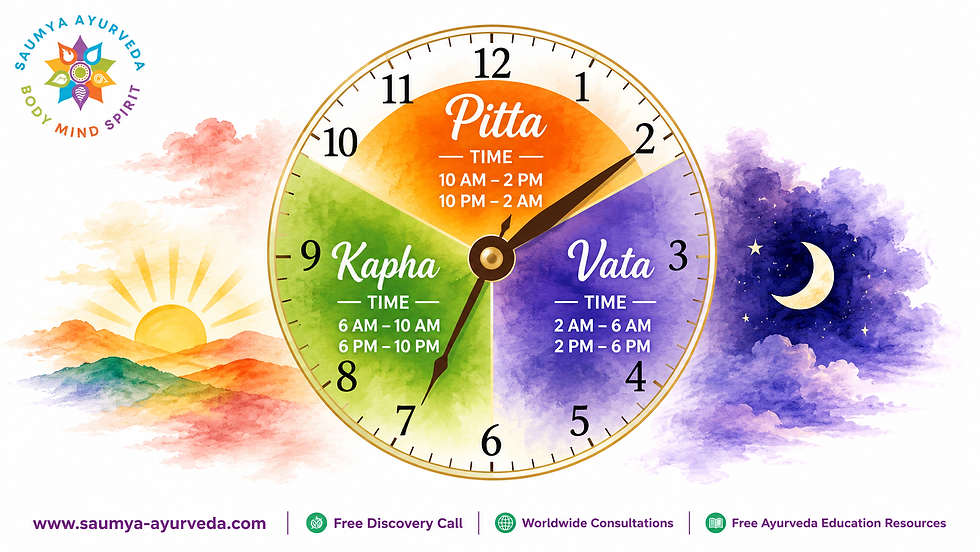
Ayurveda describes the day as a continuous flow of energetic qualities, guided by the natural rhythms of the three doshas—Vata, Pitta, and Kapha. Each period of the day carries a dominant influence, shaping how we feel, think, and function.
In the early morning (Vata time), there is a lightness in the air. Thoughts are clearer, the world is quieter, and the mind is more receptive. This is why waking earlier often feels easier than waking later—there is subtle support built into the timing itself.
By midday (Pitta time), intensity rises. Digestion strengthens, focus sharpens, and the body is naturally prepared for its main meal.
In the evening (Kapha time), heaviness returns, inviting rest, stillness, and eventual sleep.
When we move with these rhythms instead of against them, daily life begins to feel less effortful. There is less pushing, less forcing—more alignment. The body and mind begin to work with nature, rather than resist it.
Modern research highlights that Ayurvedic practices like Dinacharya and the Dosha Kala—which identify the times of day when Kapha, Pitta, #and Vata are most active—closely align with the body’s natural circadian rhythms, influencing hormone release, metabolism, and overall physiological balance. (Journal Neonatal Surgery)
The Charaka Samhita describes Kala (time) as a foundational factor in health, noting that daily cycles of day and night and the timing of routines (including meals) influence bodily states and dosha conditions—laying the groundwork for the Ayurvedic clock of Kapha, Pitta, and Vata phases throughout the day. (Caraka Samhita)
Learn how to balance your doshas for optimal health with our beginner-friendly guide to Ayurveda, exploring practical tips to harmonize Vata, Pitta, and Kapha for better energy, digestion, and overall well-being. How to Balance Your Doshas for Optimal Health: A Beginner’s Guide to Ayurveda

Morning Dinacharya: Creating a Grounded Start
How you begin your morning sets the tone for the entire day. A rushed, overstimulated start often carries tension forward, while a calm, intentional morning fosters steadiness and clarity.
Ideally, waking before 6 AM aligns you with the naturally lighter phase of the day. Even a slight shift earlier can improve mental clarity, mood, and energy.
The goal of a morning Ayurvedic routine is not to do more—but to do a few things with presence. A simple morning flow might include:
Drinking warm water to gently awaken digestion
Tongue scraping to remove overnight buildup
Gentle movement to energize the body without depleting it
One of the most nourishing additions is Abhyanga (self-oil massage). Applying warm oil before bathing soothes the nervous system, supports circulation, and creates a profound sense of grounding. Over time, this practice can become less of a “wellness step” and more of a quiet moment of reconnection.
After movement and cleansing, breakfast can be light and warm—supporting digestion rather than overwhelming it. These small, consistent steps form the foundation of a daily rhythm that strengthens both body and mind.
The National Institutes of Health explains that the body’s internal biological clocks—known as circadian rhythms—regulate essential physiological functions throughout the 24‑hour day, including sleep–wake cycles, hormone release, hunger, digestion, metabolism, and alertness. Keeping these rhythms in sync through consistent daily timing of sleep, activity, meals, and other routines supports overall health and well‑being. (NIH)
Charaka Samhita (classical Ayurvedic text). Dinacharya (daily regimen) outlines morning practices beginning at waking for preservation of health and balance of doshas, forming the foundation of Ayurvedic daily living. (Caraka Samhita)
Start your day with balance and energy by learning Ayurvedic lifestyle practices and how to build a mindful morning routine that aligns with your doshas: Ayurvedic Lifestyle Practices: How to Build an Ayurvedic Morning Routine.
Tip: Even shifting wake time 15–30 minutes earlier can improve mental clarity and mood.

Midday Rhythm: Supporting Digestion and Focus
Midday is often overlooked in discussions of routine, yet in Ayurveda, it is one of the most important anchors of your day. This period—dominated by Pitta energy—is when digestive fire (agni) is strongest.
Eating your main meal at this time allows the body to fully process and absorb nourishment. When lunch is rushed, skipped, or replaced with something cold and heavy, the effects often appear later as fatigue, bloating, or cravings.
A supportive Ayurvedic midday routine might include:
Eating a warm, freshly prepared meal to optimize digestion
Sitting mindfully and enjoying food without distractions
Pausing briefly afterward before returning to activity to allow assimilation
This doesn’t require a perfect schedule. Even small adjustments create more energy, focus, and steady digestion, helping the body and mind flow with ease throughout the afternoon.
NIH‑funded chrononutrition research shows that meal timing impacts metabolism and circadian rhythms, with eating earlier in the day (aligned with the body’s biological day) supporting metabolic health, suggesting benefits to having the largest meal before the evening. (NIH)
Classical Ayurvedic texts emphasize that digestive fire peaks around midday (Pitta period), so the largest meal is traditionally taken then for optimal digestion and assimilation. (Caraka Samhita)
Tip: Avoid skipping or rushing lunch; it prevents afternoon fatigue and supports sustained energy.

Evening Dinacharya: Transitioning Into Rest
Evening is often when daily routines begin to unravel. The day stretches longer than planned, screens stay bright, and meals become heavier or later. Gradually, the body misses its natural window for rest.
In Ayurveda, the evening is Kapha time, a period meant for winding down and restoring balance. The key is to slow down before exhaustion sets in, allowing the body and mind to prepare for restorative sleep.
Simple ways to support your evening Ayurvedic routine include:
Gently reducing stimulation: dim lights, step away from screens, and create a calm environment
Eating a lighter dinner earlier to support digestion and nightly repair
Engaging in calming practices like herbal tea, light stretching, short walks, journaling, or quiet reflection
Aligning sleep closer to 10 PM supports the body’s natural repair cycle. Even moving incrementally toward this time can improve the quality of rest, helping digestion, nervous system function, and energy the next day.
By following a gentle evening rhythm, the body transitions naturally into rest, completing the day in harmony with nature’s cycles.
NIH notes that as light decreases in the evening, the brain triggers melatonin production, promoting drowsiness and facilitating the transition into rest — the biological basis for an evening routine. (NIH)
Ayurveda classifies Nidra (sleep) as one of the three pillars (Trayopastambha) of life — along with food (ahara) and regulated conduct (brahmacharya). Proper sleep at the right time supports physical, mental, and emotional balance. (Research Gate)
Unwind and support restful sleep with 10 Ayurvedic evening rituals designed to calm your mind, balance your doshas, and prepare your body for a rejuvenating night: 10 Ayurvedic Evening Rituals for a Calming Night
Tip: Aligning your evening routine with Kapha time improves digestion, repair, and energy for the next day.

A Realistic Dinacharya for Modern Life
One of the biggest misconceptions about Ayurveda is that practicing Dinacharya requires a complete lifestyle overhaul. The truth is simpler: even small, consistent habits can create lasting balance, energy, and wellness.
A sustainable modern Dinacharya begins with just a few key anchors:
Consistent wake time: Rising at roughly the same hour each day helps regulate sleep, digestion, and energy.
Regular meals: Eating at predictable times supports digestion (agni), steadies blood sugar, and prevents afternoon slumps.
Evening wind-down: A simple nightly routine—dim lights, light stretching, or journaling—signals the nervous system to slow down, improving sleep quality.
From these anchors, you can gradually layer additional Ayurvedic practices, such as Abhyanga (self-oil massage), mindful movement, or herbal teas—without feeling overwhelmed.
The goal is not perfection. It is rhythm. Over time, even modest routines create a natural flow your body begins to trust, supporting mental clarity, emotional balance, and physical vitality.
Modern life may be busy, but Dinacharya doesn’t have to be complicated. By starting small, you can weave Ayurvedic wisdom into your day in a way that feels effortless, grounding, and nourishing.
Tip: Start small, stay consistent, and build rhythm gradually—consistency matters more than perfection.

The Deeper Benefits of Daily Rhythm
At first, the benefits of Dinacharya may feel primarily physical: stronger digestion, more consistent energy, and more restful sleep. These are tangible and noticeable, which is why many people begin their practice there.
But over time, something deeper begins to unfold.
When the body is supported through gentle, consistent routines, the mind naturally follows. Reactivity softens, emotional patterns begin to shift, and clarity grows. Daily rhythm becomes more than a checklist—it becomes a framework for harmony between body, mind, and spirit.
You may begin to notice:
A quieter, more focused mind, making it easier to make thoughtful decisions
Greater resilience to stress, responding with steadiness rather than tension
A sense of ease in daily life, where challenges feel manageable rather than overwhelming
In Ayurveda, this is where Dinacharya moves beyond habit and enters the realm of transformation. Your daily routine becomes a practice of alignment with natural rhythms, allowing your body to function efficiently, your mind to settle, and your spirit to feel nourished.
Over weeks and months, this gentle structure can create a profound sense of balance that touches every aspect of life.
Even a few consistent practices—like mindful mornings, attentive meals, or evening wind-downs—compound over time, producing benefits far beyond the physical. You begin to experience not just wellness, but a way of living that feels grounded, vibrant, and inherently supported.
Learn how diaphragmatic breathing can transform your health and well-being, reduce stress, and improve energy with our step-by-step guide: How to Breathe Diaphragmatically and Change Your Life.

Common Mistakes That Disrupt Balance
Even with the best intentions, certain habits can quietly throw off your daily rhythm and disrupt both body and mind. Understanding these common pitfalls—and how to adjust them—can make your Dinacharya far more effective.
Inconsistent sleep and wake times
Sleeping and waking at different hours prevents the nervous system from settling and the body from anticipating rest. Over time, this can lead to fatigue, digestive issues, and emotional instability.
Tip: Start by moving your bedtime and wake-up time gradually toward consistency, even by 15–20 minutes each week.
Irregular meals or eating on the go
Skipping meals, eating late, or consuming food while distracted can weaken digestion (agni) and create fluctuations in energy.
Tip: Aim to eat at roughly the same times each day and take a few mindful moments to chew and savor your food.
Overstimulation during sensitive periods
The early morning (Vata time) and evening (Kapha time) are naturally quieter phases of the day. Excessive screen time, bright lights, or noisy environments during these periods can create subtle stress, disturbing sleep, digestion, and mental clarity.
Tip: Reduce morning and evening distractions—dim lights, take quiet pauses, and create a calming environment.
Overcomplicating the routine
Trying to do too much at once can lead to overwhelm and inconsistency. Ayurveda works best when practices are simple, steady, and supportive.
Tip: Start with a few anchor habits and layer in additional practices gradually.
By becoming aware of these common disruptions, you allow your Dinacharya to work its true magic: supporting steady energy, balanced digestion, mental clarity, and emotional resilience. Remember, small, consistent adjustments often have the greatest long-term impact.
Scientific reviews show that when daily routines become misaligned with circadian rhythms — through erratic schedules or lifestyle habits — health outcomes across body and mind can suffer. (PMC)
Tip: Small adjustments yield the most sustainable benefits.

Frequently Asked Questions (FAQ) About Dinacharya
1. What is Dinacharya in Ayurveda? Dinacharya is the Ayurvedic daily routine designed to align your body, mind, and energy with natural rhythms. By incorporating practices for morning, midday, and evening, it supports digestion, metabolism, detoxification, mental clarity, and overall balance. Over time, Dinacharya helps the body function with ease, creating consistent energy and emotional stability.
2. How do I start an Ayurvedic daily routine?Start with a few foundational habits that fit your modern life:
Consistent wake time
Mindful meals at regular intervals
Calming evening wind-down
Once these anchors feel natural, gradually layer in other practices such as self-oil massage (Abhyanga), gentle movement, or herbal teas. The key is consistency, not perfection.
3. What time should I wake up according to Ayurveda? Ideally, before 6 AM, during the Vata-dominant phase of the day when the mind is naturally lighter and clearer. Waking early supports mental focus, balanced digestion, and alignment with natural rhythms. Even shifting your wake-up time slightly earlier can have noticeable effects.
4. Do I need to follow every step of Dinacharya? No. Ayurveda emphasizes simplicity and sustainability. Even a simplified daily routine practiced consistently can create meaningful changes in energy, digestion, mood, and sleep. Over time, you can expand your routine as it fits your lifestyle.
5. How long before I see results from Dinacharya? Some effects, like improved digestion, steadier energy, and better sleep, may appear within days. Deeper transformations—such as enhanced mental clarity, emotional balance, and long-term vitality—develop over weeks of consistent practice. The benefits compound gradually, reinforcing the body’s natural intelligence.

Our Commitment to Accessible Ayurveda Education
At Saumya Ayurveda, we believe Ayurveda's transformative ancient wisdom belongs to everyone—not just those who can afford it. That's why we're committed to making high-quality, authentic Ayurveda education available globally, free of charge.
Through our free eBooks, guides, and educational resources, we offer practical, grounded wisdom to help those seeking greater balance, vitality, and wellbeing integrate Ayurveda into their daily lives.
Accessible. Authentic. Free. Just as it was meant to be.
Free Ayurveda eBooks – Download practical guides, recipes, and wellness resources to support your health journey.
Ayurveda Blog – Enjoy easy-to-read articles, seasonal wellness tips, healthy recipes, and everyday inspiration—always educational, never a sales pitch.
Free Guided Traditional Progressive Meditations – Practice authentic, step-by-step guided meditations to cultivate calm, focus, and inner stillness.
Monthly Educational Newsletter – Receive seasonal Ayurveda insights, new articles, healthy recipes, and free resources delivered to your inbox each month.

Continue Your Ayurveda Knowledge Journey
If you enjoyed learning about Dinacharya, these resources will help you deepen your understanding of Ayurveda and discover simple, practical ways to create a balanced daily routine, strengthen digestion, cultivate lasting energy, and support your health naturally.
Build a Strong Foundation
Support Your Vitality Naturally
How to Do Abhyanga Massage at Home: Benefits, Oils, and Step-by-Step Guide
Why Seasonal Transitions Matter for Ojas: An Ayurveda Guide to Immunity and Resilience (Coming August 2026)
Better Understand Your Unique Constitution
Explore Common Health Challenges Through an Ayurvedic Lens

Glossary of Ayurvedic Terms
Abhyanga – A traditional Ayurvedic self-massage using warm oil to nourish the skin, support circulation, calm the nervous system, and promote overall well-being.
Agni – The body's digestive and metabolic "fire." Healthy Agni is essential for proper digestion, nutrient absorption, and sustained energy.
Dinacharya – The Ayurvedic daily routine that aligns your daily habits with nature's rhythms to support digestion, energy, sleep, and overall well-being.
Doshas – The three fundamental energies—Vata, Pitta, and Kapha—that govern physical, mental, and emotional functions. Each person has a unique balance of these doshas.
Kapha – The dosha associated with structure, stability, nourishment, and endurance. When balanced, Kapha promotes strength, calmness, and resilience.
Pitta – The dosha associated with digestion, metabolism, transformation, and body heat. When balanced, Pitta supports healthy digestion, focus, and discernment.
Vata – The dosha associated with movement, circulation, breathing, and the nervous system. When balanced, Vata supports creativity, flexibility, and vitality.

Frequently Asked Questions
What is Dinacharya in Ayurveda?
Dinacharya is the Ayurvedic daily routine that aligns your daily habits with your body's natural circadian rhythms. It includes practices such as waking early, oral care, movement, mindful eating, meditation, and restful sleep to support digestion, energy, mental clarity, and overall well-being.
Why is Dinacharya important?
Ayurveda teaches that consistent daily routines help maintain balance in the body and mind. Following Dinacharya supports healthy digestion (Agni), balanced doshas, restorative sleep, emotional resilience, and long-term wellness by working with—not against—your body's natural rhythms.
What are the main steps of an Ayurvedic daily routine?
While routines are personalized, a traditional Dinacharya often includes:
Waking before sunrise
Tongue scraping and oral care
Drinking warm water
Elimination
Self-massage (Abhyanga)
Gentle movement or yoga
Meditation and diaphragmatic breathing
Eating meals at regular times
Creating a calming evening routine
Going to bed at a consistent time
Do I need to follow every step of Dinacharya?
No. Ayurveda emphasizes consistency over perfection. Starting with one or two sustainable habits—such as eating meals at regular times or creating a calming bedtime routine—can provide meaningful benefits. As those habits become established, you can gradually add others.
How long does it take to notice benefits from Dinacharya?
Many people notice improvements in energy, digestion, sleep, or mental clarity within a few weeks of practicing a consistent routine. More significant changes often develop over months as healthy habits become part of everyday life.
Is Dinacharya different for each dosha?
Yes. While the basic framework remains the same, Ayurveda personalizes daily routines based on your unique constitution (Prakriti), current imbalances (Vikruti), age, season, climate, and lifestyle. An individualized routine provides the greatest benefit.
Can I practice Dinacharya if I have a busy schedule?
Absolutely. Dinacharya is flexible and can be adapted to modern life. Even simple practices like waking at a consistent time, eating mindfully, taking a short walk after meals, or practicing five minutes of meditation can support better health when done consistently.
Is there scientific evidence supporting daily routines?
Yes. Modern research shows that consistent daily habits, regular meal timing, adequate sleep, physical activity, mindfulness, and alignment with circadian rhythms can support metabolic health, digestion, mood, cognitive function, and overall well-being. These findings closely align with many principles of Ayurvedic Dinacharya.
What is the best way to begin an Ayurvedic daily routine?
Choose one small habit that feels realistic and practice it every day. Once it becomes part of your routine, gradually add another. Ayurveda teaches that lasting health is built through steady, consistent actions rather than dramatic changes made all at once.

Final Thoughts: Ayurveda Daily Routine
Dinacharya, the Ayurvedic daily routine, is not about perfection or adding more to your day. It is about creating a steady rhythm that helps your body function as it was designed to—supporting digestion, restoring energy, calming the mind, and bringing greater balance to everyday life.
The beauty of Dinacharya lies in its simplicity. You don't need to transform your entire lifestyle overnight. Begin with one nourishing habit—waking a little earlier, eating meals mindfully, taking a daily walk, or creating a calming evening routine. As one practice becomes natural, another can take its place.
Over time, these small daily choices become powerful investments in your health, supporting:
Increased energy and vitality
Sharper mental clarity and focus
Balanced digestion and metabolism
Greater emotional resilience and inner calm
Ayurveda teaches that lasting wellness is created through the habits we repeat every day. When your daily routine aligns with your body's natural rhythms, healthy choices begin to feel effortless rather than forced.
Dinacharya is more than a schedule—it is a way of living that helps you feel grounded, resilient, and connected to your own natural intelligence. By returning to this rhythm each day, you create a foundation for lifelong health, balance, and well-being.

What Our Clients Say | Saumya Ayurveda Testimonials
Real Transformations Through Ayurveda Consultation
Physician Testimonial (Medical Endorsement)
“As a physician, I have always believed that prevention is better than cure. In today’s healthcare environment, Ayurveda offers a logical and natural approach to long-term health and prevention.
I began working with Veena during a very demanding phase of my life, and she made the process accessible even within my busy schedule. I was encouraged to follow a steady, sustainable approach focused on real lifestyle change.
Over time, I experienced meaningful improvements in balance, energy, and well-being. In my medical practice, I now see many patients with similar stress- and diet-related imbalances, which has further reinforced my trust in Ayurvedic principles.
I have since referred several patients to Saumya Ayurveda and consider Veena a valuable resource in supporting holistic well-being.”
Dr. Gauri Nagargoje
M.D., Oncology & Hematology
Physician Testimonial (Medical Endorsement)
“As a physician, I initially struggled with Ayurveda’s simplicity and depth, but Veena’s guidance made it practical, scientific, and deeply effective.
Veena has transformed my health and perspective on healing. I experienced significant improvements in focus, digestion, stress response, and overall vitality.
Her personalized approach made lifestyle changes easy and sustainable.
This journey not only improved my health but also inspired a lifelong commitment to integrating Ayurveda into holistic healthcare.”
Dr. Jessica Bedi
D.O., & Ayurvedic Doctor


Audriana Anaya, Albuquerque, New Mexico, USA
Psst… don’t just take our word for it—explore more Saumya Ayurveda client stories, read their experiences, and watch their transformations in action.

Discover the Saumya Ayurveda Way
Ayurveda begins with seeing the whole person.
At Saumya Ayurveda, symptoms are not viewed in isolation. Ayurveda looks at the relationship between digestion, elimination, sleep, stress, energy, daily rhythms, mind, stage of life, season, climate, constitution, and current dosha imbalances to understand the patterns that influence how you feel.
When health concerns persist, it can be frustrating to feel that individual symptoms are being addressed without understanding the bigger picture. Ayurveda offers another way—one that asks not only “What is the symptom?” but also “What are the body and mind communicating?”
Personalized Ayurveda, Rooted in Tradition
Saumya Ayurveda combines classical Ayurvedic principles with practical guidance for modern life. Your Ayurveda plan is based on your individual prakriti (natural constitution), virkriti (current imbalances of the doshas), lifestyle, and circumstances—not a generic dosha checklist or one-size-fits-all protocol.
The goal is not to overwhelm you with rules. It is to help you understand your own body and mind, and make sustainable changes that fit naturally into your life, informed by the wisdom of Ayurveda.
For those who want ongoing support, concierge-style Ayurveda consultation packages provide personalized guidance, thoughtful follow-up, and practical tools to help turn Ayurvedic principles into everyday habits.
Education First. Personalized Guidance When You Need It.
Veena takes an education-first, client-centered approach. At Saumya Ayurveda, our favorite product is knowledge. You won’t find education built around selling a supplement, herb, or wellness product. Instead, you’ll find traditional Ayurvedic perspectives, practical guidance, and timeless principles that help you better understand your body, mind, and unique constitution.
When understanding deepens, better choices naturally follow.
For those who want ongoing support, Saumya Ayurveda consultation packages provide personalized guidance, thoughtful follow-up, and practical tools to help turn Ayurvedic principles into everyday habits.
Learn. Observe. Understand. Transform.
Begin your Ayurveda journey with a free 15-minute Discovery Call with Veena and explore whether personalized Ayurvedic guidance is right for you.

MEET VEENA: YOUR TRUSTED AYURVEDIC GUIDE FOR CLIENTS WORLDWIDE
Veena Blilie is a Certified Ayurvedic Practitioner, Ayurveda teacher, meditation guide, and monk with more than three decades of experience helping people cultivate greater balance and well-being through Ayurveda.
As founder of Saumya Ayurveda and President Emeritus of the Meditation Center, Veena combines traditional Ayurvedic wisdom with practical, compassionate guidance for modern life.
Her work integrates Ayurveda, meditation, and yoga with an emphasis on self-observation, education, and sustainable daily practices.
Veena's connection to traditional healing began early, learning about herbal remedies, food as medicine, and natural healing practices at her grandmother's knee.
Today, she brings that foundation into accessible Ayurvedic education, personalized wellness guidance, nourishing recipes, and practical tools that help people better understand their own bodies and minds.
Saumya Ayurveda has been recognized as the #1 Ayurveda cooking blog and #3 Ayurveda website and blog, along with multiple consecutive awards for excellence in wellness practice.
Known for her warmth, humor, intuitive approach, and accessible teaching style, Veena helps people create personalized Ayurvedic wellness plans that fit naturally into everyday life rather than adding another complicated set of rules.
Veena is also the author of several free Ayurveda eBooks and writes the educational articles published on the Saumya Ayurveda blog, sharing Ayurveda knowledge with readers and clients around the world.
As seen in:
Voice America
Albuquerque The Magazine
Learn more about Veena and her work through Saumya Ayurveda.
Disclaimer: This information is for educational purposes only and is not a substitute for professional medical advice. Ayurveda works best when tailored to your unique doshic profile, so it’s essential to understand your constitution and imbalances before using herbs, foods, or lifestyle practices. Consult a Certified Ayurvedic Practitioner for personalized guidance.


