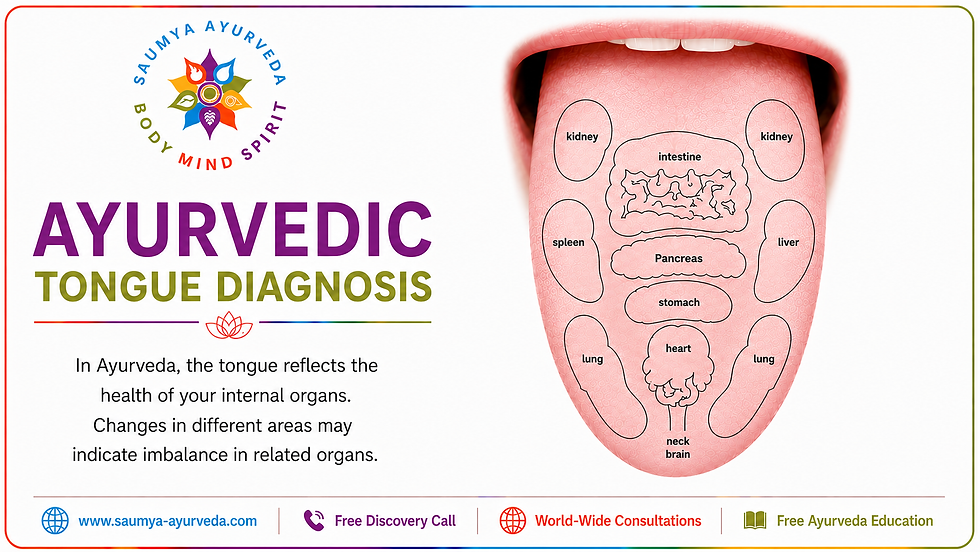
The Three Malas: Ayurveda’s Guide to Healthy Elimination, Digestion & Balance

Updated: Sep 3
Have you ever wondered what your body's everyday elimination patterns can tell you about your health?
Ayurveda offers a fascinating perspective through the concept of the Malas—the body's physiological waste products.
The three primary Malas are Purisha (feces), Mutra (urine), and Sveda (sweat). These ordinary processes are easy to overlook until something changes.
Ayurveda teaches us that healthy elimination is an important part of maintaining dosha balance, supporting digestion, and allowing the body to release what it no longer needs.
In this guide, you'll discover the Three Malas and their connection to Agni, the doshas, digestion, and daily rhythm—and learn how paying attention to these natural processes can offer valuable insight into your own health.
Sometimes, understanding your health begins simply by learning to listen to what your body is already telling you.

In Ayurveda, the Malas are the physiological waste products produced by the body. The three primary Malas, known as Tri Malas, are Purisha (feces), Mutra (urine), and Sveda (sweat).
Proper formation and elimination of these wastes are essential to healthy digestion, physiological balance, and the body’s ability to remove what it no longer needs.
Key Takeaways
The Three Malas are Purisha (feces), Mutra (urine), and Sveda (sweat).
Malas are normal physiological waste products, not simply “toxins.”
Healthy elimination is essential to balance and reflects the body's ability to process and release what it no longer needs.
Ahara Mala arises from the processing of food and drink; Dhatu Mala arises through the ongoing transformation of the body's tissues.
Agni is foundational to healthy elimination because digestion and transformation precede proper waste formation and elimination.
Vata, Pitta, and Kapha influence elimination in different ways, with Vata especially governing movement and downward elimination.
Observable Ayurveda encourages you to notice your own patterns rather than compare your body with someone else's.
More elimination is not necessarily better. Ayurveda emphasizes appropriate, natural elimination rather than constant detoxification.
Simple daily rhythms—nourishing food, hydration, movement, rest, regularity, and mindful breathing—can support healthy elimination.
When elimination changes significantly or persistently, don't simply blame a Dosha; seek appropriate medical evaluation.
Table of Contents

What Are The Three Malas?
Have you ever stopped to think about how much your body is doing every day without asking for your attention?
You eat, and your body begins the remarkable work of digestion and transformation. It breaks down what you have taken in, absorbs what can nourish you, and continues the process of using what it needs while separating what it no longer needs.
Eventually, that which is no longer needed has to leave. You have a bowel movement. You urinate. You sweat.
These are such ordinary parts of daily life that we rarely give them much thought—until something changes. Suddenly, we become aware of our digestion, our elimination, or the way our body is responding.
Ayurveda has been paying attention to these everyday processes for thousands of years.
The physiological waste products produced by the body are called Malas. The three primary Malas, known as the Tri Malas, are Purisha, or feces; Mutra, or urine; and Sveda, or sweat.
At first, this may sound like a fairly simple concept. But there is more here than meets the eye.
The Malas are part of the body's larger process of transformation and release. They help us understand what happens after we take something into the body—how it is processed, what is useful is retained, and what is no longer needed is eliminated.
This is an important Ayurvedic perspective because health is not simply about what we put into our bodies. We can spend a great deal of time thinking about what to eat, what herbs to take, or what supplements might support us.
Ayurveda also asks us to consider what happens afterward.
How well are we digesting, transforming, using, and letting go?
That is where the Three Malas become particularly interesting. And it is also where Ayurveda offers a different perspective from today's constant focus on “detoxing.”
The goal is not to force the body to eliminate more and more. The goal is to support the body's natural ability to process what it receives and release what it no longer needs.
Your body is already doing this work every day. Sometimes, the most helpful thing we can do is learn to pay attention.
🌿Saumya Self-Observation™: Notice What Your Body Is Already DoingBefore moving on, take a quiet moment to notice your own patterns. You don't need to change anything or decide whether something is “good” or “bad.” Simply become curious. What do you notice about your digestion and elimination? Do your bowel movements generally feel easy and complete? Have you noticed any recent changes in urination or sweating? Do you tend to ignore or postpone your body's natural urges when you are busy? What happens to your elimination when your routine, sleep, food, or stress level changes? There is nothing you need to fix from this brief observation. For now, simply notice. Your body is already communicating with you. Ayurveda begins by learning how to listen. |

Mala Does Not Mean “Toxin”
One of the first things to understand about Mala is what the word actually means. It is often translated as waste, impurity, or excretory product.
When we hear “waste,” it is easy to assume that we are talking about something harmful or toxic that the body needs to get rid of. That is not the Ayurvedic understanding.
The body naturally produces waste every day, and this is a normal part of being alive. Food is digested, transformed, and used to nourish the body.
The tissues are continually nourished and renewed, and metabolism is constantly at work. With all of this transformation, there will naturally be substances the body no longer needs. Their presence does not mean something has gone wrong. It means the body is doing what it is designed to do.
What matters is whether the body can form, move, and eliminate these wastes appropriately.
Ayurveda therefore does not begin by asking, “How can I get rid of as much waste as possible?” A more useful question is: “How well is the body carrying out its natural processes of transformation and elimination?”
That distinction moves the conversation away from fear and toward observation. It also helps explain why Ayurveda does not equate health with constant cleansing.
A healthy body is not one that eliminates as much as possible. It is one that can digest, transform, nourish, and eliminate in a natural rhythm.
It is also important not to confuse Mala with Ama. Mala refers to the body's normal waste products, while Ama is associated with material that has not been properly processed, often in the context of impaired digestion or metabolism.
They are not the same thing. Understanding this distinction helps prevent the common tendency to label all bodily waste as “toxins.”
So when Ayurveda speaks about Mala, think about what the body has finished using. The body is constantly taking in, transforming, using, and letting go.
Mala is part of that natural cycle. The aim is not to eliminate everything possible, but to support the body's ability to do what it already knows how to do: create what is needed and let go of what is no longer needed.
Ahara Mala and Dhatu Mala
Ayurveda takes the understanding of Mala further by recognizing that waste is produced at different levels of activity within the body.
It is not only what is eliminated through the digestive and urinary systems. As the body continually digests, transforms, nourishes, and renews itself, it also continually produces substances that are no longer needed.
Two broad ways Ayurveda describes this are Ahara Mala and Dhatu Mala.
Ahara Mala refers to waste associated with the food and drink we take in. Within this larger process of digestion and elimination, Ayurveda identifies three primary and easily recognizable forms of bodily waste: Purisha (feces), Mutra (urine), and Sveda (sweat).
These are the wastes we notice most directly, and their regular elimination is an important part of normal physiological function.
Dhatu Mala takes us deeper into the body's ongoing process of nourishment and transformation. Ayurveda describes seven Dhatus, or tissues, and each tissue is continually being nourished, transformed, and used.
As this happens, there are also substances that the tissue no longer needs and must
release. Ayurvedic descriptions of these tissue-level wastes include localized secretions such as earwax and eye and nasal secretions, along with substances associated with hair, skin, and nails.
Ancient Ayurvedic Reference: Charaka Saṃhitā, Sūtra Sthāna 28/4 describes food being transformed into a nutritive essence (āhāra-rasa) and a waste portion (kiṭṭa). The nutritive essence nourishes the seven dhātus, while the waste portion contributes to the body's malas.
What matters most is the larger Ayurvedic principle: the body is continually creating, transforming, using, and releasing.
Elimination is therefore not something that happens only when you use the bathroom. It is happening throughout the body, as part of the body's natural rhythm of transformation and renewal.
The Three Malas are simply the primary and most recognizable forms of this larger process. Once Mala is understood in this context, it becomes less about “getting rid of toxins” and more about recognizing the remarkable work the body is already doing every day.

Dhatu Mala: The Waste Products of the Seven Tissues
Ayurveda's understanding of Mala becomes even more interesting when we look beyond the three primary wastes.
According to Ayurveda, the body has seven Dhatus, or tissues, that are continually nourished and transformed: Rasa (plasma), Rakta (blood), Mamsa (muscle), Meda (fat), Asthi (bone), Majja (marrow), and Shukra (reproductive tissue). As these tissues undergo nourishment and transformation, they also produce tissue-level byproducts known as Dhatu Malas.
This gives us a broader understanding of elimination. The body is continually taking in, transforming, utilizing, nourishing, and releasing. Some Dhatu Malas are familiar. Nasal secretions, tears, and earwax are traditionally understood within the broader concept of Mala.
Hair and nails are associated with Asthi Dhatu, while sweat is associated with Meda Dhatu. These examples illustrate the broader concept of elimination, but they are not one-to-one equivalents of modern biomedical categories. Ayurveda and modern physiology describe the body through different frameworks. (NIH.)
The body is always in motion. It takes in. It transforms. It uses. It releases. Waste is not automatically a sign that something is wrong. Waste is a natural consequence of transformation. Concern arises when digestion, metabolism, nourishment, movement, or elimination become disturbed.
This brings us to Ama. When digestion and metabolism are not functioning appropriately, Ayurveda describes the possibility of incompletely processed material accumulating in the body. Ama is therefore more useful to understand as a sign of impaired processing than simply as a mysterious “toxin” that needs to be flushed away.
The body may offer clues. Bloating, altered bowel movements, unusual odors, increased mucus or congestion, a coated tongue, fatigue, or changes in the skin and other secretions may become part of a larger Ayurvedic assessment. These observations do not, by themselves, establish the presence of Ama or its cause.
The goal is not to eliminate everything. The goal is to support the body's ability to transform what it receives and release what it no longer needs.
And that brings us naturally to Agni—the Ayurvedic principle of digestion and transformation.
If you would like to explore this foundational Ayurvedic concept more deeply, see The Seven Dhatus Explained: How Ayurveda Builds Strength, Immunity & Vitality
🌿Saumya Self-Observation™: Notice the Smaller SignsFor one day, simply notice some of the body's quieter forms of elimination. You might notice nasal secretions, tears, earwax, perspiration, or the normal shedding of hair and skin. There is nothing you need to analyze or correct. Simply recognize that your body is continually processing, transforming, using what it needs, and releasing what it no longer needs. Take a moment to consider: How does it change your perspective when you see elimination as a normal part of the body's ongoing work? |
Before understanding healthy elimination, it helps to understand what happens first:
How does the body transform what we take in?

From Food to Elimination: The Role of Agni
To understand Mala, it helps to begin with Agni.
Agni is often translated as digestive fire, but its meaning extends beyond digestion in the narrow sense.
Agni is the body's power of transformation—its ability to process what comes in, separate what can be used from what cannot, and transform nourishment so it can support the body.
Consider what happens when you eat a meal. The food that enters the body is not yet part of you. It must be broken down, transformed, absorbed, and distributed.
Some becomes nourishment for the tissues and provides energy. Some becomes material the body no longer needs and must release.
That material moves toward elimination.
This is one reason Ayurveda places such importance on digestion. It is easy to focus on which foods are healthiest, which supplements to take, or which herbs might provide additional support.
Ayurveda asks us to look one step deeper: How well is the body digesting and transforming what is already being taken in?
Even the most nutritious meal still has to be digested.
When Agni is functioning well, the body can more effectively carry out this natural process of transforming what comes in, using what is needed, and releasing what is not.
When Agni is weakened or disturbed, digestion and metabolism can become less efficient, and the orderly process of nourishment and elimination can be affected.
This is where Ama enters the conversation. In Ayurveda, when food and other substances are not properly transformed, improperly processed material may contribute to the formation of Ama.
Understanding Agni therefore helps put Mala into context: healthy digestion is not only about extracting nourishment from food; it is also about allowing the body to process and release what it no longer needs.
This is why supporting Agni is often more foundational than continually adding more to the body. Before asking what else the body needs, Ayurveda asks how well the body is processing what is already there.
This is why Ayurveda places such importance on digestion. If you would like to explore this foundational concept more deeply, see Improve Agni: Your Digestive Fire Is Key To Good Health.
Agni, Ama and the Process of Elimination
Ama is often translated as “toxin,” but that translation can create confusion. In Ayurveda, Ama is associated with incomplete or impaired digestion and metabolism.
It is more useful to understand Ama within the larger process of transformation than to think of it simply as a modern toxic substance.
When Agni is functioning well, what enters the body can be properly transformed. Nourishment is separated from what the body does not need, useful substances are assimilated and utilized, and what is no longer needed moves toward elimination.
The process can be understood simply:
What comes in must be transformed. What is useful must be assimilated and utilized. What is no longer needed must be eliminated.
When Agni is weakened, irregular, or overwhelmed, this process may become incomplete. Ayurveda teaches that improperly transformed material can contribute to the formation of Ama.
This is why Ayurveda looks beyond the question, “What should be eliminated?”
A more useful place to begin is with the process of digestion itself. How regularly are meals being eaten? Is there genuine hunger before eating? Are meals being rushed or eaten while distracted? Is there enough time between meals for digestion? Is sleep restorative? Is the body spending much of the day in a state of stress or constant stimulation?
These simple observations can offer valuable insight into how well Agni is being supported.
Rather than continually adding cleansing products, supplements, or herbs, Ayurveda first looks at the body's own capacity for digestion, transformation, assimilation, and elimination.
When these processes are supported, the body has a better opportunity to do what it is naturally designed to do.
Before asking what needs to be removed, begin by noticing how well the body is processing what comes in.
For a deeper exploration of this important Ayurvedic concept, see Understanding Ama or Toxins in Ayurveda is the Key to Good Health.

Purisha: The Wisdom of the Bowel
Purisha, or stool, is perhaps the Mala most familiar to us. Yet familiarity does not always mean awareness. Most people know whether they had a bowel movement today, but Ayurveda encourages a little more observation.
What is the consistency? Is elimination easy? Is there straining or urgency? Is the stool unusually dry or loose? Does elimination feel complete? Has the usual pattern changed?
These observations are not intended to diagnose a medical condition. They are simply ways of becoming more familiar with how the body is functioning.
Classical Ayurveda has long paid attention to the characteristics of stool—including its consistency, quantity, color, odor, and ease of elimination—as part of understanding the body's patterns.
One of the most useful Ayurvedic principles is to learn what is normal for you. Once your personal baseline becomes familiar, changes are easier to notice.
There is also no single bowel pattern that is perfect for every person. Constitution, diet, age, daily routine, activity, hydration, stress, travel, medications, and many other factors can influence elimination.
Rather than comparing your bowel habits with someone else's definition of “normal,” Ayurveda encourages a more useful approach: become familiar with your own patterns, notice what changes, and listen to what your body may be telling you.
For a deeper exploration of how Ayurveda observes stool—including color, consistency, frequency, odor, and ease of elimination—see Ayurveda stool analysis.

Purisha and Apana Vayu
Purisha has a close relationship with Apana Vayu, the downward-moving aspect of Vata. Apana governs movement downward and outward and plays an important role in elimination through the bowel and bladder, menstruation, and reproductive functions.
When Apana is moving appropriately, elimination tends to have a natural downward flow. When Vata becomes aggravated, that movement can become irregular, making elimination more difficult or incomplete.
Dryness, straining, gas, bloating, difficulty passing stool, and a feeling of incomplete elimination may be observed in a Vata-influenced pattern.
This relationship becomes easier to understand when we consider the qualities of Vata: dry, light, cold, mobile, subtle, and irregular.
Ayurvedic support therefore emphasizes qualities that bring greater balance—warmth, moisture, regularity, nourishment, grounding, and relaxation.
Rather than simply asking, “What will make you go?” Ayurveda asks a more useful question:
“What may be interfering with natural movement?”
That shift matters. It moves the focus away from forcing elimination and toward understanding what the body may need for elimination to happen more naturally.

Constipation Is About More Than Frequency
One of the simplest ways to misunderstand bowel health is to focus only on how often you have a bowel movement.
A bowel movement every day does not necessarily mean elimination is healthy if the stool is hard, straining is required, or there is a persistent feeling of incomplete emptying.
Another person may have a different natural rhythm and experience comfortable, complete elimination. There is no single frequency that defines what is normal for everyone.
Ayurveda therefore looks at the whole experience of elimination.
What is normal for you? How much effort is required? What is the quality of the stool? Does elimination feel complete? How does the body feel afterward? And, perhaps most importantly, has anything recently changed?
Travel can change elimination. Stress can change elimination. A change in diet, hydration, sleep, or activity can change it as well. Sometimes, the change itself offers a clue.
This is the value of observation. Rather than immediately reaching for something to correct the symptom, pause long enough to consider what may have influenced the change.
Learning to recognize these patterns is an important part of Ayurvedic self-observation and can reveal much more than frequency alone.

Mutra: Understanding Urine Through Ayurveda
Mutra, or urine, is the liquid waste eliminated through the urinary system. From an Ayurvedic perspective, it is part of the body's ongoing management of fluids and elimination and is associated with the regulation and removal of excess Kleda, or bodily moisture.
As with the other Malas, the larger principle is balance. The body is continually responding to how much fluid comes in and how much is lost through urine, sweat, breathing, and other processes. Climate, exercise, diet, age, health, medications, and daily activity can all influence this balance.
This is why hydration is not quite as simple as following a single rule. The idea that everyone needs exactly the same amount of water every day does not account for the body's changing needs. Hydration is individual.
Someone exercising in summer heat will have different needs from someone spending the day indoors in a cool environment.
Someone eating water-rich foods will have different circumstances from someone whose diet is naturally drier.
The body is continually responding to its environment, and urine can offer useful clues about those changes.
Ayurveda traditionally observes characteristics such as color, clarity, odor, quantity, frequency, and ease of urination as part of understanding the body's patterns.
For a deeper look at this topic, see Ayurvedic Urine Analysis: What Your Urine Reveals About Your Health. This Saumya Ayurveda article explores what urine may reveal through an Ayurvedic lens and also discusses the importance of recognizing changes that may warrant medical attention.
The goal is not to force the urine to look a particular way or to drink as much water as possible. Hydration is about supporting balance, not forcing a particular number.
Learning your own patterns—and noticing when those patterns change—is a much more useful approach.
This is exactly the kind of Observable Ayurveda that helps turn everyday bodily functions into useful information rather than something to fear or overanalyze.

Sveda: Sweat, Skin and the Regulation of Heat
The third primary Mala is Sveda, or sweat. Sweating is easy to take for granted until something changes, yet it is a normal and important part of the body's regulation of heat.
Ayurveda recognizes Sveda as one of the Three Malas and traditionally associates it with Meda Dhatu, while also recognizing its relationship with the skin, moisture, and heat regulation.
As with the other Malas, it is helpful to move away from the modern tendency to label every form of elimination as “detoxification.” Sweating does not mean the body is releasing more toxins, and more sweat does not mean more detoxification. Sweat is a normal physiological process, not a measure of how much the body needs to cleanse.
From an Ayurvedic perspective, the pattern of sweating can also be observed. Changes in how much a person sweats, when sweating occurs, or how the skin feels may offer useful clues when considered alongside digestion, activity, environment, constitution, and other signs of balance or imbalance.
🌿Saumya Self-Observation™: Know Your NormalAyurveda encourages us to become familiar with our own patterns before deciding that something is out of balance. Consider your usual bowel movements, urination, and perspiration. What feels normal for you? What has changed recently, if anything? Has your digestion, hydration, sleep, activity, stress, or daily routine changed along with it? Knowing your normal gives you something to notice when your body changes. |
Do You Need to Sweat Out Toxins?
There is a popular idea that sweating is synonymous with detoxification. You may have heard that intense exercise, a sauna, or simply sweating heavily is necessary to “release toxins.” Ayurveda offers a more nuanced understanding.
Traditional Ayurveda does recognize Swedana, or therapeutic sweating, as a specific practice used appropriately within certain Ayurvedic approaches.
But this does not mean that everyone needs to sweat heavily every day, or that more sweat automatically means better health.
The body already has several natural pathways for managing waste and maintaining internal balance. Sweating is one of them, not the whole story.
How much a person sweats can also vary considerably. Someone living in a hot climate will naturally sweat more than someone living in a cool environment.
Someone exercising will sweat more than someone resting. A person with a stronger Pitta influence may naturally experience more heat and perspiration than someone with a stronger Vata influence.
The point is not to make the body sweat as much as possible. It is to understand that sweating is a normal physiological process, and healthy does not mean identical.
Sveda, Pitta and Heat
Sveda has an especially interesting relationship with Pitta because Pitta governs transformation and is closely associated with heat. When Pitta is balanced, heat and transformation are regulated appropriately.
When Pitta becomes aggravated, excess heat and perspiration may become more noticeable.
Vata, with its dry, light, cold, and mobile qualities, may express differently, while Kapha, with its cool, heavy, moist, and stable qualities, may have its own characteristic patterns.
This is one of the most useful ways to approach Ayurvedic thinking: rather than immediately placing the body into categories, observe the qualities that are present.
Heat
Dryness
Moisture
Movement
Heaviness
Stagnation
Once you begin thinking in terms of qualities, the body's patterns can become easier to understand. Instead of simply saying, “I have a symptom,”
Ayurveda invites a more useful question:
“What qualities am I noticing?”
In Ayurveda, Purisha, Mutra, and Sveda can be understood through patterns of Vriddhi (increase) and Kshaya (decrease). The classical texts describe characteristic signs associated with these changes. The summary below brings those teachings together in a clear, accessible way. (Charaka Saṃhitā, Sūtra Sthāna 7/42–43; 17/70–72.)
The Three Malas: When There Is Too Much or Too Little
Mala | When Increased — Vriddhi | When Decreased — Kshaya |
Purisha — Feces | Heaviness, flatulence, abdominal discomfort | Bloating, abdominal or low back discomfort, weakness |
Mutra — Urine | Frequent urination, bladder disturbance | Reduced urination, increased thirst, lower abdominal discomfort |
Sveda — Sweat | Excessive perspiration, body odor, itching, skin disturbance | Reduced perspiration, dry skin, burning sensations, increased body heat |
Ayurvedic perspective: Vriddhi describes an increase or excess, while Kshaya describes a decrease or deficiency.
These patterns are considered together with the person's constitution, Doshas, digestion, environment, and overall health rather than interpreted in isolation.

The Three Malas and the Doshas
The Malas do not exist separately from the Doshas. Vata, Pitta, and Kapha influence physiological processes throughout the body, including digestion, metabolism, movement, and elimination. Understanding this relationship helps explain why the same symptom can arise from very different patterns.
This is why Ayurveda does not assume that everyone with the same complaint needs the same approach. Two people can both say, “I’m constipated,” yet have very different patterns.
One may have dry stool, irregular meals, frequent travel, anxiety, and a great deal of movement—qualities that point toward Vata.
Another may feel heavy and sluggish, have little appetite, and be physically inactive—qualities that may suggest a stronger Kapha influence.
The symptom may be the same. The pattern is different. The person is different.
This is the heart of Ayurvedic thinking: understand the person rather than simply treating the symptom.

Why Ayurveda Pays Attention to Natural Urges
There is another Ayurvedic teaching about elimination that feels remarkably relevant to modern life: the importance of respecting natural urges.
Modern life has made it remarkably easy to override the body's signals. Urine is held because there is a meeting. A bowel movement is postponed because there is somewhere to be. Hunger is ignored because the schedule is full. Fatigue is pushed through because there is more work to do. Sleep is delayed because there is one more email to answer.
Over time, overriding these signals can become so habitual that we barely notice we are doing it.
Ayurveda invites a different relationship with the body. The body has rhythms. It communicates. It asks for food, water, sleep, elimination, and rest.
Whenever circumstances reasonably allow, learning to respond to these signals is part of developing a more attentive and respectful relationship with your own physiology.
“Never suppress or delay a natural urge because it interferes with the body's intelligence.”— Veena
This does not mean every urge must always be acted upon immediately or that circumstances never require flexibility. It means that repeatedly overriding the body's natural signals should not become the norm.
Your body is not an inconvenience that keeps interrupting your schedule. It is the place where you live.

Elimination and the Nervous System
Digestion and elimination do not happen in isolation from the rest of the body. The nervous system is continually communicating with the digestive system, which means that the way we move through the day can influence how the body digests, transforms, and eliminates.
Consider the modern pace of life. Rushing from one responsibility to another, eating while distracted, sleeping too little, and spending much of the day in a state of stress all send signals to the body.
When the nervous system is continually asked to remain alert, it can become more difficult to settle into the quieter state that supports digestion and restoration.
This is one reason diaphragmatic breathing can be such a simple and valuable practice. A slower, more comfortable breath gives the body an opportunity to move away from constant alertness and toward a more settled state.
Slow down. Allow the diaphragm to move naturally. Let the breath become deeper and more comfortable. Give the body a few moments in which nothing needs to be accomplished.
For someone who spends much of the day in fight, flight, or freeze, these small moments can be meaningful. They create an opportunity for the nervous system to soften, which can support the body's natural digestive and eliminative processes.
For a deeper exploration of this relationship, see Ayurveda and the Gut-Brain Connection: How to Reduce Anxiety Naturally Through Digestion. The article explores the two-way communication between digestion and the nervous system and includes Ayurvedic practices such as mindful eating, daily routine, meditation, and diaphragmatic breathing.
Ayurveda is not simply about food. It is also about the state in which we live. A body that is continually being pushed may need something very different from a body that needs more stimulation.
Sometimes supporting elimination begins with something as simple as creating enough safety and stillness for the body to soften.
Why You Don't Need to Constantly Detox
We live in a culture that often makes us feel that the body needs to be continually cleansed. A period of fatigue, some bloating, a change in diet, or simply a stressful season can quickly lead to the idea that it is time for a detox or cleanse.
Ayurveda offers a more thoughtful perspective. The presence of physiological waste does not mean that the body has failed or that it is somehow overwhelmed with toxins (ama).
The body is designed to eliminate. The Three Malas are part of that natural process of taking in, transforming, using what is needed, and releasing what is no longer needed.
Ayurvedic cleansing is individualized and is traditionally undertaken when appropriate, with attention to the person's constitution, current state, strength, digestion, season, and other factors.
For everyday health, a more useful question is not, “What do I need to detox?” but “How can I support the body's own processes of digestion and elimination?”
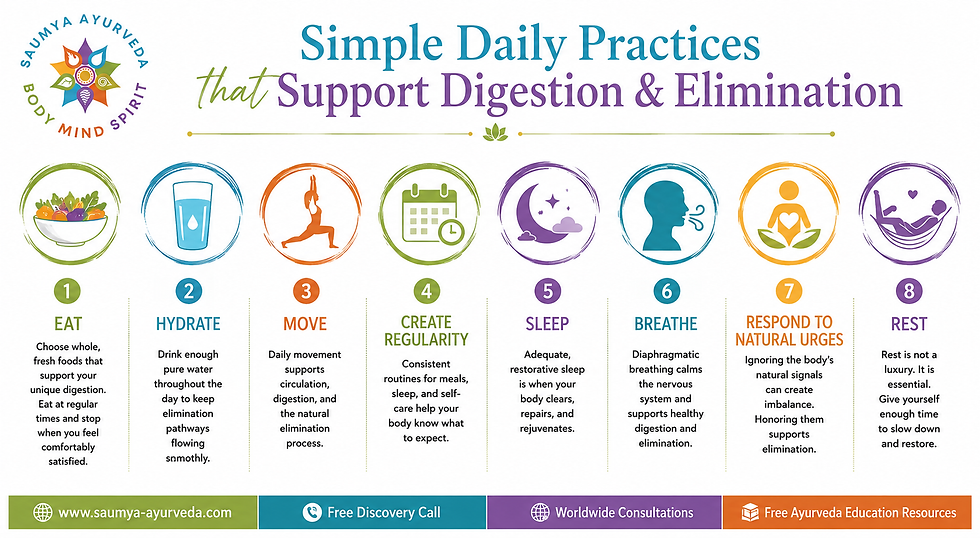
That may begin with practices that are remarkably ordinary: eating in a way that supports digestion, staying appropriately hydrated, moving the body, maintaining regularity, getting restorative sleep, responding to natural urges, and creating enough space in the day to rest and breathe.
These practices may not sound as exciting as a cleanse, but they are foundational. The body does not necessarily need more intervention. Sometimes it needs better conditions in which to do what it already knows how to do.
And that is an important distinction in Ayurveda: supporting the body's natural intelligence rather than continually trying to override it.
🌿Saumya Self-Observation™: Support Rather Than ForceBefore reaching for a cleanse or detox, pause and consider the foundations. How are you eating? Are you digesting comfortably? Are you drinking appropriately? Are you moving your body? Are you sleeping well? Are you responding to natural urges? Are you giving yourself enough time to rest and breathe? Rather than asking, “What do I need to eliminate?” consider asking: “What would help my body do its own work more easily?” |

Ten Ayurvedic Ways to Support Healthy Elimination
Supporting the Malas does not require an elaborate protocol. It begins with the ordinary things that allow the body to digest, transform, move, and eliminate well.
1. Support Agni
Start with digestion. Choose foods you digest comfortably, pay attention to appetite (agni) and meal timing (daily routine), and notice how you feel after eating. Before continually adding supplements or new foods, consider how well the body is processing what is already being consumed.
2. Create Rhythm
The body responds well to regularity. Consistent meals, sleep, waking, movement, and opportunities for elimination provide stability that can be especially supportive for Vata.
3. Give Yourself Time
A rushed morning leaves little room for the body's natural rhythms. Allow enough time to wake, breathe, use the bathroom, and begin the day without immediately creating urgency.
4. Respond to Natural Urges
Whenever reasonably possible, listen when the body signals a need to eliminate. The goal is not rigidity. It is learning not to habitually override the body's natural signals.
5. Hydrate Appropriately
Drink according to your doshic picture, considering climate, activity, diet, thirst, season, stage of life, and other circumstances. More water is not automatically better.
6. Move Your Body
Walking, yoga, stretching, strength training, gardening, and other forms of movement can support circulation, digestion, and healthy physiological rhythms. Movement does not need to be extreme to be beneficial.
7. Breathe
Diaphragmatic breathing can be a simple way to interrupt the constant momentum of the day. Allowing the breath to slow and deepen gives the body a different message: there is time to rest, restore, and digest.
8. Eat With Attention
Put down the phone occasionally. Sit down. Notice the food. Chew. Taste. Breathe. Digestion is not simply a mechanical process; the environment and state of the body surrounding a meal matter, too.
9. Honor Your Individual Constitution
There is no perfect routine for everyone. Ayurveda considers constitution (prakriti) current imbalances of the doshas (Virkrit), age, season, environment, digestion, and state of Angi and Ama. What supports one person may need to be adjusted for another.
10. Don't Make Elimination Another Source of Anxiety
This may be the most important recommendation of all. There is no need to obsess over every bowel movement, every trip to the bathroom, or every drop of sweat.
Health is not created through hypervigilance.
Observe. Learn. Adjust when appropriate. Then let go.

Observable Ayurveda: Your Body Is Your First Teacher
One of the most beautiful things Ayurveda offers is the opportunity to become a student of your own experience.
There is no need to memorize hundreds of rules or search for an answer every time the body does something unexpected. Begin with something much simpler: observe.
Notice what happens when:
Meals are eaten late
You travel
Stress increases
Sleep is disrupted
The seasons change
Your daily routine becomes irregular
These observations can tell you something that a generic list of symptoms cannot: how your own body responds to your own life.
This is the heart of Observable Ayurveda. Observation is not judgment. If a bowel movement is different today, there is no need to immediately decide, “Something is wrong with my digestion.” Instead, pause and become curious:
“That is different from my usual pattern. What might have changed?”
Perhaps the food was different. Perhaps sleep was disrupted. Perhaps there was travel, stress, dehydration, less movement, or a change in routine. Sometimes the answer is simple. Sometimes the pattern needs more attention. The important first step is noticing.
The body is continually giving information. Ayurveda teaches us to become quiet enough to notice it, curious enough to learn from it, and thoughtful enough to respond appropriately. Your body is your first teacher.
For a gentle introduction to this practice, download the free Observable Ayurveda: A Beginner’s Guide to Ayurvedic Self-Observation.
Observe. Learn. Adjust when appropriate. Then let go.

The Three Malas Within the Bigger Picture of Ayurveda
The Three Malas become even more meaningful when they are understood within Ayurveda's larger view of the body. Nothing exists in isolation. Each part of the system is connected to the next, and the health of one process influences the others.
Prakriti represents your individual constitution. The Doshas influence physiological functions.
Agni transforms what you take in. The Dhatus are nourished through that transformation. The Malas are the waste products that arise along the way and must be appropriately eliminated.
When digestion, nourishment, tissue health, rest, and daily living are supported, Ayurveda describes the development of Ojas, the deeper reserve of vitality, strength, and resilience.
Seen this way, the Three Malas are not an isolated topic. They are part of the same continuous Ayurvedic story: food enters, Agni transforms, nourishment is assimilated, the tissues are supported, waste products are produced, and the body eliminates what it no longer needs. Over time, when these processes are functioning harmoniously, vitality is cultivated.
Nothing exists in isolation. The body is a living conversation between transformation, nourishment, elimination, and renewal.
“Elimination is not the opposite of nourishment. It is part of nourishment.”- Veena Blilie
THE AYURVEDIC VIEW OF ELIMINATIONTake In → Transform → Nourish → Use → Release |
The Three Malas and Ojas
If you have explored Understanding Ojas: Ayurveda's Guide to Lasting Vitality, Energy & Resilience, you may remember the idea of Ojas as a Vitality Bank Account.
Ojas represents the deeper reserve of vitality, strength, and resilience that develops through healthy digestion, nourishment, rest, and balanced living.
The Three Malas are another essential part of this same Ayurvedic story. There must be a healthy ability to let go. The body cannot continually take in without also processing, using, and releasing what it no longer needs.
This is an important distinction. Elimination is not the opposite of nourishment. It is part of nourishment.
A healthy body knows how to receive. It knows how to transform. It knows how to use. And it knows how to let go. Each part matters.
When these processes work together, nourishment can be received, the tissues can be supported, waste can be released, and vitality can be cultivated over time.
"That is one of the quiet lessons of the Three Malas: health is not only about what we take in. It is also about how well the body knows what to keep and what to let go." -Veena Blilie

Frequently Asked Questions
What are the Three Malas in Ayurveda?
The Three Malas, or Tri Malas, are the three primary physiological waste products described in Ayurveda: Purisha (feces), Mutra (urine), and Sveda (sweat).
What does Mala mean in Ayurveda?
Mala refers to physiological waste products produced through the body's processes of digestion, metabolism, and tissue transformation. Mala should not simply be equated with the modern concept of a “toxin.”
Why are the Malas important in Ayurveda?
Proper formation and elimination of waste are important aspects of healthy physiology and balance. Ayurveda therefore pays attention not only to nourishment, but also to the body's ability to appropriately process and eliminate what it no longer needs.
What is Purisha?
Purisha is feces or stool. Ayurveda observes qualities such as consistency, quantity, color, odor, and ease of elimination when considering bowel patterns.
What is Mutra?
Mutra is urine. It is associated with the body's management of fluids and elimination and is discussed in relation to Kleda, the body's fluid or moist component.
What is Sveda?
Sveda is sweat. It is one of the Three Malas and is associated with perspiration, the skin, moisture, and regulation of heat.
What are Ahara Mala and Dhatu Mala?
Ahara Mala refers broadly to waste products associated with the digestion of food and drink. Dhatu Mala refers to waste products associated with the ongoing nourishment and transformation of the body's seven tissues, or Dhatus.
What are Dhatu Malas?
Dhatu Malas are waste products associated with the ongoing activity and transformation of the seven Dhatus, or tissues, described in Ayurveda. Examples include nasal secretions, tears, earwax, hair, nails, and sweat, along with other metabolic byproducts discussed within the Ayurvedic framework.
Is constipation always caused by Vata?
Ayurveda commonly associates dry, difficult, or irregular elimination with aggravated Vata, particularly Apana Vayu. However, constipation can have many causes, and persistent constipation should be appropriately evaluated rather than automatically attributed to a single dosha imbalance.
Does Ayurveda say everyone should have a bowel movement every day?
No. Ayurveda emphasizes an individual's normal pattern and considers factors such as ease, consistency, completeness, constitution, diet, routine, and current circumstances rather than relying on one universal number.
Does sweating detox the body?
Sweating is a normal physiological process and one of the Three Malas. Ayurveda also recognizes therapeutic sweating in specific circumstances. However, more sweating does not automatically mean better health, and the idea that everyone needs to “sweat out toxins” is an oversimplification.
What is Ama, according to Ayurveda?
Ama is an Ayurvedic concept associated with incomplete or impaired digestion and metabolism. Rather than simply thinking of Ama as a “toxin,” Ayurveda considers it in the context of how well the body is digesting, transforming, utilizing, and eliminating what it takes in.
Should I do a detox or cleanse to support elimination?
Not necessarily. Ayurveda emphasizes supporting digestion, appropriate hydration, movement, sleep, regularity, and natural elimination. Traditional Ayurvedic cleansing practices are individualized and should not be confused with commercial detox products.
Can stress affect digestion and elimination?
Stress can influence digestion and elimination, and from an Ayurvedic perspective, ongoing stress may aggravate Vata and disrupt natural rhythms. Practices such as diaphragmatic breathing, adequate rest, and regular routines can be supportive.
When should I seek medical care for changes in elimination?
Persistent or significant changes in bowel movements or urination, blood in the stool or urine, painful urination, severe dehydration, unexplained weight changes, persistent unexplained sweating, or other concerning symptoms warrant appropriate medical evaluation.

Glossary of Ayurvedic Terms
Agni — The Ayurvedic principle of digestion, transformation, and metabolism.
Ahara Mala — Physiological waste products associated with the digestion of food and drink.
Ama — An Ayurvedic concept associated with incomplete or impaired digestion and metabolism.
Apana Vayu — The downward-moving aspect of Vata associated with elimination, urination, menstruation, and reproductive functions.
Dhatu — One of the seven primary tissues described in Ayurveda.
Dhatu Mala — Waste products associated with the ongoing nourishment and transformation of the body's tissues.
Dosha — Vata, Pitta, and Kapha, the three functional principles that influence physiological processes.
Kleda — The body's fluid or moist component associated with fluid balance and elimination.
Mala — A physiological waste product produced through normal bodily processes.
Mutra — Urine; one of the Three Malas.
Ojas — The refined essence associated with vitality, strength, resilience, and healthy nourishment.
Prakriti — An individual's natural constitutional makeup.
Purisha — Feces or stool; one of the Three Malas.
Sveda — Sweat or perspiration; one of the Three Malas.
Tri Malas — The three primary physiological wastes: Purisha, Mutra, and Sveda.
Vikriti — The current state of imbalance or deviation from one's natural constitution.

Continue Your Ayurveda Knowledge Journey
Understanding the three malas is just one part of Ayurveda's timeless approach to health. Continue exploring the interconnected principles that nourish your body, strengthen your vitality, and support lasting balance.
1. Learn the Foundations of Ayurveda
2. Build a Strong Foundation
3. Better Understand Your Unique Constitution
4. Support Your Vitality Naturally
How to Do Abhyanga Massage at Home: Benefits, Oils, and Step-by-Step Guide
Why Seasonal Transitions Matter for Ojas: An Ayurveda Guide to Immunity and Resilience (Coming September 2026)
5. Explore Common Health Challenges Through an Ayurvedic Lens
7 Ayurvedic Remedies for Maintaining Healthy Blood Pressure Naturally
Gut-Brain Connection in Ayurveda: Reduce Anxiety Through Digestion
Leaky Gut Syndrome in Ayurveda: Causes, Symptoms, Diet, and Natural Healing
Histamine Intolerance: Symptoms, Causes, Diet, and Ayurvedic Treatment for Natural Relief
MCAS Natural Treatment: Ayurvedic Diet, Herbs, and Root Causes
Our Commitment to Accessible Ayurveda Education
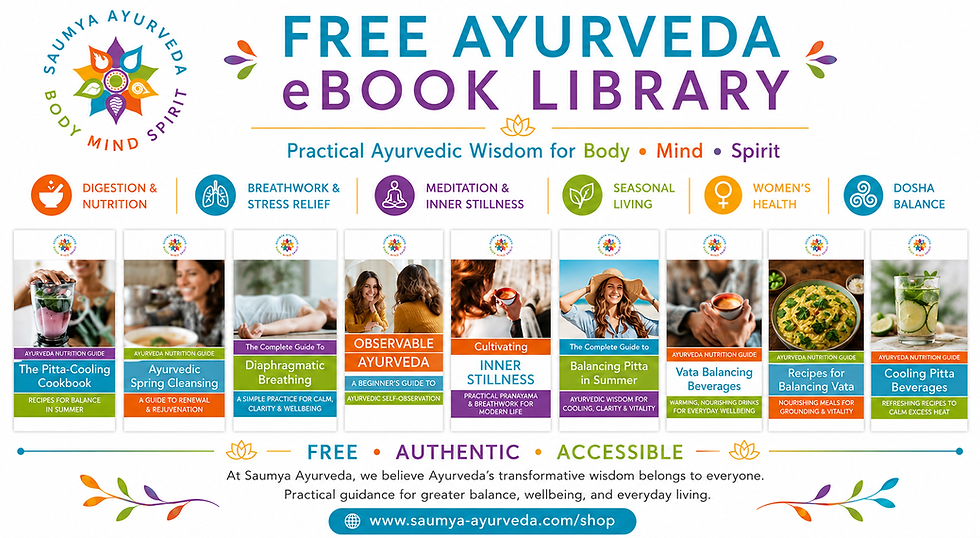
At Saumya Ayurveda, we believe Ayurveda's transformative ancient wisdom belongs to everyone—not just those who can afford it. That's why we're committed to making high-quality, authentic Ayurveda education available globally, free of charge.
Through our free eBooks, guides, and educational resources, we offer practical, grounded wisdom to help those seeking greater balance, vitality, and wellbeing integrate Ayurveda into their daily lives.
Accessible. Authentic. Free. Just as it was meant to be.
Free Ayurveda eBooks – Download practical guides, recipes, and wellness resources to support your health journey.
Ayurveda Blog – Enjoy easy-to-read articles, seasonal wellness tips, healthy recipes, and everyday inspiration—always educational, never a sales pitch.
Free Guided Traditional Progressive Meditations – Practice authentic, step-by-step guided meditations to cultivate calm, focus, and inner stillness.
Monthly Educational Newsletter – Receive seasonal Ayurveda insights, new articles, healthy recipes, and free resources delivered to your inbox each month.

Final Thoughts: Learning to Let Go
The Three Malas may seem simple at first: feces, urine, and sweat. Yet Ayurveda uses these ordinary functions to teach something much larger about how the body works.
The body is constantly taking in, transforming, nourishing, using, and releasing. Nothing is meant to remain indefinitely. Waste is not a failure of the body, and elimination is not something to fear or constantly force. It is part of the body's natural intelligence.
This is why Ayurveda encourages observation rather than obsession. Notice your bowel movements, urinary patterns, and sweating. Notice when something changes. Become familiar with your own rhythms rather than comparing your body with someone else's idea of normal.
And remember: Mala does not mean toxin. The body does not need to be constantly cleansed simply because it naturally produces waste. Supporting Agni, honoring natural urges, creating regularity, breathing, moving, sleeping, hydrating appropriately, and allowing time for rest can be far more meaningful than continually searching for something to eliminate.
There is wisdom, too, in knowing when observation is enough and when a change deserves further attention. Observable Ayurveda is not about diagnosing everything the body does. It is about becoming a better listener.
Perhaps that is the quiet lesson within the Three Malas: health is not only about what the body takes in. It is also about how well it transforms, uses, and lets go.
Sometimes the most Ayurvedic thing to do is simply pay attention, support the process, and let the body do its work.

What Our Clients Say | Saumya Ayurveda Testimonials
Real Transformations Through Ayurveda Consultation
Physician Testimonial (Medical Endorsement)
“As a physician, I have always believed that prevention is better than cure. In today’s healthcare environment, Ayurveda offers a logical and natural approach to long-term health and prevention.
I began working with Veena during a very demanding phase of my life, and she made the process accessible even within my busy schedule. I was encouraged to follow a steady, sustainable approach focused on real lifestyle change.
Over time, I experienced meaningful improvements in balance, energy, and well-being. In my medical practice, I now see many patients with similar stress- and diet-related imbalances, which has further reinforced my trust in Ayurvedic principles.
I have since referred several patients to Saumya Ayurveda and consider Veena a valuable resource in supporting holistic well-being.”
Dr. Gauri Nagargoje
M.D., Oncology & Hematology
Physician Testimonial (Medical Endorsement)
“As a physician, I initially struggled with Ayurveda’s simplicity and depth, but Veena’s guidance made it practical, scientific, and deeply effective.
Veena has transformed my health and perspective on healing. I experienced significant improvements in focus, digestion, stress response, and overall vitality.
Her personalized approach made lifestyle changes easy and sustainable.
This journey not only improved my health but also inspired a lifelong commitment to integrating Ayurveda into holistic healthcare.”
Dr. Jessica Bedi
D.O., & Ayurvedic Doctor


Anne R., Minneapolis, Minnesota USA
Explore more client success stories from Saumya Ayurveda and see how Ayurveda supports healing, balance, and transformation.

Discover the Saumya Ayurveda Way
Ayurveda begins with seeing the whole person.
At Saumya Ayurveda, symptoms are not viewed in isolation. Ayurveda looks at the relationship between digestion, elimination, sleep, stress, energy, daily rhythms, mind, stage of life, season, climate, constitution, and current dosha imbalances to understand the patterns that influence how you feel.
When health concerns persist, it can be frustrating to feel that individual symptoms are being addressed without understanding the bigger picture. Ayurveda offers another way—one that asks not only “What is the symptom?” but also “What are the body and mind communicating?”
Personalized Ayurveda, Rooted in Tradition
Saumya Ayurveda combines classical Ayurvedic principles with practical guidance for modern life. Your Ayurveda plan is based on your individual prakriti (natural constitution), virkriti (current imbalances of the doshas), lifestyle, and circumstances—not a generic dosha checklist or one-size-fits-all protocol.
The goal is not to overwhelm you with rules. It is to help you understand your own body and mind, and make sustainable changes that fit naturally into your life, informed by the wisdom of Ayurveda.
For those who want ongoing support, concierge-style Ayurveda consultation packages provide personalized guidance, thoughtful follow-up, and practical tools to help turn Ayurvedic principles into everyday habits.
Education First. Personalized Guidance When You Need It.
Veena takes an education-first, client-centered approach. At Saumya Ayurveda, our favorite product is knowledge. You won’t find education built around selling a supplement, herb, or wellness product. Instead, you’ll find traditional Ayurvedic perspectives, practical guidance, and timeless principles that help you better understand your body, mind, and unique constitution.
When understanding deepens, better choices naturally follow.
For those who want ongoing support, Saumya Ayurveda consultation packages provide personalized guidance, thoughtful follow-up, and practical tools to help turn Ayurvedic principles into everyday habits.
Learn. Observe. Understand. Transform.
Begin your Ayurveda journey with a free 15-minute Discovery Call with Veena and explore whether personalized Ayurvedic guidance is right for you.

MEET VEENA: YOUR TRUSTED AYURVEDIC GUIDE FOR CLIENTS WORLDWIDE
Veena Blilie is a Certified Ayurvedic Practitioner, Ayurveda teacher, meditation guide, and monk with more than three decades of experience helping people cultivate greater balance and well-being through Ayurveda.
As founder of Saumya Ayurveda and President Emeritus of the Meditation Center, Veena combines traditional Ayurvedic wisdom with practical, compassionate guidance for modern life. Her work integrates Ayurveda, meditation, and yoga with an emphasis on self-observation, education, and sustainable daily practices.
Veena's connection to traditional healing began early, learning about herbal remedies, food as medicine, and natural healing practices at her grandmother's knee.
Today, she brings that foundation into accessible Ayurvedic education, personalized wellness guidance, nourishing recipes, and practical tools that help people better understand their own bodies and minds.
Saumya Ayurveda has been recognized as the #1 Ayurveda cooking blog and #3 Ayurveda website and blog, along with multiple consecutive awards for excellence in wellness practice.
Known for her warmth, humor, intuitive approach, and accessible teaching style, Veena helps people create personalized Ayurvedic wellness plans that fit naturally into everyday life rather than adding another complicated set of rules.
Veena is also the author of several free Ayurveda eBooks and writes the educational articles published on the Saumya Ayurveda blog, sharing Ayurveda knowledge with readers and clients around the world.
As seen in:
Voice America
Albuquerque The Magazine
Learn more about Veena and her work through Saumya Ayurveda.
Disclaimer: This information is for educational purposes only and is not a substitute for professional medical advice. Ayurveda works best when tailored to your unique doshic profile, so it’s essential to understand your constitution and imbalances before using herbs, foods, or lifestyle practices. Consult a Certified Ayurvedic Practitioner for personalized guidance.