


Revive Your Energy with a Nourishing Bowl of Cleansing French Lentil Kitchari

Updated: Oct 22
When digestion feels heavy and energy runs low, the body often asks for something simple.
Kitchari is Ayurveda's classic one-pot meal of grains, legumes, and digestive spices, cooked slowly until soft and porridge-like. It is easy to digest, deeply nourishing, and gentle enough to eat during a cleanse.
This version uses French lentils, which hold their shape, add an earthy flavor, and make a hearty bowl.
In Ayurveda, how well you digest a meal matters as much as what is in it. Kitchari gives Agni, your digestive fire, a rest while still nourishing you, and it helps the body clear Ama, the residue of incomplete digestion. Over time, strong digestion builds Ojas, your deepest reserve of vitality.
Like every Saumya recipe, this one adapts to you. There is no single perfect diet. Small changes to the spices, oil, and vegetables make this kitchari right for Vata, Pitta, or Kapha.
Looking for more ways to bring Ayurveda into the kitchen? Explore the free Ayurveda Recipe eBook Collection for more recipes and practical guidance.

Cleansing French Lentil Kitchari is a one-pot Ayurvedic meal of French lentils, basmati rice, and digestive spices designed to support strong digestion and a gentle cleanse. Soaked, slowly cooked, and adjusted for Vata, Pitta, or Kapha, it nourishes the body while helping clear Ama and build Ojas.
Find more Ayurvedic recipes and food as medicine guidance on the Saumya Ayurveda Blog.
Key Takeaways
Kitchari is food as medicine at its simplest. One pot of grain, legume, and digestive spices that nourishes without burdening digestion.
French lentils make a hearty kitchari. They hold their shape and add protein, fiber, and an earthy flavor.
Soaking matters. Soaked lentils and well-rinsed rice cook more evenly and are easier to digest.
Spices are digestive herbs. Ginger, cumin, coriander, fennel, turmeric, and mustard seed support Agni.
Ghee supports digestion. Olive oil works well when ghee is not right for you.
It adapts to your doshic picture. More oil and spice for Vata, more cilantro for Pitta, more ginger and pepper for Kapha.
Strong digestion builds Ojas. What you digest well becomes vitality and resilience.
More recipes are free. Explore the free Ayurveda Recipe eBook Collection for more ways to cook for your dosha.
Table of Contents

What Is Kitchari?
Kitchari is a simple dish of grains and legumes, cooked with digestive spices until soft, warm, and porridge-like. In Ayurveda, it is the classic meal for resting digestion, recovering from illness, and supporting a cleanse.
Because it is so easy to digest, kitchari lets the digestive fire rest and reset while still giving the body real nourishment. It is food as medicine at its best.
Traditionally, kitchari is made with split mung dal. This version uses French lentils for a heartier bowl with more texture.
Why French Lentils?
French lentils, also called Le Puy lentils, are small green lentils grown in the volcanic soil of the Auvergne region of France. They keep their shape when cooked and have a rich, earthy flavor.
Like all lentils, they provide plant protein, fiber, folate, and iron. Because whole lentils are heavier to digest than split mung dal, soaking them and cooking them thoroughly with digestive spices is what makes this kitchari gentle on digestion.
White basmati rice is used because it is the easiest grain to digest during a cleanse. Outside of a cleanse, brown rice, oats, quinoa, or barley also work.

Spices Are Ayurvedic Digestive Herbs
In Ayurveda, the spices in your kitchen are digestive herbs. Each one supports Agni in its own way:
Fresh ginger kindles the digestive fire.
Cumin eases gas and bloating and supports absorption.
Coriander soothes excess heat.
Fennel calms the belly and eases bloating.
Turmeric supports digestion and is a classic cleansing spice.
Brown mustard seeds add warmth and stimulate digestion.
Which spices suit you best depends on your doshic picture, which is why the Make It Your Own section below adjusts them for Vata, Pitta, and Kapha.
Explore the six tastes and the healing foods and spices that suit every dosha: Food as Medicine 101: Ayurvedic Nutrition for Body, Mind, & Spirit

Cleansing French Lentil Kitchari Recipe
Serves 4
Ingredients
1 to 2 tablespoons ghee or olive oil (Vata can use more, to balance its dry nature)
1 cup French (Le Puy) lentils, soaked overnight
1 cup white basmati rice
1 teaspoon brown mustard seeds
1 tablespoon coriander seeds
1 teaspoon fennel seeds
1 teaspoon cumin seeds
2 teaspoons fresh ginger, peeled and grated
1 teaspoon turmeric powder
2 cups chopped kale, large stems removed (optional)
2 cups green beans, cut into 1-inch pieces (optional)
6 cups water, plus more as needed
1 teaspoon red Alaea sea salt, or another good-quality salt
1 tablespoon tamari
Freshly ground black pepper, to taste
Fresh cilantro, for garnish
Instructions
Soak the Lentils and Rice
Soak the lentils. Cover the lentils with water and soak overnight. Overnight soaking makes them easier to digest and helps them cook evenly.
Rinse well. Drain the lentils. Rinse the rice and lentils until the water runs clear, then drain.
Stovetop Method
Bloom the spices. Warm the ghee or oil in a heavy pot over medium heat. Add the mustard, coriander, fennel, and cumin seeds and sauté for about a minute, until fragrant. Stir in the ginger and turmeric.
Coat the grains. Add the rice and lentils and stir for a few minutes until coated in the spiced ghee.
Add the vegetables. If using kale and green beans, stir them in for a minute.
Simmer. Add 6 cups of water and bring to a boil. Reduce the heat to medium-low, cover, and cook for 30 to 45 minutes, until the lentils are tender and the kitchari is soft and porridge-like.
Season and serve. Add water as needed to prevent sticking. Season with salt, tamari, and black pepper, and garnish with fresh cilantro.
Instant Pot or Pressure Cooker Option
Bloom the spices. Use the Sauté setting to warm the ghee and toast the spices as above. Add the rice, lentils, kale, and green beans and stir to coat.
Pressure cook. Add 6 cups of water. With lentils soaked overnight, cook on high pressure for about 12 minutes, depending on your elevation, then let the pressure release naturally.
Finish. Season with salt, tamari, and black pepper, and garnish with fresh cilantro.
Note: Pressure cookers vary. At higher elevations, add a few more minutes. If the lentils are not fully soft, add a little water and cook a few minutes longer.

Make It Your Own: Adjusting for Vata, Pitta, and Kapha
This recipe is a starting point. Adjust the oil, spices, and vegetables to your doshic picture, your digestion, and the season.
Vata: Use the full 2 tablespoons of ghee and a little extra spice to support variable digestion and balance dryness.
Pitta: Add plenty of fresh cilantro for its cooling effect.
Kapha: Use less oil and increase the ginger and black pepper. A small hot chili adds welcome warmth.
Dosha | Best tastes |
Vata | Sweet, sour, and salty |
Pitta | Sweet, bitter, and astringent |
Kapha | Pungent, bitter, and astringent |
Cook nine warm, grounding Vata dishes from the free eBook: Ayurveda Recipes for Balancing Vata Dosha
Cool and calm Pitta with 11 recipes and a sample food plan: The Pitta Cooling Cookbook & Ayurveda Nutrition Guide.

Agni, Ama, and Ojas
Agni, the digestive fire, transforms food into nourishment. When Agni is strong, you digest your meals fully and feel clear and energized afterward.
When Agni is weak or irregular, digestion is incomplete. What remains is Ama, a heavy, sticky residue that can leave you feeling sluggish, foggy, or bloated. Kitchari helps here: it is easy to digest, so Agni can recover while the body clears Ama.
Lentils can be hard to digest when Agni is low. Soaking, slow cooking, and the right spices are what turn them into a gentle, cleansing meal.
What you digest well becomes Ojas, your deepest reserve of vitality, resilience, and immunity. A simple, well-digested bowl of kitchari is one of the most direct ways to support it.
Learn how Agni shapes your energy and the daily habits that strengthen it: The Power of Agni in Ayurveda: Understanding the Fire Within
Discover the causes and signs of Ama and natural ways to clear it: Understanding Ama in Ayurveda: Causes, Symptoms, and Natural Ways to Remove Toxins
See how Ojas is built and the signs it needs nourishment: Understanding Ojas: Ayurveda's Guide to Lasting Vitality, Energy & Resilience

Kitchari and a Gentle Home Cleanse
Kitchari is the heart of a traditional Ayurvedic cleanse. For a few days, simple meals of kitchari give digestion a rest, so the body can clear Ama and restore balance.

An Ayurvedic cleanse is more than food. It works on body, mind, and spirit together:
Food as medicine: kitchari, warm water, and herbal teas, eaten at regular times.
Body: gentle practices such as Abhyanga (Ayurvedic self-massage) and tongue scraping.
Mind: diaphragmatic breathing and a few quiet minutes before each meal.
Spirit: meditation and time in nature.
A cleanse works best when it fits your doshic picture, your digestion, and the season.
Learn simple seasonal routines, foods, and practices for a gentle reset: The Complete Guide to Ayurvedic Spring Cleansing
Learn the warm oil self-massage that nourishes and calms during a cleanse: Abhyanga Massage: How to Do Ayurveda Self-Massage at Home
Calm the nervous system and support digestion with simple breathing practices: The Complete Guide to Diaphragmatic Breathing
Begin each meal settled and present with the free Two-Minute Meditation: Guided Practices
🌿Saumya Ayurveda Self-Observation™ ExerciseNotice How Kitchari Feels Before you eat, put your phone away and sit down. Take a few slow diaphragmatic breaths and let your body settle. While you eat, give the meal your full attention. Notice the warmth, the aroma of the spices, and the soft texture. Eat slowly. After you eat, notice how your body responds over the next few hours. Try this over several meals.
There is nothing to force or change. Simply observe. |

Final Thoughts
Food becomes medicine when it is balancing to your unique doshic picture.
Kitchari shows how simple that can be. A pot of soaked lentils, rice, and digestive spices gives Agni a chance to rest and recover, helps the body clear Ama, and builds the Ojas that carries you through demanding seasons.
How you prepare a meal matters as much as what goes into it. Soaking, slow cooking, and spicing for your dosha turn ordinary ingredients into nourishment your body can use.
Make this kitchari your own, notice how it feels, and adjust it as your needs and the seasons change. Let it be a template for practicing food as medicine.

Our Commitment to Accessible Ayurveda Education
At Saumya Ayurveda, we believe Ayurveda's transformative ancient wisdom belongs to everyone—not just those who can afford it. That's why we're committed to making high-quality, authentic Ayurveda education available globally, free of charge.
Through our free eBooks, guides, and educational resources, we offer practical, grounded wisdom to help those seeking greater balance, vitality, and wellbeing integrate Ayurveda into their daily lives.
Accessible. Authentic. Free. Just as it was meant to be.
Free Ayurveda eBooks – Download practical guides, recipes, and wellness resources to support your health journey.
Ayurveda Blog – Enjoy easy-to-read articles, seasonal wellness tips, healthy recipes, and everyday inspiration—always educational, never a sales pitch.
Free Guided Traditional Progressive Meditations – Practice authentic, step-by-step guided meditations to cultivate calm, focus, and inner stillness.
Monthly Educational Newsletter – Receive seasonal Ayurveda insights, new articles, healthy recipes, and free resources delivered to your inbox each month.

Ayurvedic Terms Glossary
Agni — The digestive fire that transforms food into nourishment, energy, and tissue.
Ama — A heavy, sticky residue left when digestion is incomplete.
Ayurveda — The wisdom of life; India's traditional system of health and healing.
Dosha — One of the three functional energies, Vata, Pitta, and Kapha, that govern body and mind.
Doshic picture — Your unique combination of the doshas, including your constitution and current imbalances.
Ghee — Clarified butter, valued in Ayurveda for supporting digestion and carrying the benefits of spices.
Kapha — The dosha of earth and water; brings structure, stability, and nourishment.
Kitchari — A one-pot dish of grains, legumes, and digestive spices, central to Ayurvedic cleansing.
Ojas — The refined essence of good digestion; your deepest reserve of vitality, resilience, and immunity.
Pitta — The dosha of fire and water; governs digestion, metabolism, and transformation.
Prakriti — Your original constitution, the balance of doshas you were born with.
Vata — The dosha of air and space; governs movement, breath, and the nervous system.
Vikriti — Your current state of doshic balance or imbalance.

What Our Clients Say | Saumya Ayurveda Testimonials
Real Transformations Through Ayurveda Consultation
Physician Testimonial (Medical Endorsement)
“As a physician, I have always believed that prevention is better than cure. In today’s healthcare environment, Ayurveda offers a logical and natural approach to long-term health and prevention.
I began working with Veena during a very demanding phase of my life, and she made the process accessible even within my busy schedule. I was encouraged to follow a steady, sustainable approach focused on real lifestyle change.
Over time, I experienced meaningful improvements in balance, energy, and well-being. In my medical practice, I now see many patients with similar stress- and diet-related imbalances, which has further reinforced my trust in Ayurvedic principles.
I have since referred several patients to Saumya Ayurveda and consider Veena a valuable resource in supporting holistic well-being.”
Dr. Gauri Nagargoje
M.D., Oncology & Hematology
Physician Testimonial (Medical Endorsement)
“As a physician, I initially struggled with Ayurveda’s simplicity and depth, but Veena’s guidance made it practical, scientific, and deeply effective.
Veena has transformed my health and perspective on healing. I experienced significant improvements in focus, digestion, stress response, and overall vitality.
Her personalized approach made lifestyle changes easy and sustainable.
This journey not only improved my health but also inspired a lifelong commitment to integrating Ayurveda into holistic healthcare.”
Dr. Jessica Bedi
D.O., & Ayurvedic Doctor

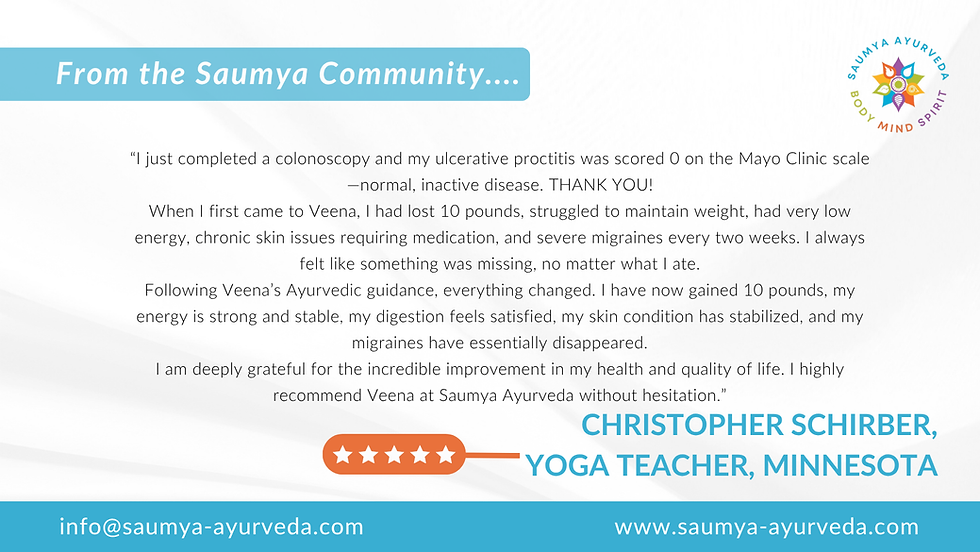

Anne R., Minneapolis, Minnesota USA
Explore more client success stories from Saumya Ayurveda and see how Ayurveda supports healing, balance, and transformation.

Discover the Saumya Ayurveda Way
Ayurveda Begins With Seeing the Whole Person
I've Tried Everything. Why Isn't Anything Working?
When health concerns persist, it can be frustrating to keep trying one recommendation after another without understanding why nothing seems to change.
More health information isn't always the answer. In fact, when stress is already part of the picture, having more information to sort through can add to that stress. Sometimes what is needed is not another recommendation, but someone who really listens and takes the time to understand you as a whole person.
Ayurveda looks beyond individual symptoms to understand the whole person and the root causes of the dosha imbalances contributing to how you feel. This makes it possible to move beyond simply managing symptoms and understanding what you specifically need.
Why the Same Symptom Can Require a Different Approach
The same symptom does not necessarily call for the same solution. General health advice—and even general Ayurvedic advice—can fall short because most people experience more than one symptom and may have more than one dosha out of balance. Understanding the doshic picture as a whole is essential for providing truly supportive guidance.
Ayurveda looks beyond the symptoms to understand the root cause of each doshic imbalance, the dynamic interplay between the doshas, and how they affect the whole person.
Personalized Ayurveda, Rooted in Tradition
Saumya Ayurveda combines classical Ayurvedic principles with practical guidance for modern life. Your recommendations are based on your individual prakriti (natural constitution), vikriti (current state of doshic imbalance), lifestyle, environment, and circumstances—not a generic dosha checklist or one-size-fits-all protocol.
The goal is not to overwhelm you with more rules or things to try. It is to help you stop searching and start understanding—so you can make sustainable changes that support balance for you.
For those who want ongoing support, concierge-style Ayurveda consultation packages provide personalized guidance, thoughtful follow-up, and practical tools for bringing Ayurvedic principles into everyday life.
Education First. Personalized Guidance When You Need It.
Veena takes an education-first, client-centered approach. Our favorite product is knowledge.
As you work with Veena, you don't simply receive recommendations—you gain knowledge and self-awareness.
With Saumya Ayurveda, you won't find education built around selling a supplement, herb, or wellness product. Instead, you'll find traditional Ayurvedic perspectives, practical guidance, and timeless principles that cultivate self-awareness and help you make choices that are right for you.
When understanding deepens, better choices naturally follow.
Learn. Observe. Understand. Transform.
Whether you're new to Ayurveda, looking for a deeper understanding of yourself and your nature, or have tried many approaches without finding lasting change, personalized Ayurvedic guidance can help you understand your individual needs and make choices that are appropriate for you.
Begin your Ayurveda journey with a free 15-minute Discovery Call with Veena and explore whether personalized Ayurvedic guidance is right for you.

Meet Veena: Your Trusted Ayurvedic Guide for Clients Worldwide
Veena Haasl-Blilie is a Certified Ayurvedic Practitioner, Ayurveda teacher, meditation guide, and monk with over three decades of experience helping clients worldwide achieve greater balance and well-being through Ayurveda.
As founder of Saumya Ayurveda and President Emeritus of the Meditation Center, Veena serves clients worldwide through personalized Ayurvedic wellness guidance, meditation, and yoga practices.
Saumya Ayurveda has been recognized as the #1 Ayurveda cooking blog and the #3 Ayurveda website and blog and has received multiple consecutive awards for best wellness practice.
Through her work, Veena shares practical Ayurvedic guidance, nourishing recipes, and wellness education for modern living.
Inspired from an early age by learning herbal remedies, food as medicine, and traditional healing practices at her grandmother’s knee, Veena combines traditional Ayurvedic wisdom with compassionate, accessible guidance that supports mental, physical, and spiritual well-being.
Known for her warmth, humor, intuitive approach, and accessible style, Veena empowers people to create sustainable health through personalized Ayurvedic wellness plans designed to fit naturally into everyday life.
Veena is also the author of several free Ayurveda eBooks and writes the educational articles published on the Saumya Ayurveda blog.
As seen in:
Voice America
Albuquerque The Magazine
Learn more about Veena and her work through Saumya Ayurveda.
Disclaimer: This information is for educational purposes only and is not a substitute for professional medical advice. Ayurveda works best when tailored to your unique doshic profile, so it’s essential to understand your constitution and imbalances before using herbs, foods, or lifestyle practices. Consult a Certified Ayurvedic Practitioner for personalized guidance.


