


The Complete Guide to Thyroid Health in Ayurveda

Updated: Aug 2
Do you wake up feeling exhausted, even after a full night's sleep? Are you noticing dry skin, dry eyes, hair thinning, constipation, brain fog, unexplained weight changes, or feeling unusually cold? Perhaps you've been told your thyroid tests are "normal," yet you still don't feel like yourself.
From an Ayurvedic perspective, the thyroid is never viewed in isolation. Instead, Ayurveda looks at the whole person, recognizing that digestion (Agni), nourishment, stress, sleep, daily routines, and the balance of the doshas all influence energy, metabolism, and overall well-being.
In this guide, you'll discover how Ayurveda approaches thyroid health, why personalized care matters, and practical ways to support your body through nourishing food, healthy daily habits, stress management, and timeless Ayurvedic wisdom.

Explore more on the Saumya Blog, selected top Ayurveda blog and website to watch.
Discover how Ayurveda supports healthy thyroid function by addressing digestion, stress, nutrition, and lifestyle. Learn why symptoms such as fatigue, dry skin, hair thinning, brain fog, and low energy may reflect deeper imbalances—and explore practical ways to restore lasting balance naturally.
Key Takeaways
Ayurveda views thyroid health holistically, recognizing that digestion, nutrition, stress, sleep, daily routines, and the balance of the doshas all influence overall well-being.
Symptoms such as fatigue, brain fog, dry skin, dry eyes, hair thinning, constipation, weight changes, and feeling cold may signal underlying imbalances that deserve a comprehensive evaluation.
Strong Agni (digestive fire) is essential for transforming food into nourishment that supports healthy metabolism, energy, and vitality.
Chronic stress, poor sleep, and lifestyle habits can disrupt the body's natural balance, affecting both thyroid function and overall health.
Personalized Ayurvedic care focuses on identifying the root causes of imbalance rather than addressing symptoms alone.
Simple daily practices—including nourishing foods, mindful routines, stress reduction, restorative sleep, and appropriate movement—can help support healthy thyroid function and long-term wellness.
Self-observation is a cornerstone of Ayurveda. Learning to notice your body's patterns can help you better understand your health and make meaningful, lasting changes.
Table of Contents

Understanding Your Thyroid
What Is the Thyroid?
Your thyroid may be small, but its influence on your health is remarkable. This butterfly-shaped gland sits at the front of your neck and produces hormones that help regulate how your body creates and uses energy.
Every heartbeat, every breath, every meal you digest, and every cell in your body depends—directly or indirectly—on healthy thyroid function. (Cleveland Clinic)
It's easy to think of the thyroid as simply a "metabolism gland," but it does far more than that. The hormones it produces help coordinate communication throughout the body, ensuring that your organs and tissues work together efficiently.
What Does the Thyroid Do?
Healthy thyroid hormones help regulate many essential functions, including:
Energy production and metabolism
Body temperature
Heart rate
Digestion and bowel function
Brain function and mental clarity
Skin and hair health
Muscle function
Growth, development, and fertility
Because thyroid hormones influence nearly every organ system, thyroid imbalance can produce a wide variety of symptoms that don't always seem connected at first glance.
Why Thyroid Health Affects the Whole Body
The thyroid doesn't work in isolation.
When your thyroid is functioning well, your body is able to produce energy efficiently, maintain a comfortable body temperature, support healthy digestion, and nourish your tissues.
When thyroid function changes, however, the effects may ripple throughout the body. You might notice fatigue, brain fog, constipation, dry skin, dry eyes, thinning hair, changes in weight, feeling unusually cold, or simply feeling like your body isn't working the way it once did.
Because these symptoms develop gradually and can overlap with many other health conditions, thyroid concerns are not always immediately recognized. That's why it's important to work with your healthcare provider for an accurate diagnosis and appropriate medical evaluation. (Mayo Clinic)

Common Signs Your Thyroid May Need Attention
Thyroid concerns often develop gradually. Instead of one dramatic symptom, many people notice a collection of subtle changes that slowly begin to affect their daily lives.
Because these symptoms can overlap with many other health conditions, they should not be used to diagnose a thyroid disorder. Instead, think of them as signals that deserve further evaluation by your healthcare provider.
You may want to discuss your symptoms if you notice:
Persistent fatigue, even after adequate sleep
Brain fog, difficulty concentrating, or forgetfulness
Hair thinning or increased hair shedding
Dry skin that doesn't improve with moisturizing
Constipation or slower digestion
Feeling unusually cold when others are comfortable
Unexplained weight changes
Mood changes, including feeling down or less emotionally resilient
Low motivation or reduced interest in activities you once enjoyed
Not everyone experiences the same symptoms, and their severity varies from person to person and on their doshic picture. Some people notice only one or two changes, while others experience several symptoms that gradually worsen over time.
According to the Mayo Clinic and the Cleveland Clinic, symptoms such as fatigue, constipation, dry skin, hair changes, cold intolerance, slowed thinking, and weight changes are among the common signs associated with hypothyroidism, although these symptoms are not unique to thyroid disease and can have many different causes. Comprehensive medical evaluation is important for an accurate diagnosis.
From an Ayurvedic perspective, these symptoms are not viewed in isolation. They provide valuable clues about your body's overall state of balance.
Rather than focusing on a single symptom, Ayurveda considers the complete picture—including your digestion (Agni), Ama (toxins), daily routines, sleep, stress levels, nourishment, and the balance of Vata, Pitta, and Kapha—to better understand the underlying patterns contributing to your health.
Self-observation begins with awareness. Before trying to change your symptoms, simply begin noticing them.
Which symptoms are most consistent? When did they begin? What makes them better—or worse?
These observations often provide valuable insights and become an important starting point for both conventional medical evaluation and an Ayurvedic assessment.

How Ayurveda Views Thyroid Health
Ayurveda teaches us to look at the whole person—not just one part of the body.
There isn't one "thyroid dosha" in Ayurveda. Instead, Ayurveda asks a much deeper question: Why has this imbalance developed?
Not focusing on the thyroid alone, Ayurveda considers how your entire body is functioning.
A Certified Ayurvedic Practitioner looks for patterns that may be influencing your health, including:
Digestion (Agni) – Are you digesting and absorbing your food well?
Metabolism – Is your body producing steady energy throughout the day?
Tissue nourishment (Dhatus) – Are your tissues receiving the nourishment they need?
Elimination (Malas) – Is your body efficiently eliminating waste?
Stress and sleep – How are your daily habits affecting your nervous system?
Vata, Pitta, and Kapha – Which doshas may be contributing to your current symptoms?
These systems don't work independently—they influence one another every day. When digestion is impaired, the body may not receive the nourishment it needs.
Chronic stress may affect digestion, sleep, energy, and overall well-being. Over time, these patterns can contribute to Dosha imbalances throughout the body.
The Charaka Samhita, one of Ayurveda's foundational texts, teaches that balanced Agni (digestive fire) is essential for health and that impaired Agni is the beginning of disease as it produces Ama. This timeless principle continues to guide Ayurvedic practice today.
Instead of asking only, "How is your thyroid functioning?" Ayurveda also asks: "How are you feeling?"
That simple shift in perspective is what makes Ayurveda so unique. Rather than treating one organ in isolation, Ayurveda seeks to understand the whole you-body, mind, and spirit. Ayurveda does not see you as a lab value.
"One of the things I love most about Ayurveda is that it continually reminds us to look at the whole person. Over the years, I've seen how often people come seeking support for one specific concern, only to discover that digestion, sleep, stress, daily habits, and nourishment are all part of the same conversation. When we begin looking at these connections instead of focusing on one symptom alone, we gain a deeper understanding of what the body is asking for and how to support it naturally." - Veena Blilie
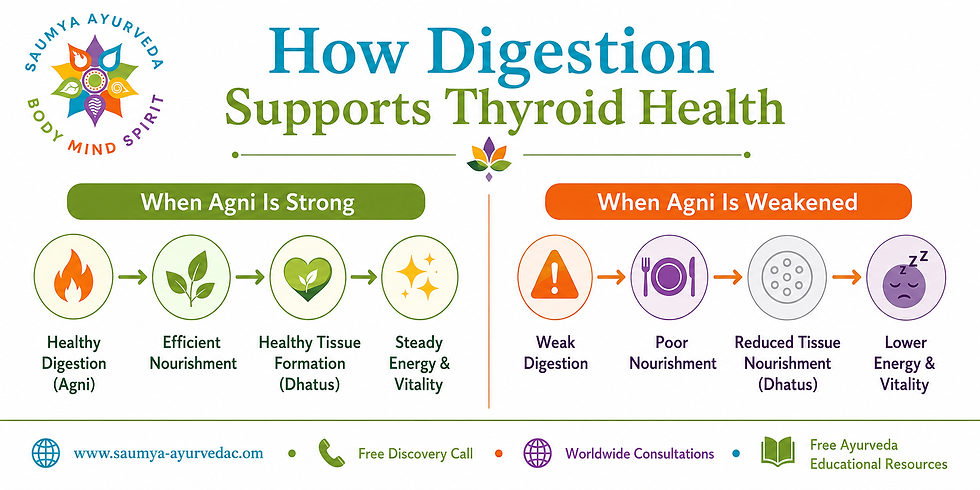
Why Digestion Matters More Than You Think
When most people think about thyroid health, they think about hormones.
Ayurveda begins somewhere different—it begins with digestion.
One of Ayurveda's foundational teachings is that good health depends on Agni, often translated as digestive fire. But Agni is much more than stomach acid or the ability to digest a meal.
It is the body's capacity to transform food into nourishment, nourishment into healthy tissues, and healthy tissues into lasting energy and vitality.
The Charaka Samhita teaches that balanced Agni is the foundation of health, while impaired Agni is considered the beginning of disease.
This timeless principle continues to guide Ayurvedic practice today.
When digestion is strong, your body is better able to absorb nutrients, nourish your tissues, eliminate waste, and support healthy metabolism.
When digestion becomes weak or irregular, your body may not receive the nourishment it needs—even when you're eating a healthy diet. Sound familiar? You're doing everything right, yet you don't feel like yourself.
From an Ayurvedic perspective, the effects of impaired digestion don't stop in the digestive tract. Over time, they may influence how well your tissues (Dhatus) are nourished, how steadily you produce energy, and how resilient you feel from day to day. Rather than asking only, "What should I take for my thyroid?" Ayurveda asks:
How well am I digesting my food?
Am I absorbing the nourishment my body needs?
Are my tissues receiving proper nourishment?
Is my body efficiently eliminating waste?
How are stress, sleep, and daily habits affecting my digestion and overall well-being?
These questions help uncover the underlying root causes contributing to dosha imbalance, allowing Ayurveda to support the whole person rather than focusing on one symptom or one organ.
Supporting digestion is not simply about improving digestive comfort—it is one of the most important ways Ayurveda seeks to promote energy, resilience (Ojas), and whole-body health. For this reason, strengthening Agni is often one of the first priorities in an Ayurvedic wellness plan.
Protecting Ojas Supports Long-Term Thyroid Health
In Ayurveda, Ojas is considered the body's reserve of vitality, resilience, and natural immunity. Chronic stress, poor digestion, inadequate sleep, and long-standing illness can gradually deplete Ojas, leaving you feeling exhausted even when thyroid lab values appear "normal."
Many of the recommendations in this article—including eating nourishing foods, improving digestion, reducing stress, practicing diaphragmatic breathing, sleeping well, and following a consistent daily routine—help support the healthy formation of Ojas.
Rather than chasing quick fixes, Ayurveda focuses on rebuilding this deep reserve of vitality over time.

Ama: When Digestion Leaves Residue Behind
Ama is often translated as toxins, but that translation doesn't tell the whole story. Think of Ama as what the body is unable to fully digest, absorb, or eliminate. While Ama can develop from poorly digested food, Ayurveda also teaches that we can struggle to "digest" stress, emotions, and an overly busy lifestyle.
When Agni—your digestive fire—is strong, your body transforms food into nourishment and naturally eliminates what it no longer needs.
When Agni becomes weak or imbalanced, that process is less efficient. Instead of creating healthy tissues and steady energy, digestion may leave behind residue that Ayurveda calls Ama.
Think of your kitchen sink. If water flows freely, everything drains away as it should. But if the drain begins to clog, residue gradually builds up.
Ayurveda uses a similar way of thinking about the body. When digestion isn't working efficiently, Ama may slowly accumulate over time.
From an Ayurvedic perspective, Ama can interfere with the body's natural balance. You may notice sluggish digestion, feelings of heaviness, low energy, mental fog, or simply not feeling like yourself.
These are observations—not a diagnosis—but they can be important clues that your body is asking for support.
This is one of the reasons Ayurveda places such a strong emphasis on digestion. Rather than trying to cover up symptoms, Ayurveda first works to strengthen Agni, because healthy digestion is the foundation of healthy nourishment.
One of the beautiful teachings of Ayurveda is that your body is always communicating with you. The question is, are we listening?
Start by noticing:
How hungry am I before meals?
Do I feel energized or sluggish after eating?
Is my digestion comfortable and regular?
Do I wake up feeling refreshed or tired?
What foods leave me feeling nourished, and which leave me feeling heavy?
There are no right or wrong answers—only observations.
As you begin paying attention to these daily patterns, you may discover that digestion influences far more than your stomach. It plays a role in your energy, mental clarity, resilience, and overall well-being.
That's why Ayurveda begins with digestion. When we strengthen Agni, we create the conditions for the body to nourish itself more effectively and support lasting health.

Which Doshas Influence Thyroid Health?
One of the questions I'm often asked is, "Which dosha causes thyroid problems?" The answer may surprise you.
From an Ayurvedic perspective, thyroid health is rarely explained by a single dosha. Instead, Ayurveda looks for patterns of dosha imbalances unique to each individual.
Two people may share the same medical diagnosis yet have very different Ayurvedic constitutions, lifestyles, digestive health, and symptoms. That's why Ayurveda emphasizes personalized care rather than one-size-fits-all recommendations.
Rather than beginning with the question, "Which thyroid condition do you have?" Ayurveda asks, "What dosha imbalances is your body showing?"
For example:
Vata
When Vata is out of balance, you may notice:
Anxiety or feeling easily overwhelmed
Difficulty sleeping
Dry skin or dry hair
Constipation
Feeling scattered or mentally fatigued
Variable energy throughout the day
Pitta
When Pitta is aggravated, you may notice:
Feeling unusually warm or heat intolerant
Irritability or frustration
Excessive hunger or thirst
Inflammation or sensitivity
A tendency to push yourself even when you're tired
Kapha
When Kapha is increased, you may notice:
Low energy or sluggishness
Feeling heavy or unmotivated
Weight gain or difficulty losing weight
Slow digestion
A tendency to feel sleepy or less mentally alert
These are common Dosha expressions—not diagnoses. Many people experience qualities from more than one dosha, and those patterns often change with stress, diet, sleep, the seasons, and different stages of life.
One of the reasons Ayurveda is so individualized is that it doesn't focus on symptoms alone. It asks how your digestion (Agni), daily habits, stress levels, sleep, tissue nourishment, and doshic balance are working together to influence your overall health.
Change the question from, "Which dosha am I?" to: "What Dosha patterns are my body (and mind) showing me today?"
That simple shift in perspective encourages curiosity instead of labels and helps guide a personalized approach to supporting balance and well-being.

Thyroid Health Looks Different for Everyone
One of the reasons Ayurveda is personalized is that no two people are exactly alike. Two people may share the same thyroid diagnosis, yet their symptoms can be very different. Ayurveda recognizes these differences and uses them to guide individualized care.
Prakriti is your unique constitution—the natural balance of Vata, Pitta, and Kapha you were born with. Think of it as your body's blueprint. It influences your physical characteristics, tendencies, strengths, and natural predispositions throughout life.
Vikriti, on the other hand, reflects your current state of balance or imbalance. It changes over time in response to factors such as diet, stress, sleep, age, daily routines, the seasons, aging, and life experiences.
Understanding this distinction is important because Ayurveda doesn't treat everyone with the same symptoms the same way.
For example, one person with low energy may also struggle with anxiety, dry skin, constipation, and poor sleep. Another person with similar fatigue may experience weight gain, sluggish digestion, and feeling cold most of the time.
Although both individuals may complain of fatigue, the underlying patterns are different, and their Ayurvedic recommendations may also differ.
Rather than asking, "What thyroid condition do I have?" Ayurveda also asks:
What is my natural constitution (Prakriti)?
What imbalances am I experiencing today (Vikriti)?
What patterns are my body and mind showing me?
These questions help create a personalized approach to supporting the whole you.
One of the beautiful teachings of Ayurveda is that your constitution doesn't change—but your imbalances can. As digestion improves, daily habits become more supportive, stress is better managed, and the doshas return toward balance, many people begin to feel more like themselves again.
Want to learn more? Read our in-depth guide, What Is Prakriti vs. Vikriti? Understanding Your Ayurvedic Constitution and Current Imbalance, to discover how these two foundational concepts can help you better understand your body and support lasting balance.

The Mind-Thyroid Connection
Ayurveda recognizes the deep connection between the mind and the body. They are not separate—they continually influence one another.
Have you ever noticed that during stressful periods you feel more tired, your digestion changes, your sleep suffers, or it's harder to think clearly?
Those observations matter.
Modern research continues to demonstrate that chronic stress and poor sleep can influence hormones, the nervous system, inflammation, and overall health. When stress becomes a daily companion, the body remains in a constant state of alertness.
Over time, elevated levels of stress hormones such as cortisol may affect energy, metabolism, sleep, and the body's ability to recover. While stress does not directly cause every thyroid condition, it can influence how we feel and how resilient we are. (1)
Ayurveda has long recognized that rest is just as important as activity. When we are constantly rushing from one task to the next, the body has fewer opportunities to repair, restore, and nourish itself.
This is one of the reasons daily practices are such an important part of Ayurveda.
Simple practices like diaphragmatic breathing, meditation, mindful movement, spending time in nature, and creating a consistent daily routine help calm the nervous system and support a healthier response to stress.
These aren't quick fixes—they are gentle habits that, practiced consistently, help create a stronger foundation for long-term well-being.
One of the beautiful things about the breath is that it is always with us.
Breath is the only bridge between the body and the mind.
When we slow the breath, we often begin to quiet the mind. As the mind becomes calmer, the body has a greater opportunity to rest, digest, and restore itself. Over time, many people notice improvements not only in how they feel emotionally, but also in their energy, sleep, digestion, and resilience.
"You don't have to change everything overnight. Begin with one nourishing habit, practice it consistently, and let your body show you what is possible." -Veena Blilie
¹ This section is supported by information from the National Institutes of Health, Mayo Clinic, and Cleveland Clinic on the effects of chronic stress, sleep, cortisol, and overall health.
🌿 Saumya Self-Observation™Take a moment to reflect:
There are no right or wrong answers—only observations. One of Ayurveda's greatest gifts is learning to recognize these patterns. As you become more aware of how stress, sleep, breathing, and daily habits affect your body, you can begin making small, meaningful changes that support lasting balance. |

Food as Medicine for Thyroid Health
One of Ayurveda's most beautiful teachings is that food is medicine.
Every meal is an opportunity to nourish your body, support digestion, and build healthy tissues. Rather than asking, "What foods are good for my thyroid?"
Ayurveda begins with a more fundamental question:
"Can my body fully receive the nourishment I'm giving it?"
That's an important distinction.
You can eat the healthiest foods in the world, but if your digestion is weak, your body may not fully absorb or utilize those nutrients.
This is why Ayurveda places such importance on Agni, your digestive fire. Healthy digestion is what transforms food into energy, healthy tissues, and vitality.
Food isn't simply measured by calories or nutrients. Ayurveda also considers:
Is this food fresh and nourishing?
Is it easy for me to digest?
Does it support my current state of balance?
How do I feel after eating it?
These questions help us move beyond dieting and toward nourishment.
Choose Foods That Nourish
Whenever possible, choose whole, unprocessed foods that are freshly prepared. Ayurveda favors meals that are colorful, seasonal, and satisfying rather than processed or packaged
As Veena says, "Eat food as nature grew them." That makes decision making simple.
A nourishing plate often includes:
High-quality protein
Healthy fats
Whole grains
Plenty of vegetables
Seasonal fruits
Digestive spices
Adequate hydration
Simple, wholesome meals are often easier for the body to digest than foods filled with refined sugars, additives, preservatives, and artificial ingredients.
Support Healthy Digestion
How you eat matters just as much as what you eat.
Whenever possible:
Eat in a calm, relaxed environment.
Avoid eating while working or scrolling on your phone.
Chew your food thoroughly.
Eat only when you're genuinely hungry.
Allow time between meals so your previous meal has a chance to digest.
These simple habits help support Agni, allowing your body to better digest and utilize the nourishment you receive.
Nutrients That Support Thyroid Health
While Ayurveda doesn't reduce thyroid health to individual nutrients, modern nutrition has identified several that play important roles in normal thyroid function.
Foods naturally rich in iodine include:
Sea vegetables (such as seaweed)
Cod, sardines, salmon, and shrimp
Plain yogurt
Milk
Eggs
Iodized salt (used appropriately)
Other nutrients that support healthy thyroid function include:
Selenium: Brazil nuts
Zinc: Pumpkin seeds, legumes, nuts
Omega-3 fatty acids: Walnuts and fatty fish
Vitamin E: Almonds and sunflower seeds
Ayurveda's Favorite Nourishing Foods
Many traditional Ayurvedic foods also support healthy nourishment and digestion.
These include:
Ghee for nourishment and healthy digestion
Lightly cooked leafy greens for minerals and easier digestion
Mung (Moong) beans as one of Ayurveda's most digestible protein sources
Sattu (roasted Bengal gram flour) for steady, sustained energy
Fresh seasonal vegetables and fruits
Digestive spices such as cumin, coriander, fennel, turmeric, ginger, cardamom, and black pepper, chosen according to your constitution and digestive capacity
Instead of relying on one "superfood," Ayurveda encourages eating a wide variety of nourishing foods prepared with care and enjoyed mindfully.
There isn't one perfect diet for everyone.
Food is medicine when it is balancing for your doshic picture.
The foods that nourish one person may not be the best choice for another. Ayurveda encourages us to choose foods that support our digestion, our constitution, and our current state of balance.
When food is selected thoughtfully, prepared with care, and digested well, it becomes one of the most powerful ways to support lasting health.
One of my favorite moments during an Ayurvedic consultation is when someone begins noticing these patterns for themselves. Instead of wondering whether a food is "good" or "bad," they begin asking how it makes them feel. That simple shift—from following rules to observing the body's response—is where Ayurveda becomes deeply personal and where lasting change often begins.-Veena Blilie

Herbs Traditionally Used in Ayurveda
One of the biggest misconceptions about Ayurveda is that there is one herb for every condition.
There isn't. It's not how it works.
In Ayurveda, herbs are never selected simply because two people share the same diagnosis. Instead, they are chosen based on the individual.
Two people with the same thyroid condition may have different constitutions, different patterns of imbalance, different digestive strength, different lifestyles, and different health histories.
Because of this, their herbal recommendations may be completely different. This personalized approach is one of Ayurveda's greatest strengths.
Before herbs are ever recommended, a Certified Ayurvedic Practitioner completes a comprehensive Ayurvedic assessment that considers your Prakriti (constitution), Vikriti (current imbalances), Agni (digestive fire), doshic balance, digestion, Ama, elimination, lifestyle, climate, season, medications, health history, and overall Dosha patterns.
This comprehensive evaluation is important because the wrong herb, taken at the wrong time or for the wrong person, can contribute to further doshic imbalance.
A warming herb that supports one person may aggravate another. Likewise, an herb that is appropriate during one stage of life may not be the best choice during another.
For example, someone with a predominantly Vata pattern may benefit from a very different herbal approach than someone experiencing a Kapha pattern of sluggishness or a Pitta pattern of heat and inflammation.
The goal is not simply to choose a popular herb.
Only after understanding the whole person does Ayurveda begin considering whether herbs are appropriate and, if so, which herbs are the best fit for that individual.
Some herbs that have been traditionally used in Ayurveda to support healthy digestion, metabolism, vitality, stress resilience, and overall well-being include:
Ashwagandha
Ashwagandha has been used in Ayurveda for centuries as a rejuvenating herb that supports resilience, vitality, and the body's ability to adapt to stress. Because it is naturally warming, it is not appropriate for everyone and should be used under the guidance of an experienced Ayurvedic professional.
Guduchi
Guduchi is traditionally valued for supporting healthy digestion, immune function, and overall vitality.
Guggulu
Guggulu has long been used in classical Ayurveda to support healthy metabolism and tissue health. It is most commonly recommended as part of a carefully selected herbal formulation rather than as a single herb.
Turmeric
Turmeric is one of Ayurveda's most respected herbs for supporting healthy digestion and overall well-being. It is valued both as a culinary spice and as part of traditional herbal preparations.
Brahmi
Brahmi is traditionally used to support mental clarity, concentration, and a calm, balanced mind.
One of the beautiful things about Ayurveda is that herbs are never the starting point—they build upon a strong foundation.
Healthy digestion, nourishing food, restorative sleep, supportive daily routines, stress management, and personalized care remain at the heart of Ayurvedic treatment.
When herbs are selected thoughtfully and used as part of a comprehensive Ayurvedic wellness plan, they become one of many tools that help support balance, vitality, and long-term well-being.

Daily Habits That Support Thyroid Health
One of the most beautiful teachings of Ayurveda is that health is created every day.
It's built through the small choices we make from the moment we wake until the time we go to bed.
What we eat, how we move, when we rest, how we respond to stress, and the rhythms we create each day all influence our overall well-being.
There isn't one habit that transforms your health overnight. Instead, Ayurveda teaches that small, consistent practices become the foundation for lasting vitality.
Live in Rhythm
One of the simplest ways to support your body is to create a consistent daily routine.
Ayurveda teaches that the body and mind loves rhythm. Waking at a similar time each morning, eating meals at regular times, moving your body every day, and going to bed at a consistent hour all help support healthy digestion, balanced energy, and a calmer nervous system.
If you're not sure where to begin, creating an Ayurvedic morning routine is one of the simplest ways to establish healthy daily rhythms.
Small routines practiced consistently are often more powerful than dramatic changes that are difficult to maintain.
Rest Before You Need It
Many of us have been taught to keep going until we're completely exhausted. We push through fatigue, ignore the signs that we're overwhelmed, and tell ourselves we'll rest when everything is finished.
The problem is that there will almost always be one more task waiting for us.
Ayurveda offers a gentler approach. Rather than waiting until you're depleted, it encourages you to make rest part of your daily routine.
A few minutes of diaphragmatic breathing, a short walk outdoors, stepping away from your computer, or enjoying a nourishing meal without distractions can help calm the nervous system before stress has an opportunity to build.
One of the beautiful things about Ayurveda is that it reminds us rest is not something we have to earn. It is one of the ways we nourish ourselves every day.
These small moments of restoration help support healthy digestion, a calmer mind, steadier energy, and greater resilience over time.
If chronic stress has become part of your daily life, our article on Ayurveda for Stress Relief offers practical ways to calm the nervous system and restore a greater sense of balance.
Make Sleep a Priority
Sleep is one of the body's greatest opportunities to restore balance.
When sleep becomes irregular or insufficient, we often notice the effects throughout the next day. Energy declines. Mental clarity fades. Digestion may become sluggish. Stress feels more difficult to manage.
Creating a calming evening routine and allowing yourself enough time for restorative sleep is one of the kindest things you can do for your body.
Move in a Way That Feels Good
Movement is important, but Ayurveda isn't about pushing harder or exercising until you're exhausted.
Instead, choose movement that leaves you feeling stronger, more energized, and more connected to your body.
Walking, yoga, strength training, gardening, stretching, or simply spending time outdoors can all support healthy circulation, metabolism, and overall well-being. The best movement is the one you'll enjoy enough to practice consistently.
Nourish Yourself with Abhyanga
One of Ayurveda's most cherished daily practices is Abhyanga, or Ayurvedic self-massage.
More than caring for the skin, Abhyanga is an act of self-care. It helps calm the nervous system, nourish the tissues, support healthy circulation, and create a sense of grounding—especially during busy or stressful times.
Many people are surprised by how something so simple can leave them feeling calmer, more relaxed, and more connected to their bodies.
If you've never tried this daily ritual, our complete guide to Abhyanga: How to Do Ayurvedic Self-Massage at Home walks you through the benefits, oils, and step-by-step instructions.
Let Your Breath Become Your Anchor
If I could recommend just one daily practice, it would be diaphragmatic breathing. Breath is the bridge between the body and the mind.
When we breathe slowly and deeply, we signal to the nervous system that it is safe to relax. Over time, this simple practice can help us respond to stress with greater ease while supporting better sleep, steadier energy, and a greater sense of well-being.
It sounds almost too simple, yet time and again people discover that as they practice, they begin to feel calmer, sleep more deeply, and move through their day with greater resilience.
If diaphragmatic breathing is new to you, our free guide explains exactly how to begin and why this simple practice can have such a profound effect on your health.
Create Space for Stillness
Our world is constantly asking for our attention, making it easy to move through the day without taking a moment to simply be still.
Ayurveda gently reminds us that caring for the mind is just as important as caring for the body. When we create even a few quiet moments each day, we give the nervous system an opportunity to rest, the mind a chance to settle, and ourselves the space to reconnect with what truly matters.
Stillness looks different for everyone. For some, it may be meditation. For others, it may be prayer, quiet reflection, time in nature, or simply sitting in silence with a cup of tea before the day begins.
There isn't one right way to practice stillness. What matters most is finding a practice that feels nourishing and returning to it consistently.
You don't need an hour each day to experience the benefits. Even five or ten minutes of regular practice can become part of the natural rhythm of your day. Over time, those quiet moments often help us respond to life's challenges with greater calm, clarity, and resilience.
If you're new to meditation or would enjoy a little guidance, explore our collection of free guided meditations and breathing practices, designed to help you cultivate greater inner stillness and support a calmer, more balanced nervous system.
Ayurveda doesn't ask us to become perfect. Instead, it encourages us to make small, thoughtful choices that support our well-being each day.
Those choices may seem simple, but practiced consistently, they become the foundation for greater balance, vitality, and lasting health.
🌿 Saumya Self-Observation™ Exercise Observe for one week: ✔ Energy upon waking ✔ Hunger before meals ✔ Afternoon energy ✔ Bowel movements ✔ Skin and hair ✔ Sensitivity to cold ✔ Mood ✔ Sleep quality Instead of changing everything at once, begin by noticing the patterns your body is already showing you. Ayurveda teaches that awareness is the first step toward lasting balance. |

Supporting Thyroid Health Through Different Life Stages
Ayurveda recognizes we are continually changing as we move through the three Ayurveda life stages.
The person you are today is not the same person you were twenty years ago, and the habits that supported you then may not be the ones your body needs now.
Rather than expecting one way of eating or living to work throughout life, Ayurveda encourages us to grow and change with each season of life.
The classical Ayurvedic texts describe three natural stages of life, each influenced by one of the doshas.
Understanding these stages reminds us that our needs naturally evolve over time—and our daily habits should evolve with them.
Building a Strong Foundation (Kapha Stage)
The Kapha stage of life includes childhood and young adulthood—a time of growth, development, and building strong tissues.
Although many people feel resilient during these years, this is the ideal time to establish healthy habits that support lifelong well-being.
Strong digestion, nourishing whole foods, regular movement, restorative sleep, and healthy ways of managing stress become investments in your future health.
The choices you make today help lay the foundation for all the life stages ahead.
The Busy Years of Life (Pitta Stage)
As we move into adulthood, Pitta naturally becomes more prominent. This is often the busiest season of life as we build careers, volunteer, persue education, raise families, care for others, and juggle countless responsibilities.
It's also the stage when many people begin putting everyone else's needs before their own.
Irregular meals, chronic stress, inadequate sleep, and constantly pushing through fatigue can gradually affect digestion, energy, and overall well-being. Ayurveda gently reminds us that caring for ourselves is not selfish—it's essential.
Regular meals, restorative sleep, daily movement, diaphragmatic breathing, meditation, and moments of quiet throughout the day help create the balance needed to thrive during these active years.
For many women, perimenopause begins during this stage. As hormones naturally change, nourishing the body, calming the nervous system, and protecting healthy daily routines become even more important.
Embracing Menopause with Compassion
Menopause is not something to fear or "get through." Ayurveda views it as a natural transition into a new season of life.
Many women notice changes in energy, sleep, digestion, body temperature, and resilience during this time. Rather than resisting these changes, Ayurveda encourages us to listen to them.
This season often invites us to slow down, nourish ourselves more deeply, simplify our routines, and honor what our bodies need today—not what they needed twenty years ago.
The Wisdom Years (Vata Stage)
As we grow older, the qualities of Vata naturally become more noticeable.We may need more warmth, more nourishment, more rest, and more time to recover than we did in earlier years. This isn't a sign that something is wrong—it's one of the natural rhythms of life.
Simple daily practices become even more valuable:
Warm, freshly prepared meals that are easy to digest.
Gentle movement, such as walking, stretching, or yoga.
Daily Abhyanga (Ayurvedic self-massage) to nourish the tissues.
Diaphragmatic breathing to help calm the nervous system.
Meditation, prayer, or quiet reflection to cultivate inner stillness.
Consistent daily routines that support healthy digestion, sleep, and energy.
Time in nature to restore a sense of balance and connection.
Meaningful relationships that provide support, purpose, and joy.
These practices help nourish the body, calm the nervous system, and support vitality as we age.
One of the greatest gifts of Ayurveda is that it teaches us to work with our bodies and minds rather than against them.
Every stage of life brings new opportunities to care for ourselves in different ways and maintain Dosha balance.
By honoring those changes with curiosity, compassion, and daily self-care, we can continue cultivating energy, resilience, and well-being throughout every season of life.

Frequently Asked Questions
Can Ayurveda help support thyroid health?
Ayurveda takes a whole-person approach to health. Rather than focusing on the thyroid alone, it evaluates digestion (Agni), nutrition, lifestyle, stress, sleep, elimination, and the balance of the doshas. An individualized Ayurvedic wellness plan may help support overall health and vitality alongside appropriate medical care.
Does Ayurveda treat hypothyroidism or hyperthyroidism?
Ayurveda is a traditional system of health that focuses on promoting balance throughout the body. It should not replace medical evaluation or treatment for thyroid disease. If you have been diagnosed with hypothyroidism, hyperthyroidism, Hashimoto's disease, Graves' disease, or another thyroid condition, continue working with your healthcare provider. Ayurveda can often complement conventional care by supporting healthy lifestyle habits and overall well-being.
Which dosha is associated with thyroid health?
There isn't one "thyroid dosha." Ayurveda evaluates the whole person rather than assigning thyroid concerns to a single dosha. Depending on the individual, Vata, Pitta, Kapha, or a combination of doshas, agni and ama issues may contribute.
Why is digestion so important in Ayurveda?
Ayurveda teaches that Agni, or digestive fire, is the foundation of health. Healthy digestion allows the body to transform food into nourishment, healthy tissues, and energy. When digestion becomes weak or irregular, the body may not receive the full benefit of even the healthiest foods.
What is Ama?
Ama is often translated as "toxins," but Ayurveda describes it more broadly as material the body has not fully digested, absorbed, or eliminated. From an Ayurvedic perspective, supporting healthy digestion helps reduce the conditions that allow Ama to accumulate.
What foods does Ayurveda recommend for thyroid health?
Rather than recommending one "thyroid diet," Ayurveda encourages eating fresh, nourishing, minimally processed foods that are appropriate for your constitution, digestive capacity, and current state of balance. Healthy digestion is considered just as important as the foods themselves.
Are Ayurvedic herbs safe for everyone?
No. Ayurvedic herbs should be selected based on a comprehensive assessment of your Prakriti, Vikriti, digestion, health history, medications, and overall health. A herb that benefits one person may not be appropriate for another, which is why personalized recommendations are so important.
Can stress affect thyroid health?
Chronic stress may influence many systems throughout the body, including sleep, digestion, energy, and hormone regulation. Ayurveda places great importance on calming the nervous system through daily practices such as diaphragmatic breathing, meditation, restorative sleep, and consistent routines.
What daily habits best support thyroid health?
Ayurveda encourages simple, sustainable habits practiced consistently, including:
Eating nourishing, whole foods
Supporting healthy digestion
Maintaining a regular daily routine
Prioritizing restorative sleep
Moving your body every day
Practicing diaphragmatic breathing
Managing stress
Performing daily Abhyanga (oil massage)
Making time for quiet reflection or meditation
Small daily choices often have the greatest influence on long-term health.
How does an Ayurvedic consultation differ from a medical appointment?
A medical evaluation focuses on diagnosing thyroid conditions and determining appropriate medical treatment.
An Ayurvedic consultation looks comprehensively at your overall health, including your constitution (Prakriti), current imbalances (Vikriti), digestion (Agni), lifestyle, stress, sleep, nourishment, elimination, and daily habits. This comprehensive assessment helps create a personalized wellness plan designed to support balance and vitality.
How do I know if Ayurveda is right for me?
If you're looking for a personalized, whole-person approach to health, Ayurveda may be a valuable complement to your medical care. Rather than focusing on one symptom or one organ, Ayurveda helps you understand how digestion, daily habits, stress, nourishment, sleep, and lifestyle work together to influence your overall well-being. Many people find that learning to observe these patterns becomes one of the most empowering parts of their healing journey.

Glossary of Ayurvedic Terms
Abhyanga
A traditional Ayurvedic self-massage using warm herbal oil to nourish the tissues, calm the nervous system, improve circulation, and promote relaxation.
Agni
Often translated as digestive fire, Agni is the body's ability to digest, absorb, and transform food into nourishment, energy, and healthy tissues. Ayurveda considers balanced Agni to be one of the foundations of good health.
Ama
Ama refers to material the body has not fully digested, absorbed, or eliminated. Ayurveda teaches that supporting healthy digestion helps reduce the conditions that allow Ama to accumulate.
Ayurveda
A traditional system of health that originated in India more than 5,000 years ago. Ayurveda emphasizes restoring balance through nutrition, lifestyle, daily routines, herbal support, and self-awareness while recognizing that every person is unique.
Dhatus
The seven body tissues described in Ayurveda. Healthy Dhatus are formed through strong digestion and proper nourishment and help support the body's structure, strength, and vitality.
Doshas
The three governing energies in Ayurveda—Vata, Pitta, and Kapha—that influence physical, mental, and emotional characteristics. Every person has all three doshas in a unique balance.
Kapha
The dosha composed primarily of the Earth and Water elements. Kapha provides stability, strength, structure, and lubrication. When out of balance, it may contribute to heaviness, sluggishness, or slow digestion.
Ojas
In Ayurveda, Ojas is the body's reserve of vitality, resilience, and immunity. It is nourished through healthy digestion, wholesome food, restful sleep, and balanced daily habits.
Pitta
The dosha composed primarily of the Fire and Water elements. Pitta governs digestion, metabolism, transformation, and body temperature. When aggravated, it may contribute to heat, irritability, or inflammation.
Prakriti
Your unique Ayurvedic constitution established at birth. Prakriti represents your natural balance of Vata, Pitta, and Kapha and serves as your body's blueprint for health.
Vata
The dosha composed primarily of the Air and Space elements. Vata governs movement throughout the body, including breathing, circulation, the nervous system, and elimination. When out of balance, it may contribute to dryness, anxiety, constipation, or irregular energy.
Vikriti
Your current state of balance or imbalance. Unlike Prakriti, Vikriti changes over time in response to diet, lifestyle, stress, sleep, the seasons, aging, and other life experiences. It reflects what is happening in your body today.

Final Thoughts
The thyroid may be a small gland, but it reminds us of one of Ayurveda's most important teachings: every part of the body is connected.
Digestion, nourishment, sleep, stress, movement, daily routines, and the mind all influence one another, and true health comes from supporting the whole person rather than focusing on a single symptom or one organ in isolation.
Ayurveda encourages us to become active participants in our own health. Instead of asking only, "What is wrong?" Ayurveda also asks, "What is my body communicating?"
That simple question invites us to slow down, observe our daily patterns, and make choices that gently guide us back toward balance.
You don't have to change everything at once. Lasting health is rarely built through dramatic changes. More often, it grows from the small decisions we make each day—choosing nourishing foods, supporting healthy digestion, moving our bodies, creating time for rest, breathing deeply, and honoring the changing needs of each season of life.
Your journey will not look exactly like anyone else's, and that's exactly as it should be. Ayurveda reminds us that every person is unique, every stage of life brings new opportunities for growth, and every small step toward balance is meaningful.
As you learn to listen to your body with curiosity and compassion, you begin to discover one of Ayurveda's greatest gifts: the wisdom to care for yourself in ways that support lasting vitality and well-being.
🌿 Start Today Three simple ways: ✔ Eat one warm, nourishing meal without distractions. ✔ Take five slow diaphragmatic breaths before eating. ✔ Observe your energy, digestion, and mood throughout the day. Small, consistent changes often create the greatest long-term improvements. |

What Our Clients Say | Saumya Ayurveda Testimonials
Real Transformations Through Ayurveda Consultation
Physician Testimonial (Medical Endorsement)
“As a physician, I have always believed that prevention is better than cure. In today’s healthcare environment, Ayurveda offers a logical and natural approach to long-term health and prevention.
I began working with Veena during a very demanding phase of my life, and she made the process accessible even within my busy schedule. I was encouraged to follow a steady, sustainable approach focused on real lifestyle change.
Over time, I experienced meaningful improvements in balance, energy, and well-being. In my medical practice, I now see many patients with similar stress- and diet-related imbalances, which has further reinforced my trust in Ayurvedic principles.
I have since referred several patients to Saumya Ayurveda and consider Veena a valuable resource in supporting holistic well-being.”
Dr. Gauri Nagargoje
M.D., Oncology & Hematology
Physician Testimonial (Medical Endorsement)
“As a physician, I initially struggled with Ayurveda’s simplicity and depth, but Veena’s guidance made it practical, scientific, and deeply effective.
Veena has transformed my health and perspective on healing. I experienced significant improvements in focus, digestion, stress response, and overall vitality.
Her personalized approach made lifestyle changes easy and sustainable.
This journey not only improved my health but also inspired a lifelong commitment to integrating Ayurveda into holistic healthcare.”
Dr. Jessica Bedi
D.O., & Ayurvedic Doctor


Rachel R., Denver, Colorado, USA
Explore more client success stories from Saumya Ayurveda and see how Ayurveda supports healing, balance, and transformation.

Discover the Saumya Ayurveda Way
At Saumya Ayurveda, we see you as a whole being—not just a collection of symptoms. True health is more than the absence of disease; it is a state of balance between body, mind, and awareness.
Many people today feel unheard or only partially supported in conventional health systems, especially when symptoms persist without clear answers.
This is where Ayurveda offers a different path.
If you are seeking a holistic approach to health and balanced living, you are in the right place. Saumya Ayurveda provides personalized Ayurvedic guidance designed to support physical, mental, and emotional harmony—helping you move toward a more vibrant and aligned life.
Our approach is rooted in classical Ayurveda and adapted for modern life, with a focus on understanding your unique dosha and prakriti (your natural constitution ) so recommendations are truly individualized—not generic.
Saumya Ayurveda offers concierge-style, client-centered care, meaning your experience is personal, supportive, and free from retail or product pressure. The focus is entirely on education, clarity, and sustainable lifestyle transformation.
Through structured Ayurveda consultation packages, you receive ongoing guidance, thoughtful coaching, and practical tools to help you create lasting change—not temporary fixes.
Begin your Ayurveda journey and book a free 15-minute discovery call.

Meet Veena: Your Trusted Ayurvedic Guide for Clients Worldwide
Veena Blilie is a Certified Ayurvedic Practitioner, Ayurveda teacher, meditation guide, and monk with more than three decades of experience helping clients cultivate greater balance, vitality, and well-being through the timeless wisdom of Ayurveda.
As the founder of Saumya Ayurveda and President Emeritus of the Meditation Center, Veena provides personalized Ayurvedic wellness consultations to clients worldwide while sharing practical guidance through meditation, yoga, nutrition, and daily lifestyle practices.
Inspired from an early age by learning herbal remedies, food as medicine, and traditional healing practices at her grandmother's knee, Veena combines the wisdom of classical Ayurveda with a compassionate, practical approach that fits naturally into modern life.
Known for her warmth, humor, and engaging teaching style, Veena empowers people to better understand their bodies through self-observation and personalized Ayurvedic wellness plans that support mental, physical, and spiritual well-being.
Veena is the author of numerous free Ayurveda eBooks and the educational articles published on the Saumya Ayurveda Blog, which has been recognized as the #1 Ayurveda Recipe Blog and the #3 Ayurveda Website and Blog worldwide.
As seen in:
Voice America
Albuquerque The Magazine
Learn more about Veena and her work through Saumya Ayurveda.
Disclaimer: This information is for educational purposes only and is not a substitute for professional medical advice. Ayurveda works best when tailored to your unique doshic profile, so it’s essential to understand your constitution and imbalances before using herbs, foods, or lifestyle practices. Consult a Certified Ayurvedic Practitioner for personalized guidance.


