


The Ear as a Map of the Body: An Ayurvedic View

Updated: Sep 10
Why would Ayurveda pay attention to something as small as the ear when considering the health of the whole person?
In Ayurveda, no part of the body exists in isolation. The ears are more than organs of hearing; they are sensory organs connected with the nervous system, the doshas, the mind, and our ability to receive information from the world around us. Because the mind and body are interconnected, Ayurveda observes the ears as part of the larger picture of health and balance.
The shape and structure, texture, temperature, color, and sensitivity of the ears can offer observations about an individual's constitution and current state of balance. Ayurveda also recognizes the ear as a seat of Vata, and its qualities may be reflected in the ear's dryness, coolness, subtlety, and mobility. Subtle lines, discoloration, or tissue changes on the external cartilage may also reflect imbalances in corresponding areas of the body.
Learning to observe the ears is a way of developing a more complete understanding of the body and recognizing the subtle ways different systems are connected.
The ear can be a small place to begin observing a much bigger picture.

Discover how Ayurveda views the ear through its structure, qualities, sensory function, and relationship with Vata, doshas, and whole-body balance.
“The ear is a doorway through which we receive the world. Sound is vibration, and what we hear becomes part of our inner experience. The sounds we take in can support or disturb the balance of the mind, creating tension or relaxation, anxiety or deep stillness."— Veena Blilie
Key Takeaways
The ear is closely connected with Vata dosha, sensory perception, and the nervous system.
Ayurveda views the ear as a window into whole-body patterns, not simply an organ of hearing.
Changes in the ears can offer clues when considered alongside other signs and symptoms.
Protecting the ears from excessive noise, cold, and overstimulation supports sensory health.
Ayurveda encourages observation, quiet, and awareness as part of caring for the senses.
Table of Contents

The Ear as a Sense Organ
In Ayurveda, the ear is much more than an organ of hearing. It is one of the five jnanendriyas, the sensory faculties through which we receive knowledge and information from the world around us. In the Charaka Samhita, hearing is described as one of the five sensory faculties, with the ear (shrotra) serving as its sensory site. (Charaka Samhita, Sutra Sthana 8.8)
Through the ears, we take in sound, speech, music, rhythm, and the subtle sounds of everyday life. Hearing allows us to connect with others, orient ourselves within our surroundings, and remain aware of what is happening around us.
Modern physiology also demonstrates this interconnectedness: the inner ear contributes to balance through sensory information that is integrated with signals from the eyes, muscles, and other sensory systems. (NIH)
Ayurveda recognizes that the senses are continually receiving information, and that this sensory input can influence the mind, nervous system, and overall state of balance.
What we hear, how much we hear, and the environments in which we spend our time all become part of our daily experience.
For a deeper look at how Ayurvedic principles can help us understand stress, anxiety, and overwhelm, explore Reduce Stress Naturally: 7 Ayurvedic Tips to Ease Anxiety and Overwhelm.
This is why sensory health matters in Ayurveda. The senses are not separate from the rest of the body; they are pathways through which we receive and respond to the world.
The ear offers a clear example. Rather than considering hearing in isolation, Ayurveda considers the ear in relation to the doshas, mind, sensory function, and daily life.
When we begin to observe the ear in this broader context, something small becomes surprisingly significant: the way we receive sound can tell us something about how we are experiencing the world—and how well we are able to remain in balance within it.

Why the Ear Is Closely Associated With Vata
In Ayurveda, the ear has a particularly close relationship with Vata dosha, whose qualities include movement, lightness, subtlety, and mobility.
Vata governs movement throughout the body and is closely connected with communication, sensory perception, and the flow of information.
The ear reflects these qualities beautifully. Sound is movement—it travels through space as vibration, enters through the ear, and becomes information that we can perceive and understand.
Because the ear is so intimately connected with movement and space, it can be particularly sensitive when Vata becomes aggravated.
This sensitivity may be more noticeable during times of stress, excessive activity, travel, irregular routines, insufficient rest, or too much sensory stimulation.
In an Ayurvedic framework, Vata aggravation may be associated with sensations such as increased sensitivity to sound, dryness, or ringing and buzzing in the ears.
These are just a few ways Vata imbalance can express throughout the body and mind.
Ayurveda does not suggest that every ear concern is caused by Vata. Instead, the qualities, symptoms, causes, and overall pattern help determine which doshas may be involved.
This is why the ear's relationship with Vata is so important in Ayurvedic assessment: the qualities present in the ear can provide another piece of information about the person's broader doshic pattern.
🌿 Saumya Self-Observation: Listen to Your VataRather than asking, “What is wrong with my ears?” begin with curiosity. Take a quiet moment and notice:
There is nothing to diagnose or fix in this exercise. Simply notice. |
The Ear, Mind & Sensory Experience
The ear does more than receive sound. What we hear becomes part of what we experience.
A gentle voice, calming music, birdsong, or the quiet sounds of nature can help us feel at ease. In contrast, persistent noise, loud environments, or too much stimulation can leave the mind feeling unsettled or fatigued.
Ayurveda recognizes the senses as pathways through which we experience the world. The ears are continually receiving information, while the mind is continually interpreting it.
When there is more sensory input than we can comfortably process, it can become harder for the mind to settle.
Consider how much sound may fill an ordinary day: phones ringing, conversations, traffic, television, music, notifications, and the steady hum of modern life. We may be physically still while our senses are still working.
This is why Ayurveda values periods of quiet. Silence gives the senses a chance to rest and the mind an opportunity to become less outwardly engaged. Even a few quiet moments can change how we experience the rest of the day.
The goal is not to avoid sound, but to become more aware of the quality and quantity of what we take in.
Just as Ayurveda encourages thoughtful choices about food, it also invites us to consider the sensory experiences we take in throughout the day.
The Ear as a Reflection of the Whole Body
One of Ayurveda’s foundational principles is that the body functions as an interconnected whole. An observation in one area can therefore provide information that becomes more meaningful when considered alongside the person's broader pattern.
This broader assessment begins with understanding Prakriti and Vikriti—the distinction between what is naturally characteristic of an individual and what may reflect a current imbalance.
The ear is one place where these observations can be considered. Its structure, qualities, sensory function, and changes over time may be viewed alongside the person's constitution, doshas, symptoms, and other clinical findings.
Rather than assigning significance to a single feature, Ayurveda looks for patterns and relationships. A trained practitioner considers what is observed in the ear together with the rest of the person's presentation to understand which Ayurvedic principles may be relevant.
This is what makes ear assessment valuable: the ear does not have to tell the whole story. It simply provides another piece of information within the larger clinical picture.
🌿 Saumya Self-Observation: Follow the ThreadSimply Observe. If you notice changes in your ears, notice what else may be changing. Anxiety, restless sleep, difficulty focusing, ringing, or increased sensitivity to sound can all be associated with Vata. What patterns do you notice? Ayurveda looks at these experiences together, recognizing that the ears, nervous system, mind, and Vata are interconnected. |

What Your Ears May Tell You
Ayurveda does not approach the ear simply by looking at its external appearance. A trained Ayurvedic practitioner considers how the ear is functioning, what qualities are present, which doshas may be involved, and how the findings fit the individual's broader clinical picture.
Classical Ayurvedic descriptions of Karna roga, or disorders of the ear, include distinct patterns such as Karnashula (ear pain), Karnanada (abnormal sounds or ringing), Badhirya (impaired hearing), Karnakandu (itching), and Karnasrava (ear discharge).
Contemporary Ayurvedic publications continue to examine these conditions through the classical framework of dosha, nidana, samprapti, and lakshana.
Vata has a particularly important relationship with the ear. Ayurvedic literature associates Vata aggravation with manifestations such as pain, dryness, ringing or other abnormal sounds, and hearing impairment.
Vata's qualities—dry, light, mobile, subtle, and irregular—help explain why these patterns are considered in a Vata context.
Pitta and Kapha may also participate, producing different qualities and manifestations.
Ayurveda therefore does not reduce every ear concern to Vata simply because the ear is considered a Vata-related site. The dosha involved is considered through the qualities, symptoms, causes, and overall pattern.
To better understand how these qualities express through the body and mind, explore Vata, Pitta, and Kapha and how their balance or aggravation can shape individual patterns.
Ayurveda also recognizes that the health of a sense organ depends partly on how it is used.
The principle of Asatmyendriyartha Samyoga describes inappropriate interaction between a sense organ and its objects through insufficient, excessive, or improper use. In the case of the ear, this brings sensory exposure itself into the Ayurvedic understanding of ear health.
This gives us a more precise Ayurvedic way to understand the ear: not as a stand-alone diagnostic tool, but as one source of clinical information whose qualities, function, disturbances, and patterns are considered within the whole person.
The ear is just one of many ways Ayurveda invites us to observe the body. For a deeper introduction to this approach, explore the free eBook Observable Ayurveda: A Beginner's Guide to Ayurvedic Self-Observation.

The Ear and Prana
In Ayurveda, Prana Vata governs the movement of life force and the flow of sensory information toward the mind. It is associated with the head, the senses, perception, and the intake of what comes from the world around us.
The ear participates in this process through shabda, sound. Sound enters through the ear and becomes an experience that can be recognized, understood, and responded to.
In this way, hearing is not simply a mechanical function; it is part of the process by which Prana connects sensory experience with awareness.
This helps explain why Ayurvedic descriptions of the ear are not limited to its physical structure. The ear belongs to a larger network of indriya, prana, and manas—the sense organ, the vital movement that supports sensory function, and the mind that receives and interprets what the senses perceive.
The Ayurvedic perspective therefore adds another dimension to hearing: the ear receives sound, Prana carries sensory information, and the mind makes that experience meaningful.
This relationship among indriya, Prana, and manas is an important part of understanding how Ayurveda views sensory perception—and why the ear is more than an organ of hearing.

Simple Ayurvedic Ways to Care for the Ears
In Ayurveda, the head and ears are closely associated with Vata dosha, which governs movement, the nervous system, and the sense of hearing. Vata’s qualities of coldness, dryness, and mobility make the ears particularly responsive to cold, wind, excessive stimulation, and depletion.
Ayurvedic ear care therefore emphasizes warmth, gentle oiling, protection, and periods of quiet and rest.
Gentle oiling: In Ayurveda, a small amount of comfortably warm oil is traditionally used around the ears and, in some traditional practices, in the ear canal. Oil should not be placed in the ear canal if there is a perforated eardrum, ear tubes, drainage, infection, or unexplained ear symptoms.
For a closer look at traditional Ayurvedic ear care, including gentle ear massage and Karna Purana, explore Ayurvedic ear care.
Protect from cold and wind: Keep the ears covered in cold or windy weather, especially during prolonged outdoor exposure.
Reduce excessive noise: Avoid very loud environments when possible and use properly fitted hearing protection when needed.
Quiet time: Give your ears regular breaks from loud music, headphones, traffic, and other sustained noise.
Appropriate ear care: Let the ears naturally clear earwax. Avoid cotton swabs, hairpins, or other objects inside the ear canal, which can push wax deeper or cause injury.
Keep them dry: After bathing or swimming, gently dry the outer ear. Avoid inserting objects to dry the canal.

When Ear Symptoms Need Medical Evaluation
Ayurveda offers a traditional framework for understanding patterns involving the ears. However, sudden hearing loss, significant pain, discharge, dizziness, or other concerning changes should receive appropriate medical evaluation.

Frequently Asked Questions
Is the ear considered a sense organ in Ayurveda?
Yes. The ear is one of the five jnanendriyas, the sensory faculties through which knowledge is received. The ear is associated with shabda, or sound.
Why is the ear closely associated with Vata?
The ear has a strong relationship with Vata dosha, particularly because of Vata's qualities of movement, subtlety, lightness, and dryness. Classical Ayurvedic descriptions associate Vata disturbance in the ear with manifestations such as pain, dryness, ringing or other abnormal sounds, and changes in hearing.
Can the ear reflect an imbalance elsewhere in the body?
Ayurveda views the body as an interconnected whole. An ear-related change may therefore be considered alongside other signs, symptoms, doshic qualities, and patterns in the person. An observation in the ear does not establish a diagnosis on its own.
How does sound affect the mind according to Ayurveda?
Sound is the sensory object of the ear. Excessive, insufficient, or inappropriate sensory contact can disturb normal sensory function. Ayurveda therefore values appropriate use of the senses, including periods of reduced sensory stimulation and quiet.
What is Prana Vata's relationship with the ear?
Prana Vata is associated with the head, sensory perception, mental activity, and the intake of sensory information. Through the ear, sound is received as sensory information and becomes part of our experience and awareness.
Does Ayurveda associate ear symptoms with all three doshas?
Yes. Although Vata has a particularly strong relationship with the ear, Pitta and Kapha may also be involved. Their qualities can produce different patterns. For example, Pitta may be associated with heat, burning, redness, and inflammation, while Kapha may be associated with heaviness, itching, obstruction, and thicker secretions.
What simple Ayurvedic practices support healthy ears?
Traditional Ayurvedic care emphasizes protecting the ears from excessive cold and wind, avoiding excessive sound exposure, allowing periods of quiet, and maintaining appropriate sensory use. Traditional practices such as ear oiling have specific indications and should not be applied indiscriminately.
Can Ayurvedic ear care replace medical evaluation?
No. Ayurveda can offer a traditional framework for understanding the ear, but persistent pain, discharge, sudden hearing changes, significant dizziness, or ongoing ringing should receive appropriate medical evaluation.

Glossary of Ayurvedic Terms
Ayurveda — A traditional system of health and healing from India that views the body, mind, senses, and daily life as interconnected.
Asatmyendriyartha Samyoga — An inappropriate relationship between a sense organ and its object, including insufficient, excessive, or improper sensory contact.
Dosha — One of the three fundamental principles of Ayurveda: Vata, Pitta, and Kapha. The doshas govern different functions of the body and mind and can become balanced or aggravated.
Jnanendriya — A sense organ through which knowledge is received. The ear is the jnanendriya associated with hearing.
Kapha — One of the three doshas, characterized by qualities such as heaviness, coolness, stability, and unctuousness.
Karna roga — Ayurvedic disorders or diseases of the ear.
Karnakandu — Itching of the ear.
Karnanada — Abnormal sounds or ringing perceived in the ear.
Karnasrava — Discharge from the ear.
Karnashula — Pain in the ear.
Nidana — The causes or contributing factors associated with a disease or disorder.
Pitta — One of the three doshas, characterized by qualities such as heat, sharpness, intensity, and transformation.
Prana — The vital life force that supports movement, vitality, and the functioning of life.
Prana Vata — A subdivision of Vata associated with the head, sensory perception, mental activity, and the intake of sensory information.
Shabda — Sound, the sensory object associated with the ear.
Samprapti — The Ayurvedic process through which a disease or disorder develops and progresses.
Lakshana — The signs and symptoms through which a disease or disorder is recognized.
Vata — One of the three doshas, associated with movement and qualities such as dryness, lightness, coldness, subtlety, and mobility.

Continue Your Ayurveda Knowledge Journey
The ear is just one of many observations an Ayurvedic practitioner may consider when assessing the whole person. Explore more of Ayurveda's timeless approaches to understanding doshas, qualities, patterns, and individual health—and discover how these principles can deepen your understanding of the body and everyday life.
1. Learn the Foundations of Ayurveda
2. Build a Strong Foundation
3. Better Understand Your Unique Constitution
4. Support Your Vitality Naturally
How to Do Abhyanga Massage at Home: Benefits, Oils, and Step-by-Step Guide
Why Seasonal Transitions Matter for Ojas: An Ayurveda Guide to Immunity and Resilience (Coming September 2026)
5. Explore Common Health Challenges Through an Ayurvedic Lens
7 Ayurvedic Remedies for Maintaining Healthy Blood Pressure Naturally
Gut-Brain Connection in Ayurveda: Reduce Anxiety Through Digestion
Leaky Gut Syndrome in Ayurveda: Causes, Symptoms, Diet, and Natural Healing
Histamine Intolerance: Symptoms, Causes, Diet, and Ayurvedic Treatment for Natural Relief
MCAS Natural Treatment: Ayurvedic Diet, Herbs, and Root Causes
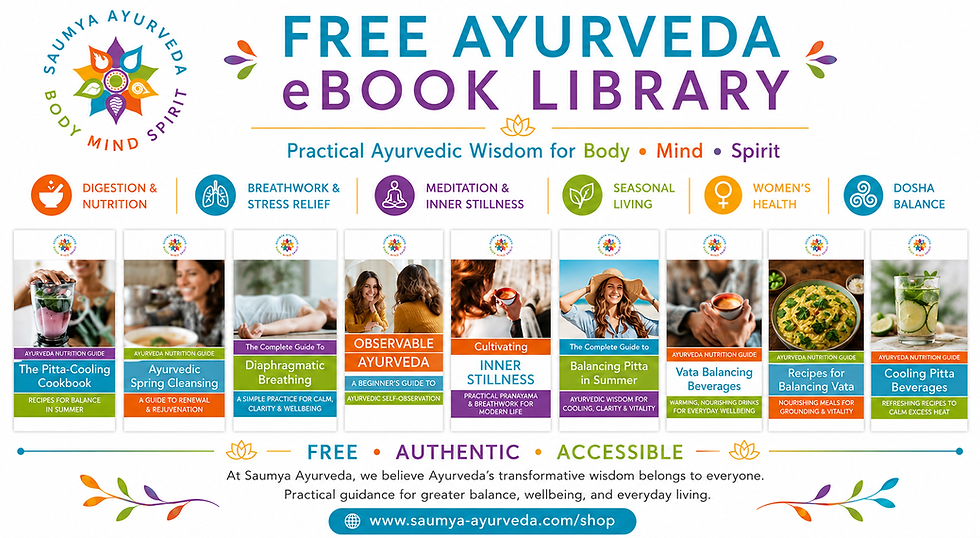
Our Commitment to Accessible Ayurveda Education
At Saumya Ayurveda, we believe Ayurveda's transformative ancient wisdom belongs to everyone—not just those who can afford it. That's why we're committed to making high-quality, authentic Ayurveda education available globally, free of charge.
Through our free eBooks, guides, and educational resources, we offer practical, grounded wisdom to help those seeking greater balance, vitality, and wellbeing integrate Ayurveda into their daily lives.
Accessible. Authentic. Free. Just as it was meant to be.
Free Ayurveda eBooks – Download practical guides, recipes, and wellness resources to support your health journey.
Ayurveda Blog – Enjoy easy-to-read articles, seasonal wellness tips, healthy recipes, and everyday inspiration—always educational, never a sales pitch.
Free Guided Traditional Progressive Meditations – Practice authentic, step-by-step guided meditations to cultivate calm, focus, and inner stillness.
Monthly Educational Newsletter – Receive seasonal Ayurveda insights, new articles, healthy recipes, and free resources delivered to your inbox each month.

Final Thoughts
The ear is a small but meaningful part of Ayurvedic assessment. Its structure, qualities, sensory function, and changes over time can provide observations that a trained Ayurvedic practitioner considers alongside the person's constitution, doshic state, digestion, elimination, sleep, and other clinical findings.
The value is not in assigning meaning to a single feature of the ear. It is in putting observations together. Dryness, pain, unusual sounds, itching, heat, discharge, or changes in hearing may each carry different significance depending on the qualities present and the larger doshic pattern.
This is the strength of Ayurvedic assessment: one observation rarely stands alone. The ear becomes one more source of information that can help a practitioner understand the person in front of them and determine which Ayurvedic principles may be most relevant.
The ear may be small, but in the hands of an experienced Certified Ayurvedic Practitioner, it can provide another valuable piece of the larger doshic picture.

What Our Clients Say | Saumya Ayurveda Testimonials
Real Transformations Through Ayurveda Consultation
Physician Testimonial (Medical Endorsement)
“As a physician, I have always believed that prevention is better than cure. In today’s healthcare environment, Ayurveda offers a logical and natural approach to long-term health and prevention.
I began working with Veena during a very demanding phase of my life, and she made the process accessible even within my busy schedule. I was encouraged to follow a steady, sustainable approach focused on real lifestyle change.
Over time, I experienced meaningful improvements in balance, energy, and well-being. In my medical practice, I now see many patients with similar stress- and diet-related imbalances, which has further reinforced my trust in Ayurvedic principles.
I have since referred several patients to Saumya Ayurveda and consider Veena a valuable resource in supporting holistic well-being.”
Dr. Gauri Nagargoje
M.D., Oncology & Hematology
Physician Testimonial (Medical Endorsement)
“As a physician, I initially struggled with Ayurveda’s simplicity and depth, but Veena’s guidance made it practical, scientific, and deeply effective.
Veena has transformed my health and perspective on healing. I experienced significant improvements in focus, digestion, stress response, and overall vitality.
Her personalized approach made lifestyle changes easy and sustainable.
This journey not only improved my health but also inspired a lifelong commitment to integrating Ayurveda into holistic healthcare.”
Dr. Jessica Bedi
D.O., & Ayurvedic Doctor


Allison F., Minneapolis, Minnesota USA
Explore more client success stories from Saumya Ayurveda and see how Ayurveda supports healing, balance, and transformation.

Discover the Saumya Ayurveda Way
Ayurveda begins with seeing the whole person.
At Saumya Ayurveda, symptoms are not viewed in isolation. Ayurveda looks at the relationship between digestion, elimination, sleep, stress, energy, daily rhythms, mind, stage of life, season, climate, constitution, and current dosha imbalances to understand the patterns that influence how you feel.
When health concerns persist, it can be frustrating to feel that individual symptoms are being addressed without understanding the bigger picture. Ayurveda offers another way—one that asks not only “What is the symptom?” but also “What are the body and mind communicating?”
Personalized Ayurveda, Rooted in Tradition
Saumya Ayurveda combines classical Ayurvedic principles with practical guidance for modern life. Your Ayurveda plan is based on your individual prakriti (natural constitution), virkriti (current imbalances of the doshas), lifestyle, and circumstances—not a generic dosha checklist or one-size-fits-all protocol.
The goal is not to overwhelm you with rules. It is to help you understand your own body and mind, and make sustainable changes that fit naturally into your life, informed by the wisdom of Ayurveda.
For those who want ongoing support, concierge-style Ayurveda consultation packages provide personalized guidance, thoughtful follow-up, and practical tools to help turn Ayurvedic principles into everyday habits.
Education First. Personalized Guidance When You Need It.
Veena takes an education-first, client-centered approach. At Saumya Ayurveda, our favorite product is knowledge. You won’t find education built around selling a supplement, herb, or wellness product. Instead, you’ll find traditional Ayurvedic perspectives, practical guidance, and timeless principles that help you better understand your body, mind, and unique constitution.
When understanding deepens, better choices naturally follow.
For those who want ongoing support, Saumya Ayurveda consultation packages provide personalized guidance, thoughtful follow-up, and practical tools to help turn Ayurvedic principles into everyday habits.
Learn. Observe. Understand. Transform.
Begin your Ayurveda journey with a free 15-minute Discovery Call with Veena and explore whether personalized Ayurvedic guidance is right for you.

MEET VEENA: YOUR TRUSTED AYURVEDIC GUIDE FOR CLIENTS WORLDWIDE
Veena Blilie is a Certified Ayurvedic Practitioner, Ayurveda teacher, meditation guide, and monk with more than three decades of experience helping people cultivate greater balance and well-being through Ayurveda.
As founder of Saumya Ayurveda and President Emeritus of the Meditation Center, Veena combines traditional Ayurvedic wisdom with practical, compassionate guidance for modern life.
Her work integrates Ayurveda, meditation, and yoga with an emphasis on self-observation, education, and sustainable daily practices.
Veena's connection to traditional healing began early, learning about herbal remedies, food as medicine, and natural healing practices at her grandmother's knee.
Today, she brings that foundation into accessible Ayurvedic education, personalized wellness guidance, nourishing recipes, and practical tools that help people better understand their own bodies and minds.
Saumya Ayurveda has been recognized as the #1 Ayurveda cooking blog and #3 Ayurveda website and blog, along with multiple consecutive awards for excellence in wellness practice.
Known for her warmth, humor, intuitive approach, and accessible teaching style, Veena helps people create personalized Ayurvedic wellness plans that fit naturally into everyday life rather than adding another complicated set of rules.
Veena is also the author of several free Ayurveda eBooks and writes the educational articles published on the Saumya Ayurveda blog, sharing Ayurveda knowledge with readers and clients around the world.
As seen in:
Voice America
Albuquerque The Magazine
Learn more about Veena and her work through Saumya Ayurveda.
Disclaimer: This information is for educational purposes only and is not a substitute for professional medical advice. Ayurveda works best when tailored to your unique doshic profile, so it’s essential to understand your constitution and imbalances before using herbs, foods, or lifestyle practices. Consult a Certified Ayurvedic Practitioner for personalized guidance.


