The Ayurvedic View of Diet, Digestion & Elimination

Updated: Sep 3
With so much conflicting information about what to eat, it is easy to feel overwhelmed—and even anxious—about whether you are making the “right” choices for your health. Ayurveda offers something different: a time-tested way of understanding diet, digestion, nourishment, and elimination as parts of one interconnected process.
An Ayurvedic diet is an individualized approach to eating that considers your constitution, current state of balance, digestive capacity, season, environment, stage of life, and the qualities of food. Rather than following one universal food plan, Ayurveda asks what is appropriate for you, at this particular time.
Instead of giving you another list of foods to follow, Ayurveda teaches you to understand how your own body processes what you eat. What you eat matters, but so do your digestive strength, daily habits, and your body’s ability to transform food into nourishment and eliminate what it no longer needs.
In this article, you’ll learn how Ayurveda connects diet, Agni, digestion, and the three malas, and why healthy elimination is an essential part of nourishment and balance. Most importantly, you’ll begin to see why there is no single “perfect” diet for everyone and how self-observation can help you understand what supports your own health.

In Ayurveda, nutrition, digestion, and elimination are connected parts of one process. Food must be properly digested and transformed into nourishment, while the body must effectively eliminate what it no longer needs. Ayurveda emphasizes Agni, individual constitution, daily habits, and healthy elimination to support overall balance.
Key Takeaways
Ayurveda views nutrition, digestion, nourishment, metabolism, and elimination as one interconnected process.
What you eat is only the beginning. The body must transform food before it can become nourishment.
Agni is the Ayurvedic principle of digestion and transformation, supporting the body’s ability to process what it receives.
Nourishment depends not simply on what is eaten, but on how well the body can digest, absorb, and utilize it.
Elimination is not separate from digestion. It is the natural completion of the process, allowing the body to release what it no longer needs.
Ayurveda encourages observation rather than obsession—learning to recognize your own patterns without turning every bodily function into a problem.
Table of Contents

The Body Is Always in a Cycle
Every day, the body is taking things in. Food, water, air, sensory experiences, and everything we encounter through our environment enter into our experience and become part of an ongoing process. But taking something in is only the beginning.
What enters the body must be processed. Food must be digested, nutrients must become available, the body must use what it needs, and what is no longer needed must be released. Ayurveda sees this not as a series of separate events, but as a continuous cycle of taking in, transforming, nourishing, using, and releasing.
Take In → Transform → Nourish → Use → Release
This simple framework brings together several foundational Ayurvedic concepts that are sometimes taught separately:
Ahara, the food we take in and the nourishment it provides
Agni, the principle of digestion and transformation; the nourishment that supports the body's tissues
Mala, the natural waste products that must ultimately be eliminated.
Modern physiology describes these processes in different language. Food is mechanically and chemically broken down, nutrients are absorbed, the body uses them for energy, growth, repair, and other functions, and waste products are eventually eliminated. The terminology is different, but the underlying observation is remarkably clear.
What enters the body must be transformed before it can nourish the body. And what the body does not need must have a pathway out.
This is one of the simple yet profound ways Ayurveda invites you to look at the body: not as a collection of isolated systems, but as a living process that is continually receiving, transforming, using, and releasing.

1. TAKE IN: Diet Begins Before Digestion
Nutrition begins with what you choose to take in.
More precisely, it begins even before that—with the state of your mind. A busy, distracted, agitated, or anxious mind can affect how you experience food and how well your body settles into digestion. A settled mind allows you to be more present, enjoy your meal, and better support digestion.
In Ayurveda, what is nourishing is highly individual. Food has qualities, tastes, textures, temperatures, and effects on the body and mind. Ayurveda asks a more personal question: What is appropriate for this person, at this time, in this place, and in this condition?
This requires more than an online dosha quiz. A quiz can offer a starting point, but a clear Ayurvedic assessment considers Prakriti (natural constitution) and Vikriti (current imbalances), along with your current state of balance, the season, environment, activity level, Agni (digestive capacity), and stage of life.
Without a clear understanding of the doshic picture, even well-intentioned dietary recommendations may be inappropriate and potentially contribute to further imbalance.
This individualized approach is central to food as medicine in Ayurveda. Rather than asking only, “Is this food healthy?” Ayurveda encourages a deeper question:
“Is this food appropriate for me right now?”
Food Is Not the Whole Story
Ayurveda also considers how you eat.
Consider the same meal in two different circumstances. You might eat while rushing through email, barely noticing what is on your plate. Another day, you sit down, take a breath, chew slowly, and actually taste your food.
The food may be identical. The experience of eating is not.
What you eat matters. How you eat matters, too. This is the first step in the Ayurvedic cycle: what we take in becomes the starting material for everything that follows.
“Food becomes medicine when it is appropriate for your unique constitution and current state—and when it is received with a calm, present mind.” - Veena Blilie

2. TRANSFORM: The Role of Agni
Once food enters the body, it must be transformed. This is where Agni becomes central to the Ayurvedic understanding of digestion.
Agni is commonly translated as “digestive fire,” but the concept is broader than simply having a strong or weak stomach. Agni represents the body's capacity to digest, transform, and process what it receives.
Food begins as something outside the body. Through digestion, it is broken down and transformed into substances the body can use.
Western physiology describes this process through chewing, stomach acid, digestive enzymes, bile produced by the liver and released through the gallbladder, intestinal movement, and absorption. The digestive tract breaks food down into smaller components so nutrients can be absorbed and enter circulation.
Because bile is essential to fat digestion, the liver and biliary system can be an important—and sometimes overlooked—part of the digestive picture, even when routine liver tests are normal.
Ayurveda describes this transformative process through the language of Agni. The framework is different, and the vocabulary is different, but both recognize digestion as an active process of transformation.
Why Agni Matters
When digestion is discussed, it is easy to focus only on symptoms: bloating, gas, heartburn, constipation, loose stools, alternating constipation and loose stool, or changes in appetite.
Ayurveda looks beyond the individual symptom and asks a broader question: How well is the body transforming what it receives?
This is why Agni is such an important Ayurvedic concept. Digestion is not simply about breaking food down. It is the process that makes nourishment possible.
The meal is not the finished product. What happens after you eat—and the state of your body and mind—determines how that food can ultimately support you.
🌿Saumya Self-Observation™: Notice Your DigestionPause before and after a meal today. Simply notice:
You are not looking for a problem to fix. Simply notice the pattern. |

3. NOURISH: From Food to the Body
The purpose of digestion is not simply to break food down. The deeper purpose is to make nourishment available to the body.
Ayurveda looks at nourishment through a broader lens. Properly transformed food supports the formation and nourishment of the body's tissues, known as the Dhatus. Nourishment, therefore, is not simply about what was eaten. It depends on what the body is able to transform, absorb, and use.
This creates an important distinction:
Eating is not the same as being nourished.
A person can eat plenty of food and still experience digestive discomfort, inconsistent energy, or a sense that the body is not receiving what it needs. Ayurveda uses this distinction to look beyond the food itself and consider the entire process of digestion and assimilation.
Instead of asking only, “Are you eating healthy food?” Ayurveda asks a more individualized question:
“How well are you digesting and utilizing what you eat?”
That question brings the focus back to the person—not simply the food—and reminds us that nourishment is the result of a process, not just an ingredient list.

4. USE: Nourishment Must Become Available
Once nutrients have been absorbed, the body puts them to work. They contribute to energy production, tissue maintenance, growth, repair, storage, and countless other physiological processes.
Ayurveda similarly views nourishment as an active process rather than passive accumulation. The body is continually transforming, distributing, and using what it receives. Nourishment becomes meaningful when it can actually support the body's needs.
This is why healthy nutrition is not simply about adding more. More protein, more supplements, more superfoods, more vitamins, or more “healthy” ingredients do not necessarily mean more nourishment.
Sometimes the more useful question is: Can the body digest, assimilate, and use what it is already receiving?
This is one reason Ayurveda traditionally gives digestion such an important place in the larger picture of health. The goal is not to put more into the body, but to support the body’s ability to make good use of what it receives.
Nourishment Is Not Accumulation
A healthy system does not simply collect everything that enters it. It distinguishes, transforms, uses, and releases. This rhythm is fundamental to life.
You breathe in and breathe out. You eat and digest. You receive and respond. You work and rest. Throughout the day, the body and mind are continually moving between taking in and letting go.
Balance requires both nourishment and release.
Nourishment supports the body by providing what it needs. Release creates space for what comes next. Together, they create a natural flow—a rhythm of receiving, nourishing, and releasing that allows life to keep moving.

5. RELEASE: The Body Must Let Go
Eventually, the process reaches another essential stage: elimination.
The body does not simply take in, transform, nourish, and use. It must also release what it no longer needs. In Ayurveda, this natural process is described through the three primary Malas: Purisha (feces), Mutra (urine), and Sweda (sweat).
These are not foreign substances invading the body or signs that something has gone wrong. They are natural waste products that arise as part of the body's normal processes.
The body is designed to eliminate them through its natural pathways; this does not necessarily require a special cleansing product or protocol.
“When the pathways of elimination are open and functioning well, the body is continuously releasing what it no longer needs. Cleansing is not something you have to continually add to the body; healthy elimination is itself an ongoing process of cleansing.” —Veena Blilie
Elimination also gives us something observable. Stool, in particular, can offer clues about digestion and how the body is processing and releasing what it no longer needs. For a closer look at what stool may reveal about digestion and balance, explore Ayurveda Stool Analysis: What Your Poop Says About Your Health.
The Three Malas deserve a deeper look because healthy elimination is an essential part of Ayurveda’s understanding of digestion and balance. Explore The Three Malas: Ayurveda’s Guide to Healthy Elimination, Digestion & Balance for a deeper look at this essential aspect of elimination.
The body has its own systems for elimination. The digestive system moves waste through the gastrointestinal tract, the kidneys filter wastes and help regulate fluid balance, and sweating helps regulate body temperature.
Together, these pathways support the body’s ongoing process of releasing what it no longer needs.
Release needs to be balanced for your doshic picture. Release is part of the body's work.
It completes the cycle. What the body can use is transformed and put to work; what it no longer needs is released, making space for the process to begin again.

Mala Does Not Mean Toxin
This distinction is especially important in today’s wellness culture, where “toxin” is often used to describe almost anything the body needs to eliminate.
Cleansing programs are not always individualized, and what supports one person may not support another. Ayurveda considers Prakriti, Vikriti, Agni, and current needs rather than relying on a standard protocol or product.
Lasting balance comes from supporting the complete cycle—beginning with a calm mind: Take In → Transform → Nourish → Use → Release. When this cycle is supported every day, healthy cleansing becomes part of the body’s natural rhythm rather than something limited to a set number of days.
In Ayurveda, Mala refers to natural waste products or by-products of physiological processes. It does not simply mean “toxin,” nor does the presence of Mala mean that the body is dirty, contaminated, or in need of aggressive cleansing.
Mala and Ama are also distinct concepts. Mala refers to what the body naturally produces and eliminates, while Ama is associated with incomplete or impaired processing.
Keeping these concepts distinct helps preserve the depth of the Ayurvedic understanding of elimination rather than reducing it to the modern idea of “toxins.”
The body naturally produces waste because it is continually processing, transforming, and using what it receives.
Elimination is therefore not evidence that something has gone wrong. It is evidence that the body is doing its work—and Ayurveda helps support these natural pathways so the body can do that work well.
The goal is healthy digestion, appropriate nourishment, normal physiological function, and proper elimination.

Digestion and Elimination Are Part of the Same Process
It is tempting to think of digestion as one subject and elimination as another. Ayurveda sees a deeper relationship between the two.
Food enters the body. Digestion transforms it. Nourishment becomes available. The body uses what it needs, and what remains moves toward elimination.
This means elimination can be understood as the downstream expression of a much larger process. What happens at the end of the process is connected to what happened at the beginning.
This does not mean that every digestive or elimination concern has one cause, nor does it mean that bowel movements, urine, or sweat can diagnose disease.
It means the body functions as an interconnected system, and each stage of the process influences what follows.
“This is why Ayurveda places such importance on digestion. When digestion is not functioning optimally, the effects may extend far beyond the digestive tract. Supporting digestion supports the entire process of nourishment, transformation, and elimination.” — Veena Blilie

What Happens When Transformation Is Incomplete?
Ayurveda uses the concept of Ama ("toxins") to describe the consequences of incomplete or impaired processing within the body. Traditionally, Ama is associated with digestion and metabolism that have not fully completed their transformative work.
Ayurveda invites an observant approach. How well is digestion functioning? What happens after meals? Are there patterns of heaviness, sluggishness, or digestive discomfort? What changes when food, routine, sleep, or stress changes?
These observations do not provide a diagnosis. They offer a way to become more aware of patterns and to consider how digestion may be responding to what the body is receiving.
The relationship between Agni and Ama is explored more deeply in Understanding Ama in Ayurveda: Causes, Symptoms, and Natural Ways to Remove Toxins.
The important principle here is simple: Transformation matters. In the Ayurvedic view, what the body cannot properly process may contribute to the formation of Ama, which is traditionally understood as a root factor in imbalance and disease.
This is why Ayurveda places such importance on the digestive process: how well we transform what we take in can influence the health of the entire system and quality of life itself.

Diet Is More Than What Is on the Plate
Ayurvedic nutrition is sometimes reduced to lists: eat this, avoid that, choose these foods for Vata, avoid those foods for Pitta. But the deeper, traditional Ayurvedic approach is more nuanced.
Food choices matter, but they are only part of the picture. Ayurveda also considers timing, quantity, preparation, season, environment, constitution, current state of imbalance, digestive capacity, and even the way a meal is eaten.
This is why two people can eat the same food and have very different experiences. A food that supports one person may not be ideal for another, depending on what is happening in the body at that particular time.
Ayurveda means the knowledge, wisdom, and science of life. Life is dynamic, and so are people. Our doshas, digestion, needs, environment, and state of balance can change over time. A static food list or one-size-fits-all approach cannot fully account for that.
Rather than searching for a universal list of “good” and “bad” foods, Ayurveda encourages a more personal question: What is nourishing for this person, at this time, in this condition?
That question shifts nutrition away from rigid rules and toward observation, understanding, and individual needs.
Through self-observation, Ayurveda invites you into a deeper connection with your own being—learning to recognize what supports you, what disturbs your balance, and how your needs change over time.
“Ayurveda brings you to a deeper connection with your being through self-observation. It is a meaningful way of living.” — Veena Blilie

The Nervous System Is Part of the Picture
You can eat nourishing food, have a strong digestive capacity, and still notice that digestion changes depending on the state of your nervous system.
The body does not digest food in isolation. The digestive tract communicates continuously with the brain through nerves, hormones, and other signaling pathways.
This gut-brain connection is a two-way relationship, with communication constantly taking place between the digestive system and the nervous system.
Western physiology describes this communication through the gut-brain axis and the enteric nervous system. Ayurveda has long recognized that the state of the person matters alongside the food being consumed.
Think about the difference between eating when your attention is pulled in ten directions and eating when you have had a moment to settle. The meal may be exactly the same, but the internal experience is different..
Stress can directly affect digestion through the nervous system, including the enteric nervous system within the gastrointestinal tract.
This does not mean that stress causes every digestive problem, or that simply relaxing will resolve a digestive disorder. It means that the state of the nervous system can meaningfully influence digestion, movement through the gut, secretion, and other digestive processes.
This is why Ayurvedic approaches to digestion extend beyond food itself. Diaphragmatic breathing, rest, routine, attention, and the way you move through a meal can all become part of supporting healthy digestion.
The body is not a collection of disconnected systems. It is an interconnected living system, continually responding to what is happening within and around it.
The Ayurvedic Cycle at a Glance
🌿Saumya Self-Observation™: Follow the Whole CyclePause for a moment and observe your own daily pattern. TAKE IN What are you eating, drinking, breathing, seeing, hearing, and experiencing? TRANSFORM How does your digestion respond? NOURISH Do you feel nourished and satisfied by what you eat? USE How are your energy, focus, activity, and daily functioning? RELEASE How are your bowel movements, urination, and sweating? You do not need to decide whether anything is “good” or “bad.” Simply become curious about the patterns. The body is already communicating. Ayurveda begins by learning how to listen. |

Five Simple Ways to Support the Cycle
Supporting nutrition, digestion, and elimination does not require a complicated routine. Small, consistent choices can support the body's natural rhythm.
1. Eat Food That Is Appropriate for You
Ayurveda does not begin with a universal food list. Consider your constitution, current state, season, stage of life, season, environment, activity, and digestive capacity.
2. Give Digestion Your Attention
Sit down for meals. Slow down. Chew thoroughly. Notice hunger, satisfaction, and how you feel after eating. Do the Two-Minute Meditation before meals.
3. Create Rhythm
Regular meals, sleep, movement, and rest can give the body predictable rhythms to work with.
4. Support the Whole Person
Digestion is influenced by more than food. Breathing, movement, rest, stress, and daily routine all belong in the larger picture.
5. Respect Elimination
Whenever reasonably possible, allow yourself enough time to respond to natural bodily urges rather than continually overriding them.

Diet, Digestion & Elimination: One Continuous Conversation
By now, the five stages can be seen not as separate steps, but as one continuous conversation between the body and what it receives.
TAKE IN
The body receives food, water, air, sensory experiences, and the many impressions of daily life. What enters the body becomes the starting point for everything that follows.
↓
TRANSFORM
What is received must be processed. Agni is central to this transformation, helping the body digest and process what it takes in.
↓
NOURISH
When transformation is successful, nourishment becomes available. What the body can digest, absorb, and use can support its tissues, energy, repair, and ongoing function. (When it is not optimal, Ama forms.)
↓
USE
Nourishment is not meant simply to accumulate. The body puts it to work—supporting movement, energy, growth, maintenance, repair, and the countless activities that keep us alive and functioning.
↓
RELEASE
Not everything the body receives can or should be retained. What is no longer needed moves toward elimination. Release is not separate from nourishment; it is part of completing the process.
↓
TAKE IN AGAIN
And then the cycle continues.
We breathe in and breathe out. Diaphragmatic breathing gives that simple rhythm more depth, helping the body settle into a more receptive state. We eat and digest. We receive and respond. We nourish and use. We release and make room for what comes next.
This is why Ayurveda does not view health simply as a matter of what you consume. It asks us to look at the entire journey: what enters, how it is transformed, what becomes nourishment, how the body uses it, and how naturally it can let go.
When one part of that conversation changes, the experience of the whole cycle can change with it.
Nutrition, digestion, nourishment, use, and elimination are interconnected stages of one continuous process.
They are expressions of one living process—continually receiving, transforming, using, and releasing.

Frequently Asked Questions
What is the Ayurvedic view of diet?
Ayurveda views nutrition as more than the nutrients contained in food. It considers individual constitution, current state, digestion, season, environment, food qualities, preparation, timing, quantity, and the way food is eaten.
What is the relationship between diet and digestion in Ayurveda?
In Ayurveda, food must be properly digested and transformed before it can become nourishment. Agni is the Ayurvedic principle of digestion and transformation that makes this process possible.
Why is Agni important in Ayurveda?
Agni represents the body's capacity to digest, transform, and process what it receives. Within the Ayurvedic framework, healthy Agni supports nourishment and contributes to proper elimination.
What are the Three Malas?
The Three Malas are Purisha (feces), Mutra (urine), and Sweda (sweat). In Ayurveda, they are understood as natural waste products or by-products of physiological processes.
Does Mala mean toxin?
No. Mala does not simply mean “toxin.” It refers to natural waste products within the Ayurvedic framework. Elimination of Mala is a normal part of the body's ongoing processes and does not, by itself, indicate that the body is toxic or contaminated.
Is Ayurvedic nutrition the same for everyone?
No. Ayurvedic nutrition is individualized. Food choices may be influenced by constitution, current state, digestion, season, environment, age, activity, and other circumstances.
How can I begin applying this framework?
Begin with Saumya Self-Observation™ exercises by noticing the complete cycle: what you take in, how you digest it, how nourished you feel, how you use your energy, and how you eliminate. You do not need to change everything at once; small observations can reveal meaningful patterns over time.

Glossary
Agni — The Ayurvedic principle of digestion and transformation. Agni represents the body's capacity to digest, transform, and process what it receives.
Ama — An Ayurvedic concept traditionally associated with incomplete or impaired processing within the body, particularly in relation to digestion and metabolism. Ama should not automatically be translated as a medically recognized “toxin.”
Ahara — Food and nourishment; what is taken into the body as part of the Ayurvedic understanding of diet and nutrition.
Ayurveda — A traditional system, of which, one aspect focuses comprehensively on health. It views nutrition, digestion, nourishment, use, and elimination as interconnected processes and emphasizes individualized understanding.
Dhatus — The body's tissues, which Ayurveda describes as being formed and nourished through the proper transformation and utilization of nourishment.
Mala — Natural waste products or by-products of physiological processes within the Ayurvedic framework. The three primary Malas are Purisha, Mutra, and Sweda.
Prakriti — An individual's natural constitution, which is one factor Ayurveda considers when understanding nutrition and what may be supportive for a person.
Purisha — Feces; one of the three primary Malas in Ayurveda.
Mutra — Urine; one of the three primary Malas in Ayurveda.
Sweda — Sweat; one of the three primary Malas in Ayurveda.

Continue Your Ayurveda Knowledge Journey
Understanding Ayurvedic diet, digestion, and elimination is just one part of Ayurveda’s timeless approach to health. Continue exploring the interconnected principles that help you understand your body, support healthy digestion, and cultivate lasting balance.
1. Learn the Foundations of Ayurveda
Understanding Ojas: Ayurveda's Guide to Lasting Vitality, Energy & Resilience
What Is Prakriti vs. Vikriti? Understanding Your Ayurvedic Constitution and Current Imbalance
The Five Elements in Ayurveda: Understanding Yourself Through Nature
The Three Malas: Ayurveda’s Guide to Healthy Elimination, Digestion & Balance
2. Build a Strong Foundation
3. Better Understand Your Unique Constitution
4. Support Your Vitality Naturally
How to Do Abhyanga Massage at Home: Benefits, Oils, and Step-by-Step Guide
Why Seasonal Transitions Matter for Ojas: An Ayurveda Guide to Immunity and Resilience (Coming September 2026)
5. Explore Common Health Challenges Through an Ayurvedic Lens
7 Ayurvedic Remedies for Maintaining Healthy Blood Pressure Naturally
Gut-Brain Connection in Ayurveda: Reduce Anxiety Through Digestion
Leaky Gut Syndrome in Ayurveda: Causes, Symptoms, Diet, and Natural Healing
Histamine Intolerance: Symptoms, Causes, Diet, and Ayurvedic Treatment for Natural Relief
MCAS Natural Treatment: Ayurvedic Diet, Herbs, and Root Causes
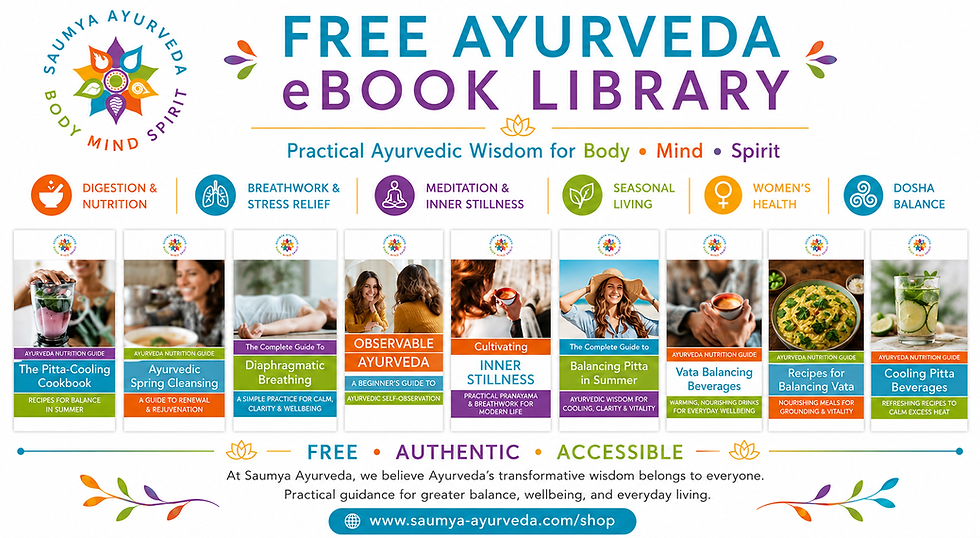
Our Commitment to Accessible Ayurveda Education
At Saumya Ayurveda, we believe Ayurveda's transformative ancient wisdom belongs to everyone—not just those who can afford it. That's why we're committed to making high-quality, authentic Ayurveda education available globally, free of charge.
Through our free eBooks, guides, and educational resources, we offer practical, grounded wisdom to help those seeking greater balance, vitality, and wellbeing integrate Ayurveda into their daily lives.
Accessible. Authentic. Free. Just as it was meant to be.
Free Ayurveda eBooks – Download practical guides, recipes, and wellness resources to support your health journey.
Ayurveda Blog – Enjoy easy-to-read articles, seasonal wellness tips, healthy recipes, and everyday inspiration—always educational, never a sales pitch.
Free Guided Traditional Progressive Meditations – Practice authentic, step-by-step guided meditations to cultivate calm, focus, and inner stillness.
Monthly Educational Newsletter – Receive seasonal Ayurveda insights, new articles, Ayurveda recipes, and free resources delivered to your inbox each month.

Final Thoughts: The Wisdom of the Whole Cycle
What if diet was not simply about what you put into your body, but about what happens next?
Ayurveda offers a way to see the whole process—not as separate functions, but as a continuous movement of receiving, transforming, nourishing, using, and releasing.
This is where Saumya Self-Observation™ becomes practical. Notice how you feel after meals, how your energy changes through the day, what influences your digestion, and how naturally your body eliminates.
Over time, these observations can reveal patterns that are far more useful than a universal list of rules.
You do not need to analyze every sensation or turn every change into a problem.
Simply pay attention. The body is already communicating.

What Our Clients Say | Saumya Ayurveda Testimonials
Real Transformations Through Ayurveda Consultation
Physician Testimonial (Medical Endorsement)
“As a physician, I have always believed that prevention is better than cure. In today’s healthcare environment, Ayurveda offers a logical and natural approach to long-term health and prevention.
I began working with Veena during a very demanding phase of my life, and she made the process accessible even within my busy schedule. I was encouraged to follow a steady, sustainable approach focused on real lifestyle change.
Over time, I experienced meaningful improvements in balance, energy, and well-being. In my medical practice, I now see many patients with similar stress- and diet-related imbalances, which has further reinforced my trust in Ayurvedic principles.
I have since referred several patients to Saumya Ayurveda and consider Veena a valuable resource in supporting holistic well-being.”
Dr. Gauri Nagargoje
M.D., Oncology & Hematology
Physician Testimonial (Medical Endorsement)
“As a physician, I initially struggled with Ayurveda’s simplicity and depth, but Veena’s guidance made it practical, scientific, and deeply effective.
Veena has transformed my health and perspective on healing. I experienced significant improvements in focus, digestion, stress response, and overall vitality.
Her personalized approach made lifestyle changes easy and sustainable.
This journey not only improved my health but also inspired a lifelong commitment to integrating Ayurveda into holistic healthcare.”
Dr. Jessica Bedi
D.O., & Ayurvedic Doctor


Anne R., Minneapolis, Minnesota USA
Explore more client success stories from Saumya Ayurveda and see how Ayurveda supports healing, balance, and transformation.

Discover the Saumya Ayurveda Way
Ayurveda begins with seeing the whole person.
At Saumya Ayurveda, symptoms are not viewed in isolation. Ayurveda looks at the relationship between digestion, elimination, sleep, stress, energy, daily rhythms, mind, stage of life, season, climate, constitution, and current dosha imbalances to understand the patterns that influence how you feel.
When health concerns persist, it can be frustrating to feel that individual symptoms are being addressed without understanding the bigger picture. Ayurveda offers another way—one that asks not only “What is the symptom?” but also “What are the body and mind communicating?”
Personalized Ayurveda, Rooted in Tradition
Saumya Ayurveda combines classical Ayurvedic principles with practical guidance for modern life. Your Ayurveda plan is based on your individual prakriti (natural constitution), virkriti (current imbalances of the doshas), lifestyle, and circumstances—not a generic dosha checklist or one-size-fits-all protocol.
The goal is not to overwhelm you with rules. It is to help you understand your own body and mind, and make sustainable changes that fit naturally into your life, informed by the wisdom of Ayurveda.
For those who want ongoing support, concierge-style Ayurveda consultation packages provide personalized guidance, thoughtful follow-up, and practical tools to help turn Ayurvedic principles into everyday habits.
Education First. Personalized Guidance When You Need It.
Veena takes an education-first, client-centered approach. At Saumya Ayurveda, our favorite product is knowledge. You won’t find education built around selling a supplement, herb, or wellness product. Instead, you’ll find traditional Ayurvedic perspectives, practical guidance, and timeless principles that help you better understand your body, mind, and unique constitution.
When understanding deepens, better choices naturally follow.
For those who want ongoing support, Saumya Ayurveda consultation packages provide personalized guidance, thoughtful follow-up, and practical tools to help turn Ayurvedic principles into everyday habits.
Learn. Observe. Understand. Transform.
Begin your Ayurveda journey with a free 15-minute Discovery Call with Veena and explore whether personalized Ayurvedic guidance is right for you.

Meet Veena: Your Trusted Ayurvedic Guide for Clients Worldwide
Veena Blilie is a Certified Ayurvedic Practitioner, Ayurveda teacher, meditation guide, and monk with over three decades of experience helping clients worldwide achieve greater balance and well-being through Ayurveda.
As founder of Saumya Ayurveda and President Emeritus of the Meditation Center, Veena serves clients worldwide through personalized Ayurvedic wellness guidance, meditation, and yoga practices.
Saumya Ayurveda has been recognized as the #1 Ayurveda cooking blog and the #3 Ayurveda website and blog and has received multiple consecutive awards for best wellness practice.
Through her work, Veena shares practical Ayurvedic guidance, nourishing recipes, and wellness education for modern living.
Inspired from an early age by learning herbal remedies, food as medicine, and traditional healing practices at her grandmother’s knee, Veena combines traditional Ayurvedic wisdom with compassionate, accessible guidance that supports mental, physical, and spiritual well-being.
Known for her warmth, humor, intuitive approach, and accessible style, Veena empowers people to create sustainable health through personalized Ayurvedic wellness plans designed to fit naturally into everyday life.
Veena is also the author of several free Ayurveda eBooks and writes the educational articles published on the Saumya Ayurveda blog.
As seen in:
Voice America
Albuquerque The Magazine
Learn more about Veena and her work through Saumya Ayurveda.
Disclaimer: This information is for educational purposes only and is not a substitute for professional medical advice. Ayurveda works best when tailored to your unique doshic profile, so it’s essential to understand your constitution and imbalances before using herbs, foods, or lifestyle practices. Consult a Certified Ayurvedic Practitioner for personalized guidance.