


Ayurveda Tongue Map: Understanding Organ Locations on the Tongue

Updated: Jul 12
What if your tongue could offer valuable clues about your health? For thousands of years, Ayurvedic practitioners have observed the tongue as part of a comprehensive assessment of digestion, dosha balance, and overall well-being.
Known as the Ayurveda Tongue Map, this traditional practice associates different regions of the tongue with specific organs and body systems, helping practitioners recognize patterns of balance and imbalance.
Rather than diagnosing disease, the Ayurveda Tongue Map is used alongside other Ayurvedic assessments, including your Prakriti (constitution), Vikriti (current imbalances), Agni (digestive fire), pulse, symptoms, and lifestyle. By observing your tongue's color, coating, moisture, shape, and texture, you can gain a deeper understanding of your body's changing needs.
In this guide, you'll learn how the Ayurveda Tongue Map is traditionally interpreted, what different areas of the tongue represent, and how to use tongue observation as part of a mindful daily wellness routine.

Explore more on the Saumya Blog, selected top Ayurveda blogs and websites.
The Ayurveda Tongue Map is a traditional Ayurvedic guide that associates different areas of the tongue with specific organs and body systems. Rather than diagnosing disease, it is used alongside other Ayurvedic assessments to help identify patterns of balance and imbalance while supporting mindful observation of overall health.
Key Takeaways
The Ayurveda Tongue Map associates different areas of the tongue with specific organs and body systems.
Tongue diagnosis is a traditional observational practice—not a medical diagnostic tool.
The tongue is evaluated alongside stool, voice, eyes, digestion, constitution, symptoms, and more
Daily observation may help you recognize patterns of balance and imbalance.
Table of Contents

What Is the Ayurveda Tongue Map?
The Ayurveda Tongue Map is a traditional observational guide that associates different regions of the tongue with specific organs and body systems. For thousands of years, Ayurvedic practitioners have used tongue observation (Jihva Pariksha) as one component of Ashtavidha Pariksha, the eightfold examination, to gain insights into a person's overall state of health.
Ayurveda developed the tongue map because it recognizes that the body functions as an interconnected whole. By observing the tongue's color, coating, moisture, shape, texture, and movement, practitioners look for patterns that may reflect the health of the digestive system, dosha balance, and overall well-being.
The Ayurveda Tongue Map is not used to diagnose disease. Instead, it serves as one piece of a comprehensive Ayurvedic assessment alongside your Prakriti (constitution), Vikriti (current imbalances), Agni (digestive fire), pulse, symptoms, lifestyle, and medical history. Together, these observations help guide personalized recommendations that support balance, prevention, and long-term wellness.

Ayurveda Organ Locations on the Tongue
Your tongue can reveal more than you might expect. In Ayurveda, it is viewed as a reflection of your digestion, dosha balance, and overall well-being. By observing the tongue each morning, practitioners gain valuable insights that help guide a comprehensive assessment of health.
The Ayurveda Tongue Map associates different regions of the tongue with specific organs and body systems. Along with evaluating the tongue's color, coating, moisture, shape, texture, and movement, practitioners look for patterns that may suggest areas of balance or imbalance. Rather than diagnosing disease, these observations are considered one piece of a holistic Ayurvedic assessment.
If you're like most people, you probably don't spend much time looking at your tongue. While modern medicine primarily examines the tongue for signs of oral or systemic disease, Ayurveda has long valued daily tongue observation as a simple practice for cultivating greater awareness of your health.
In this guide, you'll discover how the Ayurveda Tongue Map is traditionally interpreted, what different regions of the tongue represent, and how tongue observation can become a meaningful part of your daily wellness routine.
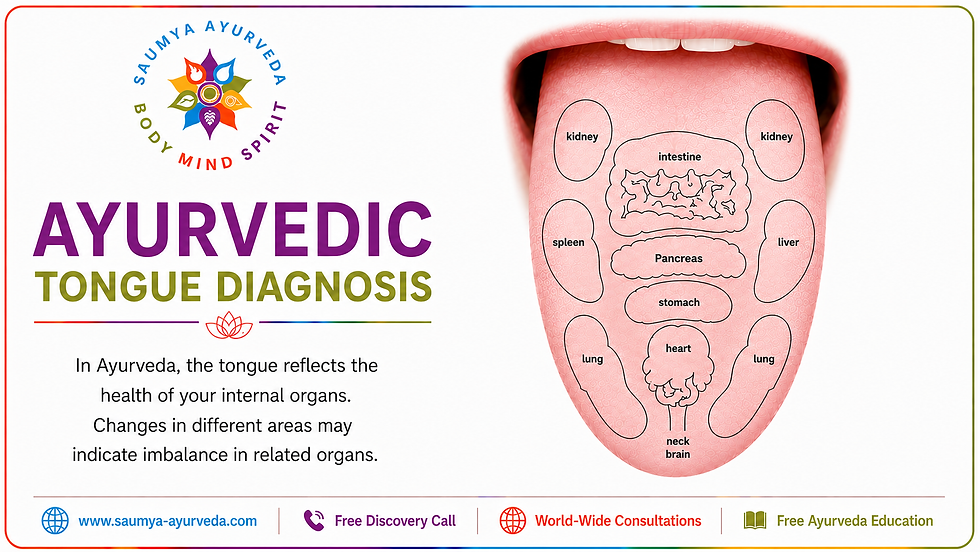
Organ Locations on the Tongue
According to the Ayurveda Tongue Map, different regions of the tongue are traditionally associated with specific organs and body systems. Rather than focusing on a single spot, Ayurvedic practitioners observe the tongue as a whole, evaluating its color, coating, moisture, shape, texture, and movement to identify patterns of balance and imbalance.
The location of a change on the tongue is just one part of the assessment. Ayurveda teaches that these observations should always be considered alongside your Prakriti (constitution), Vikriti (current imbalances), Agni (digestive fire), pulse, symptoms, lifestyle, and overall health. Together, they provide a more complete understanding of the body's current state.
It is important to remember that the Ayurveda Tongue Map is a traditional observational guide—not a medical diagnostic tool. Persistent changes in your tongue should always be evaluated by a qualified healthcare professional.
Tip of the Tongue
The tip of the tongue is traditionally associated with the heart and lungs. Ayurvedic practitioners observe this area for changes in color, coating, moisture, or texture while considering the individual's overall health, emotional well-being, and respiratory function. These observations are never interpreted in isolation but as part of a comprehensive assessment.
Center of the Tongue
The center of the tongue is traditionally associated with the stomach, pancreas, and spleen. Because healthy digestion is central to Ayurveda, practitioners pay close attention to this region when evaluating Agni (digestive fire), nourishment, and the body's ability to digest and assimilate food effectively.
Sides of the Tongue
The sides of the tongue are traditionally associated with the liver and gallbladder. Changes observed in these regions are evaluated alongside other signs and symptoms to better understand digestion, metabolism, and overall dosha balance.
Back (Root) of the Tongue
The back, or root, of the tongue is traditionally associated with the kidneys, bladder, and intestines. This area is often observed as part of a broader assessment of hydration, elimination, and digestive health. Because the back of the tongue commonly develops an overnight coating, it is best examined before brushing your teeth or scraping your tongue.
Looking Beyond the Organ Map
While the location of changes on the tongue provides valuable information, Ayurveda places equal importance on what is observed. The tongue's color, coating, moisture, shape, texture, movement, cracks, and teeth marks all contribute to a more complete picture of health.
For this reason, the Ayurveda Tongue Map should never be interpreted on its own. Tongue observation is most meaningful when combined with a comprehensive Ayurvedic assessment that considers your digestion, constitution, symptoms, lifestyle, and overall state of health.
Want to learn more? Explore Ayurveda Tongue Diagnosis: What Your Tongue Is Saying About Your Health to discover how tongue color, coating, cracks, moisture, shape, and texture are traditionally interpreted in Ayurveda.

Why Ayurveda Doesn't Look at the Tongue Alone
The Ayurveda Tongue Map is an important observational tool, but it is never used in isolation. Rather than relying on a single finding or one area of the tongue, Ayurvedic practitioners consider the tongue as one piece of a much larger picture.
During a comprehensive Ayurvedic assessment, the tongue is evaluated alongside your Prakriti (unique constitution), Vikriti (current imbalances), Agni (digestive fire), the possible presence of Ama (metabolic waste), pulse, symptoms, medical history, and lifestyle. Practitioners also consider factors such as your sleep quality, appetite, digestion, elimination, stress levels, energy, and emotional well-being to better understand patterns of balance and imbalance.
This whole-person approach is one of Ayurveda's greatest strengths. Instead of focusing on a single symptom or one area of the body, Ayurveda recognizes that every system is interconnected. A change observed on the tongue is never viewed as a diagnosis but rather as one clue that helps guide a personalized assessment.
Remember: The Ayurveda Tongue Map is designed to support awareness—not diagnose disease. If you notice persistent tongue changes, such as unusual discoloration, swelling, sores, lumps, or pain, consult your dentist or healthcare provider for a thorough evaluation.
Related Readings: Ayurveda Tongue Diagnosis: What Your Tongue Is Saying About Your Health. Ayurvedic Tongue Scraping | Why and How?

Frequently Asked Questions About the Ayurveda Tongue Map
What is the Ayurveda Tongue Map?
The Ayurveda Tongue Map is a traditional observational guide that associates different regions of the tongue with specific organs and body systems. Ayurvedic practitioners use it as one part of a comprehensive health assessment, alongside your constitution, digestion, pulse, symptoms, and lifestyle.
Can your tongue really reflect your organ health?
According to Ayurveda, different regions of the tongue are traditionally associated with different organs and body systems. Rather than diagnosing disease, practitioners use these observations to identify patterns of balance and imbalance as part of a holistic assessment. Persistent tongue changes should always be evaluated by a healthcare professional.
Which organs are associated with the tip of the tongue?
In the traditional Ayurveda Tongue Map, the tip of the tongue is associated with the heart and lungs. Practitioners observe this region alongside the rest of the tongue and other health assessments rather than drawing conclusions from this area alone.
What does the center of the tongue represent?
The center of the tongue is traditionally associated with the stomach, pancreas, and spleen. Because digestion plays a central role in Ayurveda, practitioners pay close attention to this area while evaluating Agni (digestive fire) and overall digestive health.
What do the sides of the tongue represent?
The sides of the tongue are traditionally associated with the liver and gallbladder. Observations in these regions are interpreted alongside your digestion, constitution, symptoms, and lifestyle rather than viewed independently.
What does the back of the tongue represent?
The back (root) of the tongue is traditionally associated with the kidneys, bladder, and intestines. This area is often observed before brushing or tongue scraping because it commonly develops an overnight coating.
Is the Ayurveda Tongue Map scientifically proven?
The Ayurveda Tongue Map is based on traditional Ayurvedic knowledge that has been practiced for thousands of years. While modern medicine recognizes that the tongue can reflect certain aspects of health, the traditional organ map itself has not been validated as a diagnostic method by modern scientific research.
Can the Ayurveda Tongue Map diagnose disease?
No. The Ayurveda Tongue Map is not a diagnostic tool. It is one component of a comprehensive Ayurvedic assessment and should never replace appropriate medical evaluation, laboratory testing, or professional healthcare.
Why do Ayurvedic practitioners examine the tongue?
Ayurvedic practitioners observe the tongue because it may provide insights into digestion, hydration, dosha balance, and overall well-being. Tongue observation is traditionally performed alongside pulse assessment, health history, symptoms, and lifestyle to develop personalized recommendations.
Should I check my tongue every morning?
Yes. Ayurveda encourages observing your tongue each morning before eating, drinking, brushing your teeth, or scraping your tongue. Daily observation helps you become more familiar with your tongue's normal appearance and recognize gradual changes over time.

Glossary of Ayurvedic Terms
Agni (Digestive Fire) In Ayurveda, Agni is the body's digestive and metabolic fire. Strong Agni supports healthy digestion, nutrient absorption, and overall vitality, while weakened Agni may contribute to the formation of Ama.
Ama (Metabolic Waste) Ama refers to undigested metabolic waste that forms when digestion and metabolism are impaired. Ayurveda teaches that reducing Ama and strengthening Agni are essential for maintaining health and balance.
Ashtavidha Pariksha (Eightfold Examination) A traditional Ayurvedic assessment that evaluates eight aspects of health, including Jihva Pariksha (tongue observation), pulse, eyes, voice, skin, urine, stool, and overall appearance. The tongue is considered one important observation among many.
Ayurveda Tongue Map The Ayurveda Tongue Map is a traditional observational guide that associates different regions of the tongue with specific organs and body systems. It is used as part of a comprehensive Ayurvedic assessment and is not intended to diagnose disease.
Dosha The three fundamental mind-body energies—Vata, Pitta, and Kapha—that govern physical, mental, and emotional functions. Every person has a unique combination of all three doshas.
Prakriti (Constitution) Your unique Ayurvedic constitution established at birth. Prakriti reflects your natural balance of Vata, Pitta, and Kapha and serves as the foundation for personalized Ayurvedic recommendations.
Vikriti (Current Imbalance) Your present state of balance or imbalance. Unlike Prakriti, Vikriti changes over time in response to diet, lifestyle, stress, environment, and other factors, helping guide individualized Ayurvedic care.

Final Thoughts
The Ayurveda Tongue Map reminds us that every part of the body is interconnected. Rather than viewing the tongue as simply an organ used for speaking and tasting, Ayurveda recognizes it as a valuable window into the body's internal state.
By understanding the traditional organ locations on the tongue, you can begin to appreciate how this remarkable structure has been used for centuries as part of a holistic approach to health.
While the tongue map offers valuable insights, it is only one piece of the puzzle. Ayurvedic practitioners never rely on the tongue alone. Instead, they combine tongue observation with your constitution (Prakriti), current imbalances (Vikriti), digestive fire (Agni), pulse, symptoms, lifestyle, and overall health to develop personalized recommendations that support lasting balance.
The next time you look in the mirror, take a moment to observe your tongue with curiosity rather than judgment. Over time, this simple practice can help you become more aware of your body's changing needs while deepening your appreciation for one of Ayurveda's oldest traditions of preventive care.

What Our Clients Say | Saumya Ayurveda Testimonials
Real Transformations Through Ayurveda Consultation
Physician Testimonial (Medical Endorsement)
“As a physician, I have always believed that prevention is better than cure. In today’s healthcare environment, Ayurveda offers a logical and natural approach to long-term health and prevention.
I began working with Veena during a very demanding phase of my life, and she made the process accessible even within my busy schedule. I was encouraged to follow a steady, sustainable approach focused on real lifestyle change.
Over time, I experienced meaningful improvements in balance, energy, and well-being. In my medical practice, I now see many patients with similar stress- and diet-related imbalances, which has further reinforced my trust in Ayurvedic principles.
I have since referred several patients to Saumya Ayurveda and consider Veena a valuable resource in supporting holistic well-being.”
Dr. Gauri Nagargoje
M.D., Oncology & Hematology
Physician Testimonial (Medical Endorsement)
“As a physician, I initially struggled with Ayurveda’s simplicity and depth, but Veena’s guidance made it practical, scientific, and deeply effective.
Veena has transformed my health and perspective on healing. I experienced significant improvements in focus, digestion, stress response, and overall vitality.
Her personalized approach made lifestyle changes easy and sustainable.
This journey not only improved my health but also inspired a lifelong commitment to integrating Ayurveda into holistic healthcare.”
Dr. Jessica Bedi
D.O., & Ayurvedic Doctor


Anne R., Minneapolis, Minnesota, USA
Explore more client success stories from Saumya Ayurveda and see how Ayurveda supports healing, balance, and transformation.

Discover the Saumya Ayurveda Way
At Saumya Ayurveda, we see you as a whole being—not just a collection of symptoms. True health is more than the absence of disease; it is a state of balance between body, mind, and awareness.
Many people today feel unheard or only partially supported in conventional health systems, especially when symptoms persist without clear answers.
This is where Ayurveda offers a different path.
If you are seeking a holistic approach to health and balanced living, you are in the right place. Saumya Ayurveda provides personalized Ayurvedic guidance designed to support physical, mental, and emotional harmony—helping you move toward a more vibrant and aligned life.
Our approach is rooted in classical Ayurveda and adapted for modern life, with a focus on understanding your unique dosha and prakriti (your natural constitution ) so recommendations are truly individualized—not generic.
Saumya Ayurveda offers concierge-style, client-centered care, meaning your experience is personal, supportive, and free from retail or product pressure. The focus is entirely on education, clarity, and sustainable lifestyle transformation.
Through structured Ayurveda consultation packages, you receive ongoing guidance, thoughtful coaching, and practical tools to help you create lasting change—not temporary fixes.
Begin your Ayurveda journey and book a free 15-minute discovery call.

Meet Veena: Your Trusted Ayurvedic Guide for Clients Worldwide
Veena Blilie is a Certified Ayurvedic Practitioner, Ayurveda teacher, meditation guide, and monk with over three decades of experience helping clients worldwide achieve greater balance and well-being through Ayurveda.
As founder of Saumya Ayurveda and President Emeritus of the Meditation Center, Veena serves clients worldwide through personalized Ayurvedic wellness guidance, meditation, and yoga practices.
Saumya Ayurveda has been recognized as the #1 Ayurveda cooking blog and the #3 Ayurveda website and blog and has received multiple consecutive awards for best wellness practice.
Through her work, Veena shares practical Ayurvedic guidance, nourishing recipes, and wellness education for modern living.
Inspired from an early age by learning herbal remedies, food as medicine, and traditional healing practices at her grandmother’s knee, Veena combines traditional Ayurvedic wisdom with compassionate, accessible guidance that supports mental, physical, and spiritual well-being.
Known for her warmth, humor, intuitive approach, and accessible style, Veena empowers people to create sustainable health through personalized Ayurvedic wellness plans designed to fit naturally into everyday life.
Veena is also the author of several free Ayurveda eBooks and writes the educational articles published on the Saumya Ayurveda blog.
As seen in:
Voice America
Albuquerque The Magazine
Learn more about Veena and her work through Saumya Ayurveda.
Disclaimer: This information is for educational purposes only and is not a substitute for professional medical advice. Ayurveda works best when tailored to your unique doshic profile, so it’s essential to understand your constitution and imbalances before using herbs, foods, or lifestyle practices. Consult a Certified Ayurvedic Practitioner for personalized guidance.


