


Embrace Fall with Yoga: 7 Grounding Poses for Vata

Updated: 6 days ago
As the leaves fall and the air turns cool, dry, and windy, do you feel a little more scattered, restless, or ungrounded? In Ayurveda, autumn is Vata season. The same qualities we see in nature, cold, dry, light, and moving, begin to build in the body and mind. That is why fall yoga for Vata looks different from the practice that suits you in summer.
The practices we choose can either add to that movement or bring it back into balance. In Part 2 of our Yoga for Vata series, you’ll find a complete autumn yoga sequence of 7 grounding yoga poses, practiced in order from standing to deep rest, to help you feel stable, warm, and grounded as the season turns.
Looking for more ways to stay balanced this season? Explore the free Ayurveda eBook Library.

Grounding yoga for Vata in autumn is a slow, steady sequence designed to support balance, warmth, and calm as the season turns cold, dry, and windy. This 7-pose fall practice moves from Tree Pose and Warrior II through Forward Fold, Seated Twist, Garland Pose, and Bridge to deep rest in Corpse Pose.
Learn how to practice the full autumn sequence in this guide from Saumya Ayurveda.
Key Takeaways
Autumn is Vata season. Cold, dry, windy weather increases Vata, which can leave you scattered, anxious, and ungrounded.
Practice in order. This sequence moves from standing balance to the floor to deep rest, so the body settles step by step.
Tree Pose steadies a wandering mind. Balancing on one leg builds focus and a sense of roots.
Warrior II builds strength and stability. Holding this strong stance counters autumn's light, unsettled quality.
Twists and folds release tension. Forward Fold and Seated Twist invite letting go, much like the trees releasing their leaves.
Garland and Bridge ground and warm. A deep squat and a gentle backbend bring stability and lift low autumn energy.
Always end with rest. Corpse Pose and a guided relaxation help a tired nervous system restore.
More seasonal support is free. Explore the free Ayurveda eBook Library for Vata recipes, warming drinks, and breathwork guides.
Table of Contents

Why Autumn Stirs Up Vata
In Ayurveda, each season carries the qualities of a dosha. Autumn brings Vata's qualities into the world around us: cold, dry, light, rough, and mobile. Leaves scatter, winds pick up, and daylight shortens.
Those same qualities build within us. Many people notice dry skin, restless sleep, a busy mind, or feeling unsettled as the season turns. A yoga practice that is slow, warm, and steady brings in the opposite qualities and helps you move through autumn with ease.
Notice the early signs that the season is affecting your balance: 8 Signs Your Vata is Aggravated by Seasonal Changes.
Discover simple ways to keep Vata balanced all autumn long: Vital Vata: An Ayurvedic Guide to Balancing Vata in Autumn.
How to Practice This Autumn Sequence
This practice is designed to be done in order, moving from standing balance to the floor and into deep rest. It takes about 20 to 30 minutes.
Warm the room and wear layers you can remove.
Move slowly. Hold each pose for 5 to 8 long, smooth breaths.
Breathe through the nose, deep into the belly.
Practice at the same time each day, ideally in the morning or early evening.
Leave time at the end for Corpse Pose. Rest is part of the practice.
Learn how to adjust your movement as the seasons change: Ayurveda Tips for Fall Season Exercise.
Learn how Ayurveda adapts daily routines to each season of the year: Ritucharya: Ayurveda Seasonal Tips for Enhanced Wellbeing.
A 7-Pose Grounding Yoga Sequence for Autumn
Each pose in this sequence counters one of autumn's Vata qualities. Move only within a comfortable range, and use a wall, blocks, or cushions for support.
1. Tree Pose (Vrikshasana): Roots for a Wandering Mind
Begin by grounding yourself like the roots of a tree. Tree Pose improves balance and focus, which is especially helpful when autumn's mobile energy leaves the mind wandering.
Try it: Stand tall and shift your weight into your left foot. Place the sole of your right foot on your ankle, calf, or inner thigh, avoiding the knee. Bring your hands to your heart and fix your gaze on one point. Repeat on the other side.

2. Warrior II (Virabhadrasana II): Strength Against Autumn's Lightness
Channel your inner strength and resilience with Warrior II. This strong, steady stance builds stability and confidence, countering the light, unsettled feeling that autumn can bring.
Try it: Step your feet wide apart. Turn your right foot out and bend your right knee over your ankle. Stretch your arms out at shoulder height and gaze over your right hand. Repeat on the other side.

3. Forward Fold (Uttanasana): Letting Go
Release tension and turn inward with Forward Fold. This pose stretches the back of the legs, spine, and shoulders, offering a moment of surrender and letting go, much like the trees releasing their leaves.
Try it: From standing, exhale and fold forward from the hips, bending your knees as much as you need. Let your head and arms hang heavy.

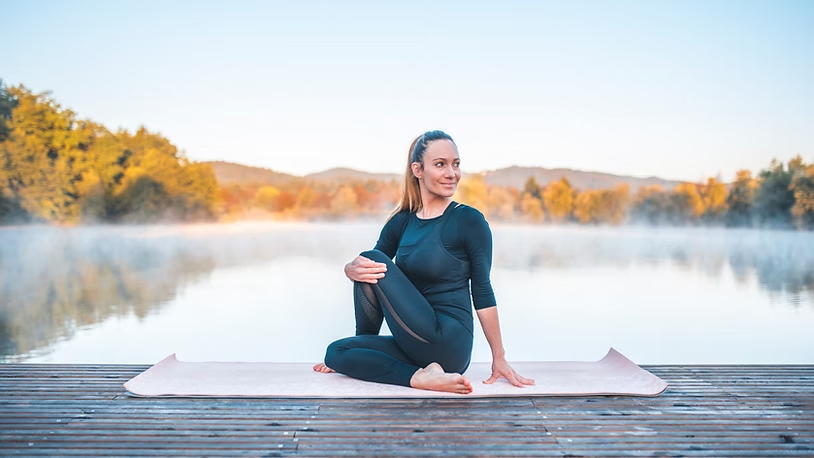
4. Seated Twist (Ardha Matsyendrasana): Renewal
A gentle seated twist supports digestion and Agni, your digestive fire, and brings a sense of renewal, mirroring the natural cycle of release and regeneration in autumn.
Try it: Sit with your legs extended. Bend your right knee and place your right foot outside your left thigh. Inhale to lengthen your spine, then exhale and twist gently to the right. Never force the twist. Repeat on the other side.
5. Garland Pose (Malasana): Grounding Into the Earth
Connect with the earth and your inner power in Garland Pose. This deep squat opens the hips and brings your weight low and steady, the perfect antidote to autumn's airy quality.
Try it: Stand with your feet wider than your hips and toes turned out. Lower into a squat, bringing your palms together at your heart. Place a folded blanket or block under your heels or hips if needed.

6. Bridge Pose (Setu Bandhasana): Warmth and Lift
Bridge Pose opens the heart and lifts low energy, counteracting the slouching and hunching that often come with colder weather. It also creates space for emotional release and renewal.
Try it: Lie on your back with your knees bent and feet hip-width apart. Press into your feet and lift your hips. Hold for a few breaths, then lower slowly.

7. Corpse Pose (Savasana): Stillness
Complete your practice with the ultimate pose of surrender. Corpse Pose lets you integrate the benefits of your practice, letting go of stress and tension to rest in the quiet stillness of autumn.
Try it: Lie on your back with a blanket over you to stay warm. Let your feet and arms fall open and rest for 5 to 10 minutes.

Go back to the foundations with Part 1 of the Yoga for Vata series, including calming poses for anxiety, bloating, and sleep: The Best Yoga Poses for Vata Dosha: Ground and Balance.
Discover which practices are right for your doshic picture this autumn: Book Your Free 15-Minute Discovery Call With Veena.

Rest Deeply: Nourish a Tired Nervous System
As you move through your active, often fast-paced day, it is necessary to downshift into neutral gear. Autumn asks this of us even more.

Practiced consistently as part of your evening routine, the free 31 Point Blue Star guided practice relaxes and rejuvenates the nervous system and prepares you for restorative sleep.
After your practice, warm up from the inside with nourishing drinks that soothe Vata: Vata Balancing Ayurveda Beverages.
Discover which fall foods ground and nourish Vata through the season: Fall Foods for Balancing Vata Dosha.
Explore more seasonal rituals that rejuvenate Vata through the autumn months: 9 Vata Rejuvenating Practices for Fall.
🍃Saumya Ayurveda Self-Observation™ ExerciseAutumn changes week by week, and so do we. Use this practice to notice how the season and your yoga practice affect you. At the start of autumn: Notice your skin, sleep, digestion, and mind. Do you feel grounded or scattered? After each practice: Which poses felt steadying? Which felt hard to hold? How is your breath? Each week: Check in again. Is your sleep deeper? Is your mind calmer on windy, cold days? Note any changes in a journal. Over the season, notice which poses become your anchors, and keep returning to them. Simply observe. |
Frequently Asked Questions
Why is autumn called Vata season in Ayurveda?
Autumn shares Vata's qualities: cold, dry, light, rough, and mobile. As the weather turns cool, windy, and dry, those same qualities build in the body and mind, which is why many people feel more restless or ungrounded in the fall.
What is the best yoga sequence for fall?
A slow, grounding sequence that moves from standing balance to the floor and into deep rest. This 7-pose practice flows from Tree Pose and Warrior II through Forward Fold, Seated Twist, Garland Pose, and Bridge, and ends in Corpse Pose.
How long should a fall yoga practice be?
About 20 to 30 minutes is enough. Hold each pose for 5 to 8 long breaths and leave at least 5 minutes for rest at the end.
Should I practice yoga in the morning or evening in autumn?
Either works. What matters most for Vata is practicing at the same time each day. A morning practice helps you start the day grounded, and an early evening practice helps you unwind before sleep.
How can I stay warm during an autumn yoga practice?
Warm the room, wear layers you can remove, and keep a blanket nearby for Corpse Pose. A cup of warm, spiced tea after your practice continues the grounding effect.

Final Thoughts: Fall Yoga for Vata
Autumn invites us to slow down, turn inward, and find our roots.
These seven poses offer a simple way to meet the season with balance. Practiced in order, they move you from standing strength to the stillness of deep rest, bringing warmth and steadiness as the days grow cooler.
Move with awareness, respect what your body needs each day, and let your practice change with the season. Even a few mindful minutes on your mat can create space for calm amid autumn's changes.
Roll out your mat, take a slow breath, and let each pose ground you through the season.

Our Commitment to Accessible Ayurveda Education
At Saumya Ayurveda, we believe Ayurveda's transformative ancient wisdom belongs to everyone—not just those who can afford it. That's why we're committed to making high-quality, authentic Ayurveda education available globally, free of charge.
Through our free eBooks, guides, and educational resources, we offer practical, grounded wisdom to help those seeking greater balance, vitality, and wellbeing integrate Ayurveda into their daily lives.
Accessible. Authentic. Free. Just as it was meant to be.
Free Ayurveda eBooks – Download practical guides, recipes, and wellness resources to support your health journey.
Ayurveda Blog – Enjoy easy-to-read articles, seasonal wellness tips, healthy recipes, and everyday inspiration—always educational, never a sales pitch.
Free Guided Traditional Progressive Meditations – Practice authentic, step-by-step guided meditations to cultivate calm, focus, and inner stillness.
Monthly Educational Newsletter – Receive seasonal Ayurveda insights, new articles, healthy recipes, and free resources delivered to your inbox each month.

Ayurvedic Glossary
Agni: Digestive fire, which transforms food into nourishment.
Asana: A yoga posture; one of the eight limbs of yoga.
Ayurveda: The traditional healing system of India, meaning "the knowledge of life."
Dosha: One of the three functional energies (Vata, Pitta, and Kapha) that make up each person's nature.
Savasana: Corpse Pose, a pose of complete rest that ends a yoga practice.
Vata: The dosha of air and space. It is light, dry, cold, and mobile, and it governs movement in body and mind.
Vata season: Autumn and early winter, when cold, dry, windy weather increases Vata.

What Our Clients Say | Saumya Ayurveda Testimonials
Real Transformations Through Ayurveda Consultation
Physician Testimonial (Medical Endorsement)
"As a physician, I have always believed that prevention is better than cure. In today's healthcare environment, Ayurveda offers a logical and natural approach to long-term health and prevention.
I began working with Veena during a very demanding phase of my life, and she made the process accessible even within my busy schedule. I was encouraged to follow a steady, sustainable approach focused on real lifestyle change.
Over time, I experienced meaningful improvements in balance, energy, and well-being. In my medical practice, I now see many patients with similar stress- and diet-related imbalances, which has further reinforced my trust in Ayurvedic principles.
I have since referred several patients to Saumya Ayurveda and consider Veena a valuable resource in supporting holistic well-being."
Dr. Gauri Nagargoje
M.D., Oncology & Hematology
Physician Testimonial (Medical Endorsement)
"As a physician, I initially struggled with Ayurveda's simplicity and depth, but Veena's guidance made it practical, scientific, and deeply effective.
Veena has transformed my health and perspective on healing. I experienced significant improvements in focus, digestion, stress response, and overall vitality.
Her personalized approach made lifestyle changes easy and sustainable.
This journey not only improved my health but also inspired a lifelong commitment to integrating Ayurveda into holistic healthcare."
Dr. Jessica Bedi
D.O., & Ayurvedic Doctor


Angela B., Minnesota, USA
Explore more client success stories from Saumya Ayurveda and see how Ayurveda supports healing, balance, and transformation.

Discover the Saumya Ayurveda Way
Ayurveda Begins With Seeing the Whole Person
I've Tried Everything. Why Isn't Anything Working?
When health concerns persist, it can be frustrating to keep trying one recommendation after another without understanding why nothing seems to change.
More health information isn't always the answer. In fact, when stress is already part of the picture, having more information to sort through can add to that stress. Sometimes what is needed is not another recommendation, but someone who really listens and takes the time to understand you as a whole person.
Ayurveda looks beyond individual symptoms to understand the whole person and the root causes of the dosha imbalances contributing to how you feel. This makes it possible to move beyond simply managing symptoms and understanding what you specifically need.
Why the Same Symptom Can Require a Different Approach
The same symptom does not necessarily call for the same solution. General health advice—and even general Ayurvedic advice—can fall short because most people experience more than one symptom and may have more than one dosha out of balance. Understanding the doshic picture as a whole is essential for providing truly supportive guidance.
Ayurveda looks beyond the symptoms to understand the root cause of each doshic imbalance, the dynamic interplay between the doshas, and how they affect the whole person.
Personalized Ayurveda, Rooted in Tradition
Saumya Ayurveda combines classical Ayurvedic principles with practical guidance for modern life. Your recommendations are based on your individual prakriti (natural constitution), vikriti (current state of doshic imbalance), lifestyle, environment, and circumstances—not a generic dosha checklist or one-size-fits-all protocol.
The goal is not to overwhelm you with more rules or things to try. It is to help you stop searching and start understanding—so you can make sustainable changes that support balance for you.
For those who want ongoing support, concierge-style Ayurveda consultation packages provide personalized guidance, thoughtful follow-up, and practical tools for bringing Ayurvedic principles into everyday life.
Education First. Personalized Guidance When You Need It.
Veena takes an education-first, client-centered approach. Our favorite product is knowledge.
As you work with Veena, you don't simply receive recommendations—you gain knowledge and self-awareness.
With Saumya Ayurveda, you won't find education built around selling a supplement, herb, or wellness product. Instead, you'll find traditional Ayurvedic perspectives, practical guidance, and timeless principles that cultivate self-awareness and help you make choices that are right for you.
When understanding deepens, better choices naturally follow.
Learn. Observe. Understand. Transform.
Whether you're new to Ayurveda, looking for a deeper understanding of yourself and your nature, or have tried many approaches without finding lasting change, personalized Ayurvedic guidance can help you understand your individual needs and make choices that are appropriate for you.
Begin your Ayurveda journey with a free 15-minute Discovery Call with Veena and explore whether personalized Ayurvedic guidance is right for you.

Meet Veena: Your Trusted Ayurvedic Guide for Clients Worldwide
Veena Haasl-Blilie is a Certified Ayurvedic Practitioner, Ayurveda teacher, meditation guide, and monk with over three decades of experience helping clients worldwide achieve greater balance and well-being through Ayurveda.
As founder of Saumya Ayurveda and President Emeritus of the Meditation Center, Veena serves clients worldwide through personalized Ayurvedic wellness guidance, meditation, and yoga practices.
Saumya Ayurveda has been recognized as the #1 Ayurveda cooking blog and the #3 Ayurveda website and blog and has received multiple consecutive awards for best wellness practice.
Through her work, Veena shares practical Ayurvedic guidance, nourishing recipes, and wellness education for modern living.
Inspired from an early age by learning herbal remedies, food as medicine, and traditional healing practices at her grandmother’s knee, Veena combines traditional Ayurvedic wisdom with compassionate, accessible guidance that supports mental, physical, and spiritual well-being.
Known for her warmth, humor, intuitive approach, and accessible style, Veena empowers people to create sustainable health through personalized Ayurvedic wellness plans designed to fit naturally into everyday life.
Veena is also the author of several free Ayurveda eBooks and writes the educational articles published on the Saumya Ayurveda blog.
As seen in:
Voice America
Albuquerque The Magazine
Learn more about Veena and her work through Saumya Ayurveda.
Disclaimer: This information is for educational purposes only and is not a substitute for professional medical advice. Ayurveda works best when tailored to your unique doshic profile, so it’s essential to understand your constitution and imbalances before using herbs, foods, or lifestyle practices. Consult a Certified Ayurvedic Practitioner for personalized guidance.


